I'm not here to yuck anyone's yum, but right off the bat, I will tell you I feel like AI coverage just does not work. It is not good with twists, complicated emotions, or in assessing human taste.
I think it can write a good synopsis, and that's mostly it.
So when I got an email from the team at Quilty, offering me to test their program, I jumped at the chance.
They're a development AI program that makes this promise on their homepage: "Hollywood greenlights $300 billion a year on gut instinct. Quilty replaces the guesswork — unified intelligence spanning story craft, market viability, talent strategy, and financial projections. Upload a screenplay. Get your free analysis in minutes."
Now, I know a lot of our readers will see ads for this, so I figured it was smart to dive into it and give it a test run.
Let's dive into what I found.
The Problems With Quilty
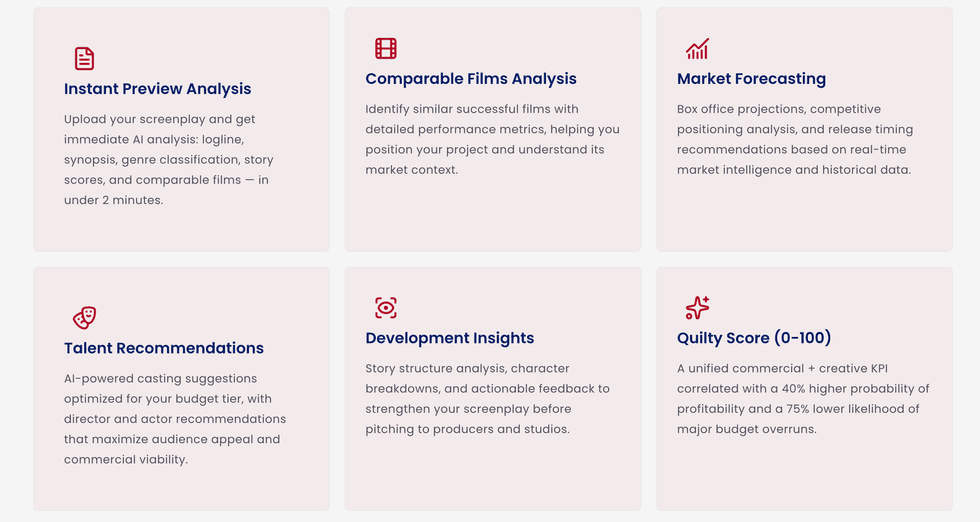 The Problems With Quilty Credit: Quilty
The above photo is what I like to call the Quilty promise. It's basically them saying, when you upload a script, these are all the things you're going to get back.
Quilty takes roughly five to ten minutes to get a useless free reading and rating of your script.
My issue with the free delivery is that I don't know who would care that Quilty reviewed your script with a certain score out of 100, because that score means nothing. It's like saying Gemini gave it a high score... no one cares.
The reason people care about The Black List score is that a human being vetted for their work in Hollywood read it and assessed what the actual industry may think of it. Even though that's subjective. It has an actual calculable metric.
If you want an actual, extensive breakdown from Quilty, they charge you $49.99 to take between one and three hours to deliver a 40ish-page report that you can customize with a cast and director and by budget.
That doc is supposed to give you a glimpse of what someone at a studio would say about your work.
The idea is that this report would replace a marketing report written by a human, as well as coverage.
But I found these reports to be buggy, hard to read, and unreliable.
My goal when writing this review was to feed the same scripts I used to test The Black List and The Page Awards and see what this platform said.
But when I did that, I found the coverage got so many story details wrong in my scripts that the article I'd write would require everyone to read my stuff to be able to understand how lackluster the report was.
And it wasn't just nitpicky stuff, I was like, whole set pieces it misunderstood. Stuff that no human or AI in the other things I tested got wrong.
So to combat this, I used Quilty on some popular scripts that if people have no read, at least they kind of know the movies, so they can tell if the feedback was good or not.
I'm Not Alone Here
Before we dig into what I found, I want to point out that The Wrap did a great write-up on Quilty that's behind a paywall. But the highlight is that the program hated Sinners. My goal after hearing that was to pick two obviously commercial movies and see how it did with them.
I picked Derek Kolstad's John Wick (originally titled SCORN) and Richard Linklater and Glen Powell's Hit Man.
The Quilty Promise
Normally, I wouldn't want to feed someone else's screenplay into AI. But Quilty's promise is that it won't use what you upload to train AI.
But that begs the question...what was Quilty trained on?
How could it have all these development notes and marketing ideas without being trained on Hollywood projects?
That's not answered here.
Here is the comprehensive Screenplay Intelligence System coverage report for "John Wick."
Quilty's Review of John Wick
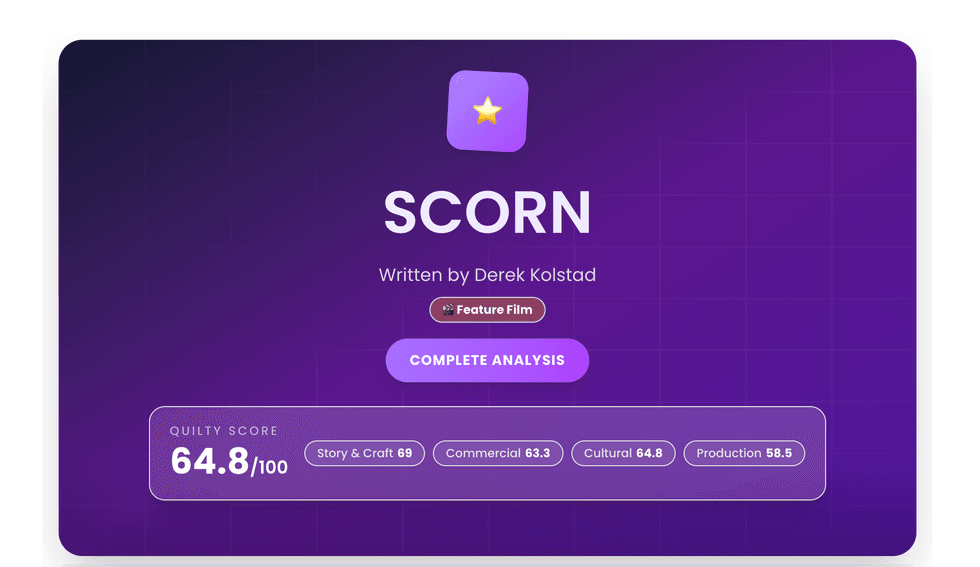 Quilty's Review of John WickCredit: Quilty
When it came to John Wick, Quilty rated it 64.8/100.
The executive summary is that "This screenplay has potential but needs further development before greenlight consideration. Focus on the weakest dimension scores to elevate the material. A masterclass in lean, visual storytelling that revitalizes the revenge subgenre through high-stakes emotional resonance."
Here's a thing that I found while reading the analysis. It seems like Quilty read this as an original movie titled Scorn, but it also thought it might be the best John Wick sequel, so it read it both as a movie that could come out in 2028 and debut, but also as a legacy sequel of the original Wick series.
I am not sure if that confused the program, but it would never confuse a person!
Here is the full coverage of John Wick.Here is the full coverage of John Wick.
As you can see, this PDF is ugly. It says it has 40+ pages of info, but really, there's a ton of weird spacing, and it feels like an algo in beta trying to catch up. As you scroll through, you can see the main headers that deal with both coverage and marketing.
I'll remind you that they charge $50 for this, and it took me roughly 90 minutes to get it.
There's so much math in this thing. It has a lot of numbers graded out of 100, trying to assess how this movie would fare in the marketplace.
These scores are kind of nonsense - like the network density is how many characters there are, with some added math that becomes pass or fail if there are too many speaking roles? I guess that may be helpful? But if you saw one read John Wick, you're not remembering how many people spoke... you're remembering a huge action movie that built a world and was great.
Is that really useful to anyone?
No.
They also really dig into the shape of the story, which I am not sure is helpful to many. But it scales what it thinks are the act breaks and page counts. Again, would a real person use this?
Then we get something called The Venue, which is budget and craft -- all these get passes even though the scores are high.
And it compares Wick's arc to Oedipus...which I don't understand.
Another analysis I found online was saying the end of Act One was on page 16, which it is clearly not. That's more the inciting incident.
I found that it really got these beats wrong in all the scripts I tried.
The proofreading section should be helpful, but it lists the same mistakes multiple times, and sometimes it just can't understand the staccato lines or ways Kolstad wrote things,...not errors but shortcuts.
I could go on, but look at it yourself and see if you think you'd use it.
There are no serious executives or companies that could rely on this software. And I wouldn't want it reading me, either.
And we still have one more script to examine.
Quilty's Review of Hitman
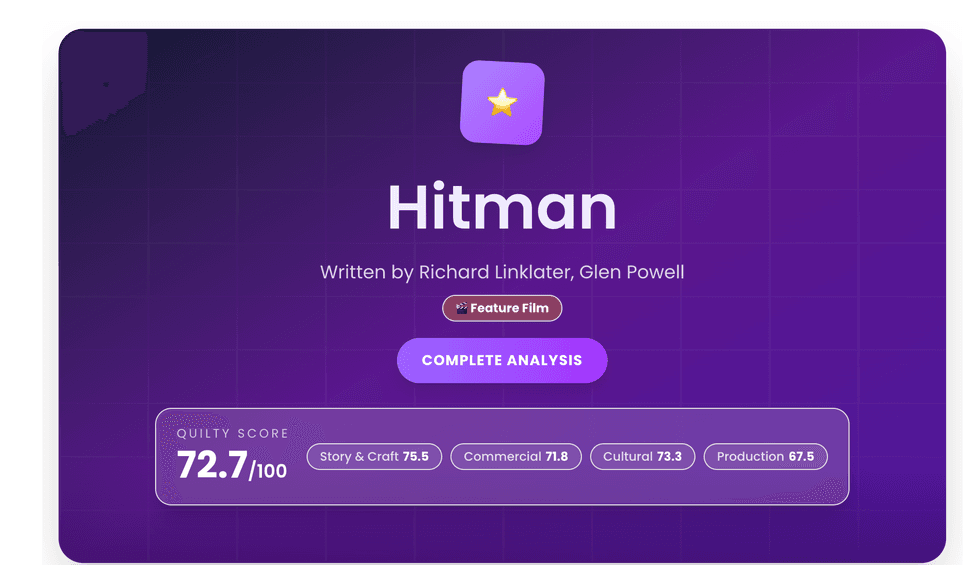 Quilty's Review of HitmanCredit: Quilty
When it came to Hit Man, Quilty rated it 72.7/100. The executive summary on this one is good!
It reads, "Greenlight. Strong screenplay recommended for greenlight. Address standard development notes, and this project is ready to move forward with confidence. A brilliant, high-concept subversion of the hitman genre that blends intellectual depth with commercial romantic-thriller appeal."
Here is the full coverage of Hit Man.Here is the full coverage of Hit Man.
While the script scored higher than Wick in many categories, I saw the same problems arising in the coverage. Its beat sheet never makes sense, it has an issue with talking characters, and when it came time to be brutally honest. It knocked the script down to a 65 because it assessed that by 2028, audiences would be exhausted by True Crime as a genre, which is a wild thing to just throw out there.
This is a package that I think went for like 20 mill a few years ago...would you want to have missed out on it because AI told you a genre may be dead?
It also gave the movie a cringe score of 38/100. Meaning in a few years, it might be cringey that you made this movie.
Well, it's been a few years since Hit Man came out...would you have been embarrassed to work on it?
I am guessing not!
The script also comes with a controversial warning...
"Madison 'rescue' (pages 35-37) sparks #NotAllWomen debates—portrays desperate housewife as redeemable vs. others as psychos, potential feminist backlash. Jasper's teen-beating video (Scene 30) nods to police brutality and could ignite copaganda discourse. True story fidelity: Texas Monthly fans nitpick Gary's real reticence vs. scripted charisma (e.g., pie ritual pages 19,32). Low-medium heat, festival buzz fodder."
I think this reads so tone deaf and again, so robotic. Is this even a thing in this movie? On the page? No.
Would you want this making decisions about what happens in Hollywood?
NO.
Why Am I So Hard on Quilty?
People create programs like this to theoretically save people time and money on hiring humans to do the work. So if they are going to do that, these programs need to be able to actually do the work.
This clearly does not, and it's kind of insulting to read these reports and think they could replace a living, thinking, smart person.
If you used this program to analyze screenplays like these two, you would get fired because you'd miss out on two very commercial, very castable, and very popular movies. One entire franchise!
I would rant more, but this really made me mad. not just because it is so unreliable, but the idea that there could be people out there using it...just do the work.
If you want to be an exec, do the work. Write great notes. Engage with artists on basic levels and help them accomplish their goals.
I promise you it'll pay off.
The Gemini Knockoff
As an experiment, I loaded all those coverages into Gemini and had it make a prompt to just knock off what Quilty does. As a reminder, Quilty costs $49.99 for one use, and Gemini is $19.99 for unlimited uses a month.
Here's the prompt below the line....
Act as an elite, data-driven AI Screenplay Intelligence System (similar to "Quilty"). Your objective is to analyze the provided screenplay and generate a highly detailed, professional-grade coverage report. You must maintain an objective, analytical, and industry-savvy tone. Do not provide a generic summary; you must synthesize empirical benchmarks, market projections, and deep creative analysis.
Generate the report using the exact structure, headers, and markdown tables outlined below. Where predictive data is required (e.g., scores, budget tiers, box office multiples), generate realistic estimates based on current industry standards and the specific attributes of the script.
1. Executive Summary
- Logline: [Write a tight, compelling 1-2 sentence logline]
- Synopsis: [Provide a comprehensive 3-4 paragraph synopsis covering the entire narrative arc, including the ending]
- Themes & Tone: [List 2-3 primary tones, e.g., 'Darkly Comedic', 'Visceral']
- Killer Insight:
- What It's Really About: [1-2 sentences on the deeper thematic subtext]
- Deal-Maker/Breaker: [Identify the single execution-dependent element that makes or breaks the film]
- The Bottom Line:
- The Verdict: [1 sentence summarizing its readiness/appeal]
- The Reward: [What is the best-case scenario for this film? e.g., Awards contender, franchise starter]
- The Risk: [What is the biggest commercial or creative risk?]
2. Analytical Score Breakdown
Generate specific scores (out of 100) for the following pillars. Include a brief 1-sentence justification for the Overall Score.
- Overall Score: [e.g., 72.2] - [Recommendation: Pass / Consider / Strong Consider / Recommend]
- Story & Craft: [Score/100]
- Commercial Viability: [Score/100]
- Cultural Resonance: [Score/100]
- Production Reality: [Score/100]
3. Top Strengths & Critical Weaknesses
Provide 3 Top Strengths and 2 Critical Weaknesses. Use this exact bulleted format:
- Top Strengths:
- [Name of Strength]: [Specific example from the script with estimated page number]
- [Name of Strength]: [Specific example from the script with estimated page number]
- [Name of Strength]: [Specific example from the script with estimated page number]
- Critical Weaknesses:
- [Name of Weakness] (Priority: High/Medium): [Specific example] -> The Fix: [Provide a targeted, actionable screenwriting fix]
- [Name of Weakness] (Priority: High/Medium): [Specific example] -> The Fix: [Provide a targeted, actionable screenwriting fix]
4. Comparable Films & Market Positioning
Create a markdown table of 4-5 comparable films, including Title, Year, estimated Box Office, and a brief note on its Relevance (tone, structure, or audience demographic).
| Title | Year | Box Office | Relevance |
| [Comp 1] | [Year] | [$X million] | [Why this is a comp] |
| [Comp 2] | [Year] | [$X million] | [Why this is a comp] |
5. Empirical Compositional Benchmarks
Analyze the script's mechanics. Provide a "Pass/Fail" and a brief explanation for the following categories:
- Story Shape: [e.g., Man in a Hole, Oedipus] - Does it match commercially successful benchmarks?
- Act Structure Ratio: [e.g., 25/50/25] - Is it structurally balanced?
- Scene Pacing: [Average lines per scene] - Is the scene length tight or bloated?
- Character Richness: [Number of speaking roles] - Is the cast size optimal for the genre?
- Dialogue Balance: [Dialogue to Action ratio] - Is it dialogue-heavy or action-heavy?
6. Coverage Grid
Provide a markdown table grading the following 8 categories on a scale of 1 to 10. Include a 1-2 sentence assessment for each.
| Category | Score/10 | Assessment |
| Marketability | [X]/10 | [Assessment] |
| Dialogue Voice | [X]/10 | [Assessment] |
| Character Arcs | [X]/10 | [Assessment] |
| Cultural Awards | [X]/10 | [Assessment] |
| Story Structure | [X]/10 | [Assessment] |
| Risk Sensitivity | [X]/10 | [Assessment] |
| Concept Originality | [X]/10 | [Assessment] |
| Production Feasibility | [X]/10 | [Assessment] |
7. Creative Analysis: Structure, Conflict & Stakes
- Story Beats (with estimated page numbers):
- Inciting Incident: [Description + Page #]
- End of Act One: [Description + Page #]
- Midpoint: [Description + Page #]
- Low Point: [Description + Page #]
- Climax: [Description + Page #]
- Resolution: [Description + Page #]
- Central Conflict (Man vs. [Force]): Give a grade out of 100 for the core conflict. Define the Protagonist Force vs. the Antagonistic Force.
- Philosophical Conflicts: Identify 2 deeper thematic or philosophical arguments in the script (e.g., "Static Identity vs. Fluid Persona"). Define Side A, Side B, and how the script resolves it.
8. Casting & Talent Strategy
Break down the top 3-4 characters (Lead and Supporting). For each, provide:
- Character Name & Role (Lead/Supporting):
- Brief Breakdown: [Age range, core essence, and narrative function]
- Suggested Actors: [List 3 working actors who fit the budget/tier, with a 4-word rationale for each (e.g., "Perfect stoicism and physicality")]
- Director Fit: [List 3 working directors whose visual style matches the script's tone]
9. Devil's Advocate (Brutally Honest Review)
- Zeitgeist Score / 100: (Cultural relevance now)
- Cringe Score / 100: (Risk of dating poorly or feeling out of touch)
- Fatal Flaws: [List 2 structural or conceptual flaws that could kill the project in development]
- Controversy Potential: [Identify any scenes, themes, or tropes that could spark social media backlash or limit international distribution]
10. Production Intelligence & Financial Projections
- Budget Tier: [Low, Mid, High]
- Estimated Budget Range: [e.g., $20M - $35M] -> List 3 key cost factors (e.g., VFX, specific locations, period wardrobe).
- Shooting Schedule: [Estimated days] -> List 2 key logistical challenges.
- Target Buyers / Distributors: [List 3-4 studios or streamers]
- Franchise Potential: [Low/Medium/High - Note any sequel or spin-off viability]
11. Action Plan (Revision Roadmap)
Provide a specific, tactical punch-list for the writer's next draft.
- Quick Wins: List 4-5 highly specific, easily implementable changes (e.g., "Cut the voiceover on page 5 and replace with a physical action", "Change the antagonist's introduction to establish their threat level earlier"). Explain why each change matters.
- Strategic Next Steps: List 3 broader steps for development or packaging (e.g., "Secure a showrunner with true-crime experience", "Trim Act 2 montage to improve pacing").
[ATTACH SCRIPT TEXT/PDF HERE]
 'John Wick' CREDIT: Lionsgate
What the Knockoff Said About 'John Wick'
Okay, so let's look at what the prompt spit out, which I will put below this line.
1. Executive Summary
Logline: When the arrogant son of a Russian mob boss kills his beloved dog—the final gift from his recently deceased wife—an aging, legendary hitman comes out of retirement to enact a relentless, one-man war of vengeance.
Synopsis: John Wick, a retired assassin in his early sixties, is mourning the death of his wife, Norma. To help him grieve, she arranged for a puppy named Moose to be delivered to him posthumously. John begins to find peace, bonding with the dog and driving his prized 1969 Mustang. However, a chance encounter with Russian mobster Iosef Tarasov at a gas station leads to a brutal home invasion; Iosef steals the car and kills Moose.
John immediately reverts to his lethal former self, unearthing his hidden arsenal from his basement with a sledgehammer. It is revealed by Iosef's father, Viggo—a powerful mob boss—that John was the "boogeyman" of the underworld, a man of singular focus. John systematically dismantles Viggo's empire, engaging in massive, kinetic shootouts at a chop shop, a high-end club called The Red Circle, and eventually destroying Viggo's multi-million dollar financial vault.
Despite Viggo placing a massive bounty on his head, John navigates the highly formalized assassin underworld, aided by an old colleague, Marcus, who acts as a guardian angel sniper. In a climactic shipyard assault, John slaughters Viggo's crew, crushes Iosef in a grain silo, and ultimately executes Viggo on the street. Battered and bleeding, John breaks into a vet clinic, patches his wounds, and adopts a new dog to continue his solitary life.
Themes & Tone: Neo-Noir Revenge, Visceral Action, Mythic Underworld.
Killer Insight: * What It's Really About: The inescapable gravity of a man's violent past and the extreme lengths to which he will go to protect the last remaining tether to his humanity.
- Deal-Maker/Breaker: The world-building elements—like The Continental hotel, the gold coin economy, and the polite society of killers—elevate this from a standard B-movie revenge flick into an immersive, mythic franchise starter.
The Bottom Line: * The Verdict: Strong Consider. It is a hyper-kinetic, myth-building action script that provides a phenomenal vehicle for an aging, bankable star.
- The Reward: A highly profitable, mid-budget franchise starter with massive international and ancillary IP appeal.
- The Risk: If cast strictly by the script's age description (early sixties), the intense close-quarters combat could feel implausible or require pacing-killing stunt editing.
2. Analytical Score Breakdown
Overall Score: 85.2 - Strong Consider This script is a masterclass in economy, pairing universal emotional stakes with rich, expandable world-building and relentless pacing.
- Story & Craft: 82/100
- Commercial Viability: 95/100
- Cultural Resonance: 75/100
- Production Reality: 88/100
3. Top Strengths & Critical Weaknesses
Top Strengths:
- Exceptional World-Building: The introduction of The Continental hotel, the gold coin currency, and the "speak easy" assassin society creates an instantly iconic mythology. [Estimated Page 43, 58]
- Relentless, Rhythmic Pacing: The script wastes no time; the inciting incident occurs efficiently, and the action sequences (Takeshi's chop shop, Red Circle) are written with punchy, visceral clarity. [Estimated Page 22, 49]
- Mythic Characterization: Viggo's monologue about John being the "boogeyman" builds legendary anticipation before John even fires his first post-retirement shot. [Estimated Page 31]
Critical Weaknesses:
- Age Implausibility (Priority: Medium): John is explicitly described as being in his early sixties, yet he executes dozens of men in close-quarters, tactical hand-to-hand combat. [Estimated Page 2, 22] -> The Fix: Lower the protagonist's age to his late 40s or early 50s to make the physical demands of the role believable without sacrificing the "retired widower" trope.
- Thin Antagonist Depth (Priority: High): Iosef is a generic, whiny mobster son with no redeeming or complex qualities, existing purely to be hunted. [Estimated Page 28] -> The Fix: Give Iosef a moment of lethal competence or strategic cunning early in the second act so he feels like a genuine foil rather than just a cowardly MacGuffin.
 'John Wick' Credit: Lionsgate
4. Comparable Films & Market Positioning
| Title | Year | Box Office | Relevance |
| Taken | 2008 | $226 million | Aging protagonist, singular revenge drive, highly competent killer. |
| Man on Fire | 2004 | $130 million | Neo-noir visual style, brutal interrogation tactics, protective grief. |
| Payback | 1999 | $161 million | Underworld mechanics, dark humor, unkillable anti-hero. |
| Collateral | 2004 | $220 million | Slick urban nightscape, highly skilled professional assassin, precise gunplay. |
5. Empirical Compositional Benchmarks
- Story Shape: Man in a Hole - Pass (John is plunged into grief and catastrophic loss, digging his way out through pure, unrelenting violence).
- Act Structure Ratio: 20/60/20 - Pass (Act 1 is highly economical, getting right to the inciting incident and crossing the threshold).
- Scene Pacing: Low lines per scene - Pass (Highly visual writing style; dialogue is sparse and impactful, accelerating the read time).
- Character Richness: Low/Medium - Pass (Keeps focus strictly on John, Viggo, and key underworld gatekeepers like Winston and Aurelio).
- Dialogue Balance: Action-heavy - Pass (Dialogue serves almost entirely to build the mythos, while the page count is dominated by kinetic action).
6. Coverage Grid
| Category | Score/10 | Assessment |
| Marketability | 9/10 | Revenge action is a universal, evergreen seller globally; highly trailer-friendly. |
| Dialogue Voice | 8/10 | Sparse, tough-guy dialogue is highly stylized and memorable without becoming campy. |
| Character Arcs | 5/10 | John's arc is flat; he changes the world, the world doesn't change him—perfect for this genre. |
| Cultural Awards | 3/10 | Not an awards contender; purely designed for commercial, visceral entertainment. |
| Story Structure | 9/10 | Lean, mean, and perfectly linear with no unnecessary subplots. |
| Risk Sensitivity | 8/10 | Very low risk if budgeted correctly; the core hook is incredibly straightforward. |
| Concept Originality | 7/10 | The revenge trope is old, but the detailed assassin underworld gives it a fresh coat of paint. |
| Production Feasibility | 8/10 | Mostly practical action, contained locations (clubs, hotels), and manageable VFX requirements. |
7. Creative Analysis: Structure, Conflict & Stakes
Story Beats:
- Inciting Incident: Iosef and his goons break into John's house, beat him, steal the Mustang, and kill his dog, Moose [Estimated Page 12-14].
- End of Act One: John unearths his buried arsenal in the basement with a sledgehammer, fully crossing back into his old life [Estimated Page 31-33].
- Midpoint: John assaults the Red Circle club; he almost reaches Iosef but is wounded and forced to retreat to the Continental [Estimated Page 45-53].
- Low Point: John is ambushed in his hotel sanctuary by David Perkins, breaking the underworld rules and proving nowhere is safe [Estimated Page 64-67].
- Climax: John assaults the Newark shipyard, fights through Viggo's army, crushes Iosef in a grain silo, and executes Viggo on the street [Estimated Page 86-97].
- Resolution: John adopts a new dog from a vet clinic, signifying a small return to his humanity, and walks away [Estimated Page 97-100].
Central Conflict (Man vs. Empire): 90/100.
- Protagonist Force: John's unstoppable grief and precision lethality.
- Antagonistic Force: Viggo's vast, desperate criminal empire trying to protect a foolish, doomed son.
Philosophical Conflicts: * "Static Identity vs. Fluid Persona": Side A represents John the grieving, peaceful husband. Side B represents John the Boogeyman. The script resolves this by demonstrating that John cannot fully escape his true nature, but he can direct its focus.
 'John Wick' Credit: Lionsgate
8. Casting & Talent Strategy
John Wick (Lead):
- Brief Breakdown: Early 60s (per script), a legendary retired hitman, grieving, relentless, and a force of nature.
- Suggested Actors: Keanu Reeves (Perfect stoicism and physicality), Liam Neeson (Proven older-guy action), Denzel Washington (Commanding, quiet, lethal presence).
- Director Fit: Chad Stahelski / David Leitch, Gareth Evans, Antoine Fuqua.
Viggo Tarasov (Supporting):
- Brief Breakdown: 60s, a pragmatic Russian mob boss, fearful of John's legend but calculating in his defense.
- Suggested Actors: Michael Nyqvist (Intelligent, weary European gravity), Mads Mikkelsen (Chilling, sophisticated, physical), Gary Oldman (Chameleonic, explosive, theatrical).
9. Devil's Advocate (Brutally Honest Review)
- Zeitgeist Score: 85/100 (Revenge for an innocent pet is a highly meme-able, universally resonant emotional hook).
- Cringe Score: 20/100 (Some of the Russian mob tropes border on dated stereotypes, but the heightened, stylized execution largely forgives them).
- Fatal Flaws: * Action Fatigue: If the practical stunts are not revolutionary, the endless sequence of headshots could become monotonous by page 70.
- Age Limitations: An actor in his 60s performing this level of close-quarters tactical shooting risks looking sluggish, demanding aggressive stunt-doubling.
- Controversy Potential: The extremely high body count and explicit gun violence will face standard media scrutiny, though the fantastical, almost comic-book nature of the underworld setting effectively buffers it from real-world critique.
10. Production Intelligence & Financial Projections
- Budget Tier: Mid
- Estimated Budget Range: $20M - $35M -> Key cost factors: Intensive stunt team training/choreography, extensive pyrotechnics and squibs, premium location rentals (NYC nightlife, hotels).
- Shooting Schedule: 45-50 days -> Key logistical challenges: Heavy exterior night work, highly complex practical stunt setups.
- Target Buyers / Distributors: Lionsgate, Universal, Netflix, Amazon.
- Franchise Potential: High - The Continental, the gold coins, and the assassin lore are ripe for sequels, prequels, and television spin-offs.
11. Action Plan (Revision Roadmap)
Quick Wins:
- Adjust Protagonist Age: Lower John's age description from early sixties to late forties/fifties. This immediately widens the net for bankable, physically capable action stars.
- Clarify Sanctuary Rules: Flesh out Winston and the rules of The Continental a few pages earlier to maximize the tension when David Perkins breaks into John's room later.
- Elevate the Antagonist: Give Iosef one moment of proactive agency or viciousness after the inciting incident rather than having him hide for the entire third act.
- Consolidate Shipyard Action: Trim the Newark shipyard/Chayka sequence; it feels slightly disconnected from the sleek neo-noir aesthetic of the Red Circle and drags slightly before the final confrontation.
Strategic Next Steps:
- Secure Action-Visionary Directors: Attach a visionary stunt-coordinator-turned-director pair to design the "gun-fu" combat, ensuring the action feels distinct from standard Hollywood coverage.
- Franchise Bible: Develop a one-sheet or franchise bible outlining the rules of The Continental and the gold coin economy to pitch this to buyers not just as a movie, but as IP.
- Lead Actor Training: Package with an A-list action star willing to commit months to intensive judo and 3-gun tactical shooting training to allow for longer takes during action sequences.
What's the Difference?
As you can see, Gemini seems to have done a much better job, and it sent that out in just a minute or two.
It also felt like it accurately talked about the script in ways Quilty did not. And it didn't give any BS math, it just wrote a list of facts.
Also, we didn't get a 40-page document that looked ugly. This is at least it's simply done in bullet points.
And it costs way less and can be used over and over again.
Still, a human being could do this in a much more thoughtful way. And I would always use a human over it.
People keep telling me these programs are tools. So hire people to use them then! They are so clearly not a replacement for a person who understands Hollywood and marketing. They are just things people outside Hollywood are making to try to make money from aspiring and execs dumb enough to give it to them.
Please, don't be so stupid.
If you need feedback, find a human being. And if you need to generate a marketing doc....hire a human being.
I promise you no one is going to care ig your spec scored high on Quilty. They're going to care if they feel something while reading it.
Summing It All Up
This was a long article. But the core of it is that these AI programs cannot and will not replace humans. They are just not good at the little things, and mediocre at the big ones.
Hollywood makes movies and TV shows that are empathy machines. How can we expect AI to understand what it's like to have the puppy your dead wife left you die at the hands of a criminal? Or to want to be anyone else but yourself because you lack confidence?
It can't, and therefore, it has no idea what people will connect with when they see your movie.
They make these programs because they want your money. That's all.
Let me know what you think in the comments.