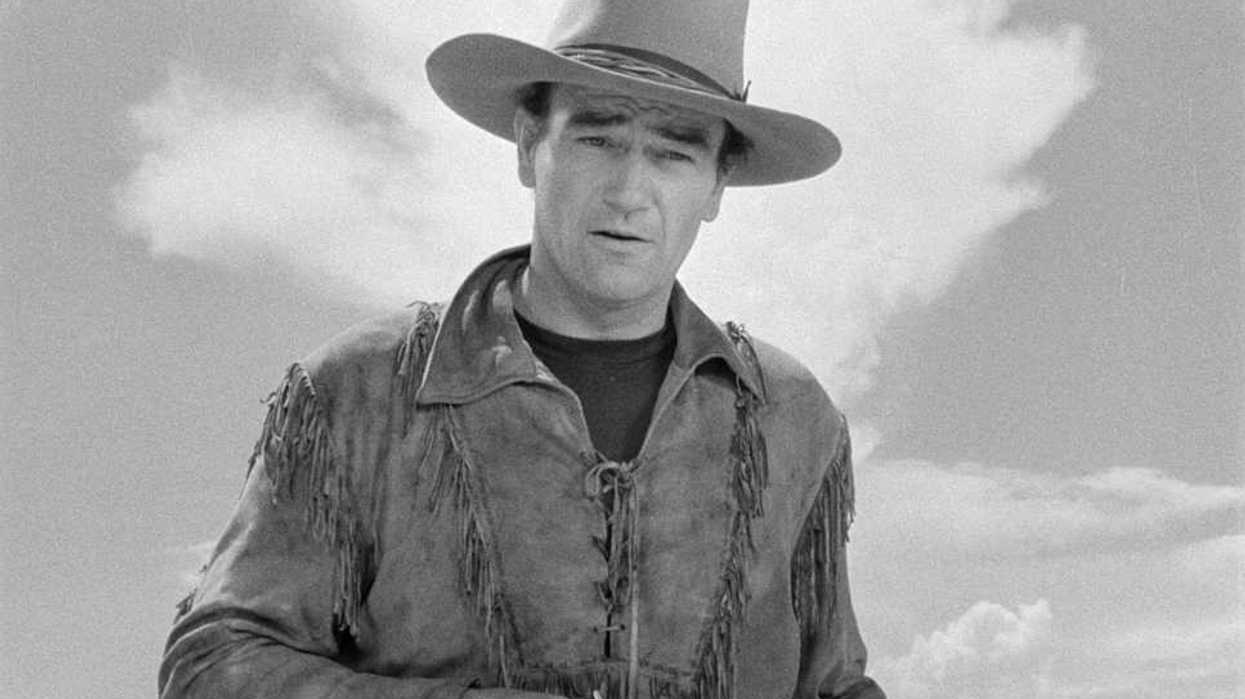
John Wayne is the archetype of the Western genre. A clear-cut American hero who won't take any guff. But what if I told you Wayne was at his best in Westerns that used that persona and flipped it on its head?
I've talked about The Shootist and a few other titles in that vein, but today I want to talk a little about Red River, which is Howard Hawks’ 1948 masterpiece.
In that movie, Wayne delivered a performance so psychologically twisted that even John Ford famously remarked, "I didn't know the big son-of-a-bitch could act."
In fact, I think I've even written about Red River before.
In this movie, Wayne plays Thomas Dunson, a cattle baron who starts out as an ambitious visionary building a kingdom from scratch. The thing is, all that power and that want for control can drive a man crazy, and that's exactly what it does on a grueling 1,000-mile drive down the Chisholm Trail. By the time his adopted son Matt Garth (Montgomery Clift) takes the herd away from him to stop the madness, Dunson has lost his grip on reality and is a dictator looking to strike back at his own flesh and blood.
There’s one specific line late in the film that completely distills Dunson’s terrifying worldview, and today, we're going to dissect it.
Let's dive in.
- YouTubewww.youtube.com
The Scene in Question
You really have to see this movie; there's a Criterion Blu-ray I highly recommend whenever I write about it.
Anyway, assuming you've seen the movie if you kept reading, the scene I'm talking about happens like halfway through the movie after Matt mutinies and takes control of the cattle drive.
Dunson is left behind, nursing his wounded leg and a broken ego. Still, he finds time to promise ot hunt Matt down and to kill him for his insubordination.
See, Dunson has saved Matt from certain death and took him in as his own; he expects allegiance; he feelsl ike Matt's God...but this betrayal shows a person ungrateful to Dunson... even though we're on Matt's side.
The rest of the movie is almost a cat-and-mouse game as they draw near to each other. Dunson is a force of nature delivering judgment and retribution; you know he's coming the whole movie, and his shadow is cast over everything Matt does.
When they finally do face off, Dunson confronts the reality of what they’ve built together, what they’ve lost, and what’s left waiting at the end of the road.
He does all that in pretty much one line, paraphrasing 1 Timothy 6:7, when he says...
"We brought nothing into this world and it's certain we can carry nothing out."
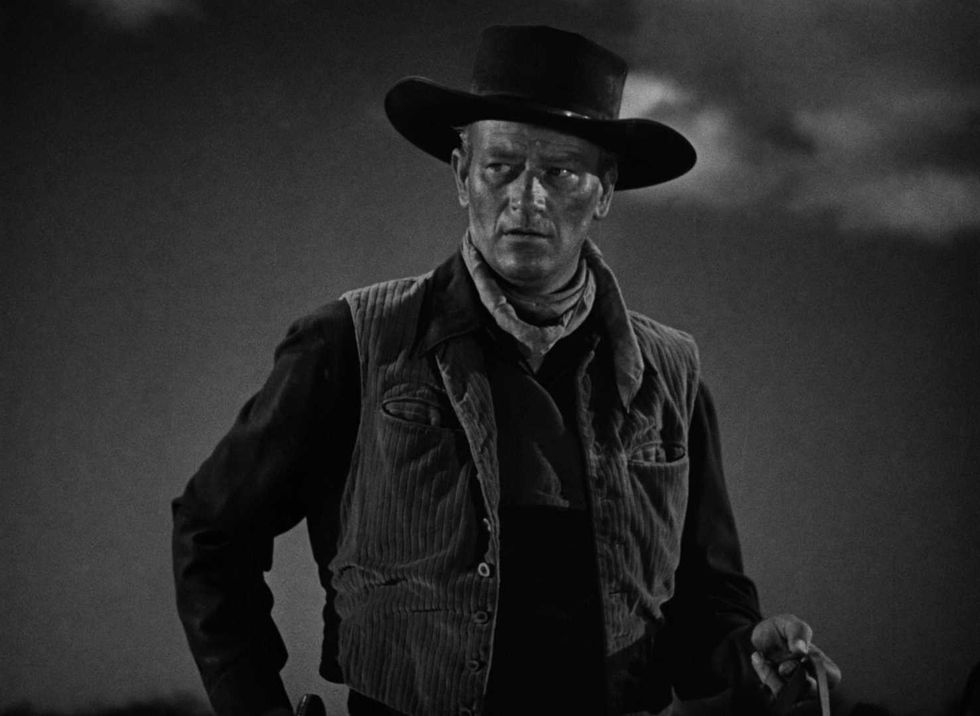 'Red River' Credit: MGM
What The Quote Means
So, this is straight-up a Bible verse they say at funerals. I hope you haven't heard it too many times in that context, but I know I have.
In that bible verse, it's a reminder that we're going to heaven without what we accumulated in the world. And I guess we could be going to hell for that. way, too.
When you hear John Wayne say it, it comes off as this nihilistic thought from a guy playing God, looking at his own son like a sacrificial lamb...which is also biblical.
In the movie, we have the actual reminder that Matt was saved and taken from the ashes of an attack by Dunson; he feelsl ike he pulled him from a birth of darkness and into the light.
Now, their roles have metaphorically switched. Matt is in the light, and Dunson has been consumed by darkness.
The words are also a reminder that Dunson built his entire empire on blood and willpower. Kind of the same way he built his family and raised his son.
Now, when that son challenges his authority, he reveals the core tragedy of his character: he'll kill him to get his own way.
This also subverts the honorable archetype that we had grown used to from Wayne in Westerns. In this movie, he's a cautionary tale about how absolute obsession curdles into madness.
What's fun is that this also plays into the auteur theory. See, director Howard Hawks loved characters who defined themselves strictly by their work and personal code. Even if that code and work were evil.
This is him deconstructing those visions via deconstructing Wayne.
And it works incredibly well in a Western, which is also deconstructing America at the same time.
Summing It All Up
Red River is a brilliant study in character collapse. Tom Dunson was a flawed figure driven to the brink of self-destruction by his own ego.
His famous line bridges the gap between classic Hollywood storytelling and the morally complex Westerns that would define cinema in the decades to come, and that didn't have a lot of Wayne in them.
That's why I think this is one of his best performances, and a rare one.
Let me know what you think.
- Film Quote of the Day: The John Wayne Line from 'Hondo' That Still Defines the Western Hero ›
- The John Wayne Quote From a 1976 Western That Still Resonates Today ›
- The John Wayne Quote From a 1968 War Movie Classic That Redefined the War Genre (In a Bad Way) ›
- 10 Lines That Made John Wayne a Hollywood Legend ›