I don’t know about you, but this weekend I’ll be celebrating the Fourth of July with the Backrooms extended rerelease in theaters. Backrooms: Everything Must Go Edition adds 15 minutes of footage and an exclusive post-credits scene, and it lands as Kane Parsons' film closes in on $350 million worldwide.
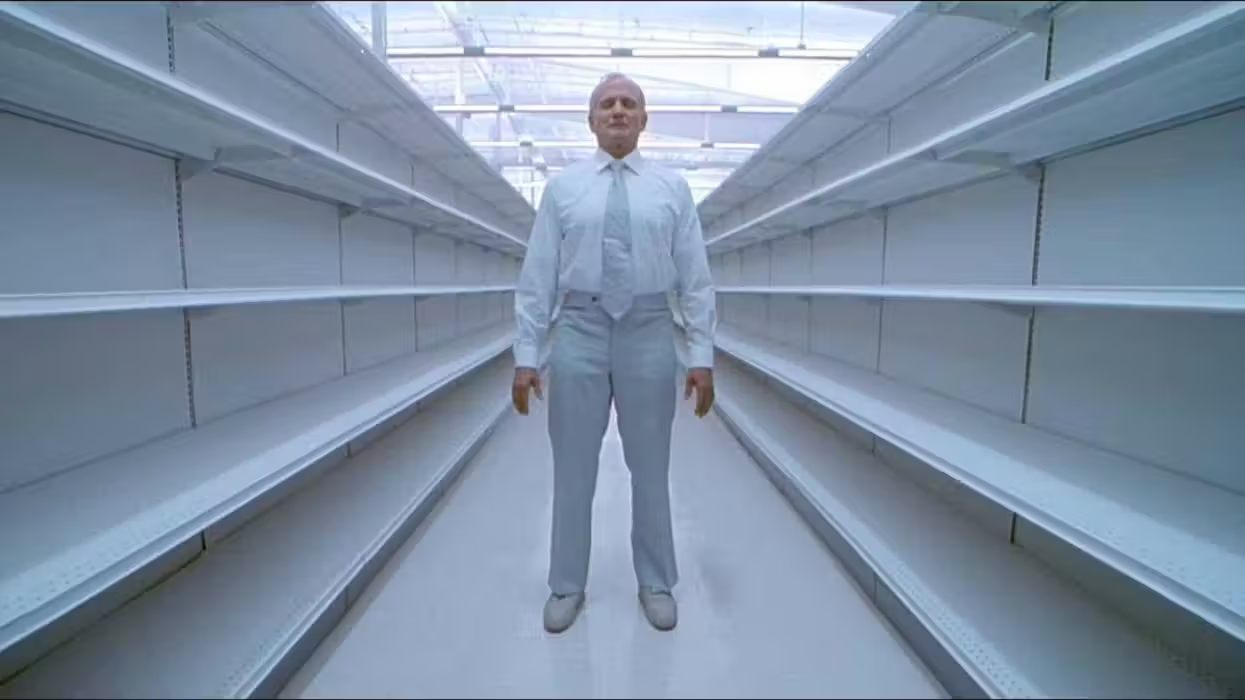
If you've somehow missed the conversation, the movie follows an unwitting furniture store owner who discovers another plane of reality underneath his building. The store itself is already pretty liminal, with its ‘90s decor and sparse inventory. But the Backrooms are even creepier, and today we’d like to look at why.
StudioBinder’s recent video essay digs into why the setting's uncanniness works, tracing the idea back to decades of filmmakers who've cultivated the same unease. It’s all about blocking, lighting, and camera choices you can use on your next project.
- YouTubewww.youtube.com
What Makes a Space Feel Liminal
Parsons has talked about liminal spaces as places specific enough to recognize but stripped of anything that tells you who's supposed to be there. "A sort of a blank slate feeling," he said in the video, describing rooms that read as familiar and empty at the same time.
That tension has a name in academic research, too. Alexander Diel, a researcher at Cardiff University, published a 2022 study in the Journal of Environmental Psychology proposing that built spaces have their own version of the uncanny valley.
“Uncanniness is a general response elicited by detecting deviations from predictable patterns. For physical places, unusually designed, distorted, or otherwise structurally deviating environments are then predicted to elicit negative experiences of creepiness, eeriness, or strangeness.”
A place doesn't need to look “wrong.” If it deviates just enough from what you expect a room like it to contain, then you’ll notice it.
Strip Out What's Expected
The simplest way to achieve liminality is subtraction. Take a space an audience already knows the "correct" version of, and remove the details that would normally fill it.
Again, Clark’s store feels odd because the stock is all so strange and spread out. It doesn’t feel right. Maybe it’s an empty house you’re just moving out of. The empty rooms in David Lynch's Twin Peaks: The Return work this way. The strangeness comes almost totally from what's missing, not from anything added.
For low-budget filmmakers, this is the cheapest version of the effect. You don't need production design if the point of the room is that it's been stripped of production design. A single unfurnished location, shot with intention, can carry the dread you’re looking for.
Let the Environment Repeat Itself
One of the scariest bits of Backrooms for me is when it all goes wrong for Clark (Chiwetel Ejiofor) and he and his two hapless helpers are attacked by Pirate Clark. When they are dragged down that chute, then scatter into the labyrinth of hallways and rooms in one long sequence, the confusing nature of doors leading to new rooms that all look slightly weird in a seemingly never-ending maze gives me the shivers. (However, I do love that Christmas room.)
In the same way, Stanley Kubrick's hallways in The Shining work because the patterned carpet and identical doors repeat down a corridor the camera tracks through in an unbroken Steadicam shot, so the geometry itself starts to feel like a trap.
We've broken down more of the camera movements horror directors reach for if you want a fuller toolkit, but the lesson here is that a smooth, sustained tracking shot through a repetitive environment builds unease in a way that’s unique to liminal horror.
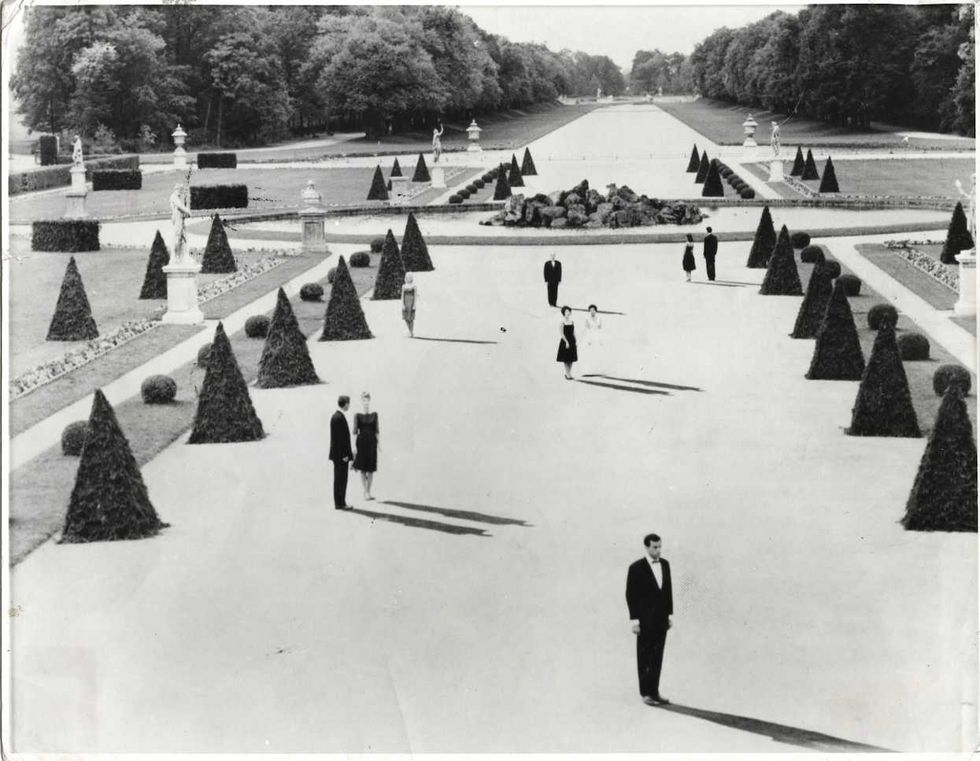 'Last Year at Marienbad'Credit: Cocinor; Cineriz
Put Familiar Things in the Wrong Spot
A room can be fully furnished and still feel liminal if its contents are arranged oddly. Last Year at Marienbad leans on this, as you can see in the video’s example. Nothing in the example shot is inherently surreal, but the blocking of people and objects within the frame is just slightly off from how you'd expect a space to be occupied.
This one's about composition more than production design, which makes it accessible on almost any budget. Move your actors or set dressing a few feet from where "natural" blocking would put them, or group them in weird ways, and see what it does to the shot.
Push Scale and Light in Weird Ways
Distorting how big or small something feels, or how visible it is, does the same thing. Think of Alice in Wonderland and how she keeps changing size. It’s weird on purpose. Or maybe props or set elements are a little off. This happens in Toys. Remember its miniature recreation of New York City?
Vivarium (which we've pointed to before as a companion piece to Backrooms) uses forced perspective to make its identical suburban houses read as slightly too small, paired with lighting that never quite matches anything natural. It looks like a painting.
If you're working with limited gear, this is where restraint helps more than more equipment. Over-lighting a scene on purpose, in a way natural light never could, does a lot of the same work Diel's research points to under "expectation violation."
Take the People Out
The last element is human presence. Maybe the simplest thing to try is just taking people out of a setting, which is a reason theme parks, malls, or schools feel weird after hours. Whenever I see an empty Disneyland, I get the creeps. A location an audience associates with crowds becomes unsettling the moment it's empty.
George Romero used this in Dawn of the Dead, shooting a real, faithfully dressed 1970s mall specifically because audiences would recognize what should be there and notice its absence. It’s the same reason Parsons’ own The Oldest View, which is also set in a recognizable but abandoned recreation of a real-life mall, is so dang scary. The technique depends on the audience's own memory of similar spaces doing the work for you, which means the more mundane and specific the location, the harder it lands.
None of these six tricks requires a soundstage. They're blocking decisions, lighting decisions, and decisions about where you point the camera, which is why Backrooms could get made for under $10 million and still look like it cost far more.
What are some other liminal spaces low-budget filmmakers could take advantage of?