Christopher Nolan crashed a real plane into an airport, but honestly, Jan de Bont’s cruise ship ramming into an actual island is way more massive and cooler.
I know that sequels are supposed to upgrade their game, but de Bont went two steps further, crafting one of the most expensive five-minute stunt scenes in 1997’s Speed 2: Cruise Control.
Just the thought of explaining to my producer that I need a million dollars for a stunt gives me nightmares. I wonder how de Bont convinced his team.
With that curiosity intact, let’s find out how and what made the cruise control scene from Speed 2: Cruise Control one of the most expensive action crash sequences, even though the movie fell short.
Story
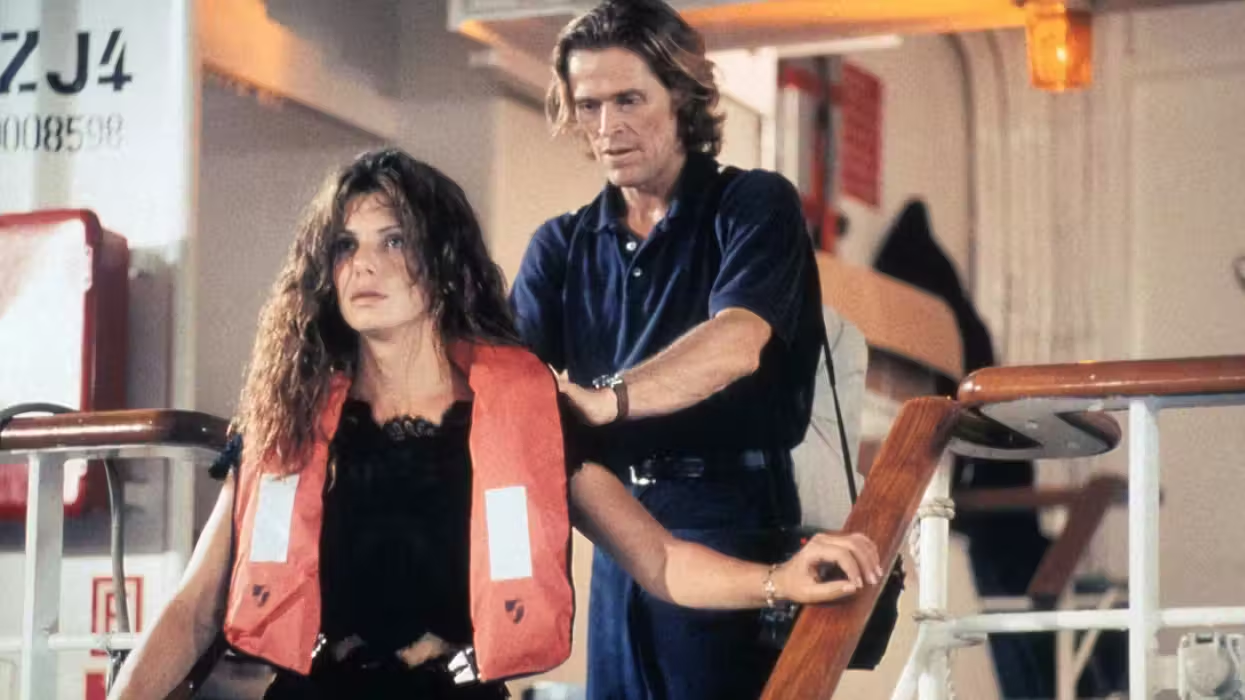
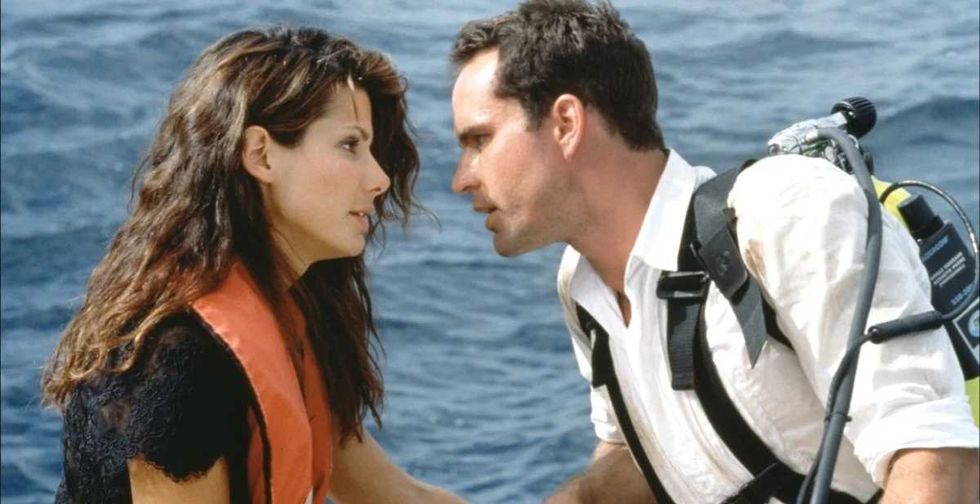
Speed 2: Cruise Control saw Keanu Reeves replaced by Jason Patric in the lead role, alongside Sandra Bullock, who reprised her role in the sequel.
This time, the story follows Annie (Bullock) and her cop boyfriend Alex (Patric), who try to stop a cruise ship while on an adventurous makeup date, as the revenge-stricken John Geiger (Willem Dafoe) damages the ship’s communication systems.
The Destruction Scene
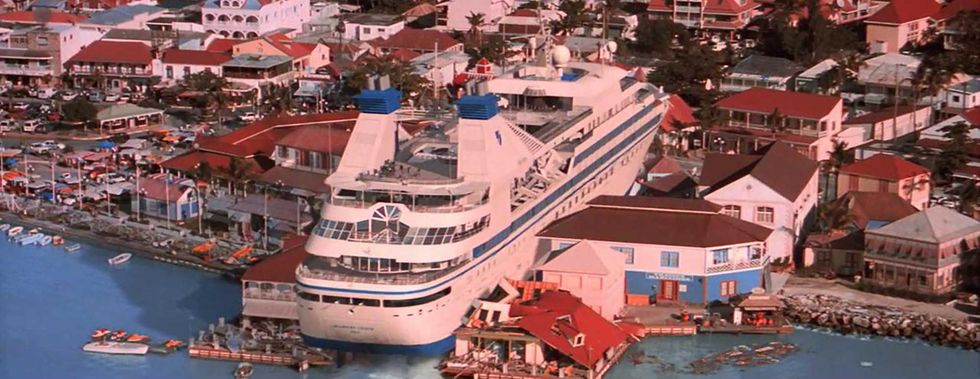
At the time of its production, the sequence set records as both the largest and most expensive stunt ever filmed. The scene comes at the climax of the movie, where a full-scale cruise ship collides with a full-scale dock on a Caribbean island, destroying buildings and structures in its path.
The Gamble of a Lifetime
The philosophy of de Bont was clear—he did not want to use miniatures. So, he built a town instead of using computer-generated effects. The reasoning was to achieve hardcore realism.
De Bont wanted the audience and the actors involved in the sequence to feel the actual weight of the ship and the destruction, so that in the theatrical experience, the scene could be felt within the bones.
Building an Entire Port and the Boat
 'Speed 2: Cruise Control' (1997)Credit: 20th Century Fox
The Town
It took approximately $5 million and a large crew to construct 35 buildings along the shores of St. Martin to replicate the local architecture. The task was so huge that the production team had offices on the island itself while they constructed the full-scale town from scratch.
They replaced all the concrete with sand-covered balsa wood so that it could explode and be destroyed when the ship hit the town with full force.
The Ship
The cruise ship, which looked like an engineering marvel, was created using CGI for most of its parts. They rebuilt the ship's false bow, which they used as a battering ram. So, almost 90% of the back of the ship was CGI, which was then tethered to the real bow in the front.
The production team fitted rails underwater, providing precise control of the ship’s motion and direction. This helped them pierce the town as they propelled the ship 50 feet at a time. Then, they would reset and go again.
This process continued until the final shot was achieved, so additional digital work was required to blend the scenes for a smoother flow. All the people running around performing stunts, trying to get out of the way of the ship, were also real.
No Margin for Error
The very scene of the ship entering Saint Martin lasts about five minutes, and when you calculate, every second of this sequence costs as much as $83,000. The ship could have gone backward, but once the destruction started, they had to capture the shots as effectively as possible in one go.
The Tragic Irony
 'Speed 2: Cruise Control' (1997)Credit: 20th Century Fox
Despite its ambitious scale, the $25 million crash sequence consumed nearly one-quarter of the originally greenlit budget and a significant fraction of the total production cost, which industry sources reported as high as $160 million after the shoot ran over schedule and budget.
With a 4% Rotten Tomatoes rating, the film was infamously awarded the Razzie for Worst Remake or Sequel. For context, the entire first Speed was produced for $30 million, only $5 million more than this single sequence cost.