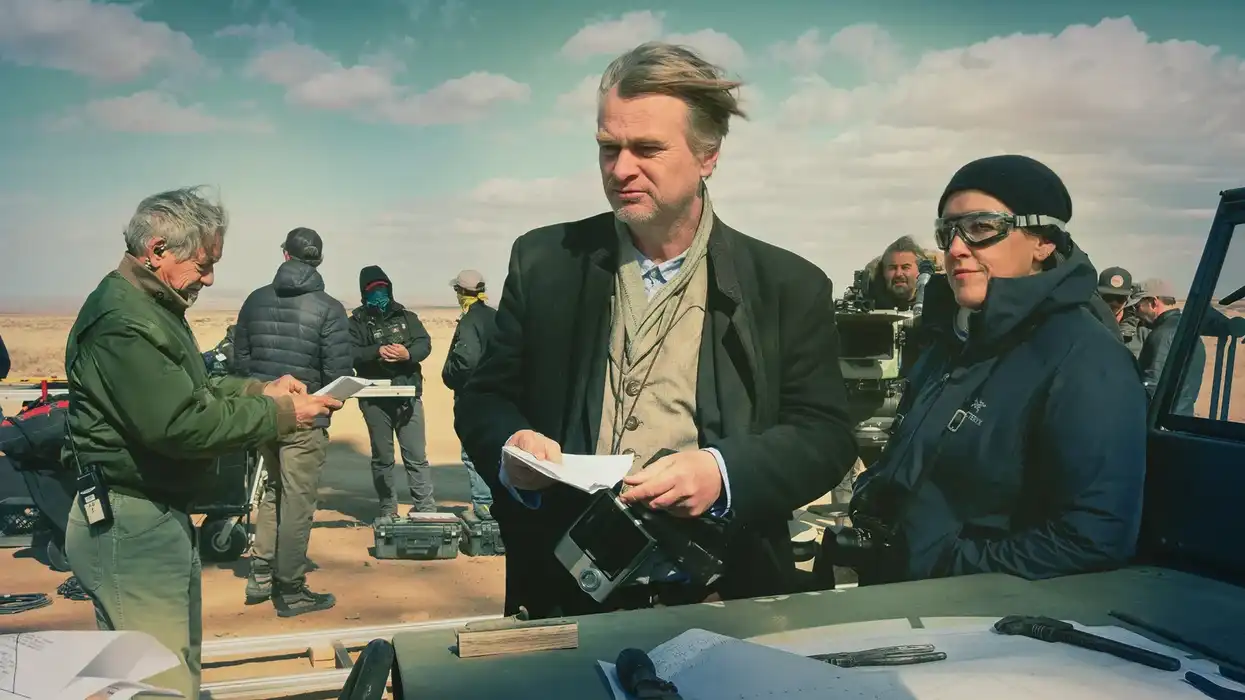
The theatrical experience is sacred. There is nothing quite like seeing one of your favorite films in a crowded theater—especially if that movie was captured specifically for large-format exhibition.
There’s something singular about this immersive, communal experience. It brings cinephiles and casual moviegoers together to stare in wonder and appreciate a director’s unfiltered vision and imagination.
Today, I’m giving you a starter course on large-format cinema, featuring the essential terms and definitions you need to know before dipping your toes into these deep waters.
Sound good? Let’s dive in.
The "Large Format & Optics" Terms
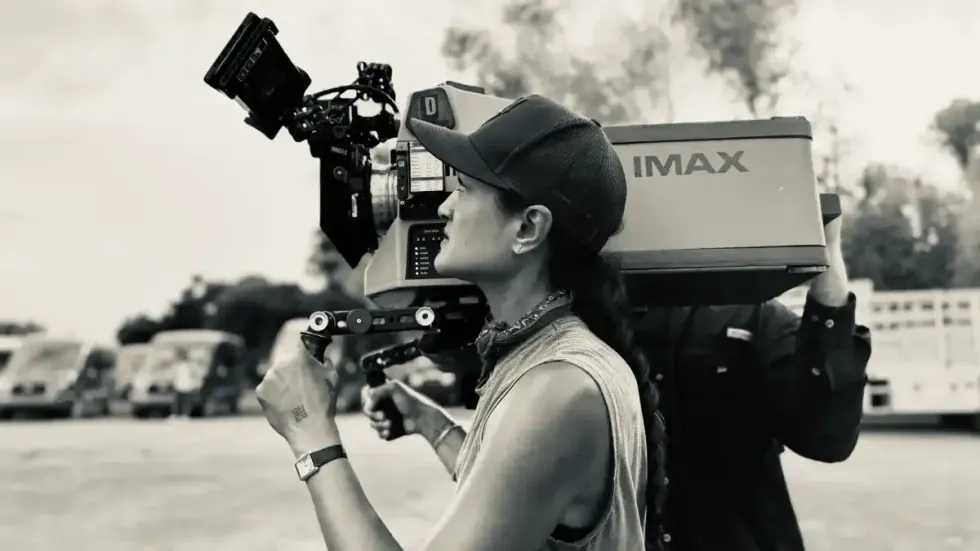
Cinematographer Autumn Durald Arkapaw with IMAX camera on "Sinners"
I. Format & Sensor Standards
- 15/70mm (IMAX): The "North Star" of large format. Film that runs horizontally with 15 perforations per frame.
- 65mm (5-perf): The classic Hollywood large-gauge negative (e.g., Lawrence of Arabia).
- Full Frame (FF): The $36 \times 24$mm standard based on 35mm still photography.
- Super 35mm (S35): The traditional motion picture standard ($24 \times 18$mm); the baseline for all crop factor math.
- VistaVision: An 8-perf horizontal 35mm format. Modern FF sensors are often called "Digital VistaVision."
- Medium Format: Sensors larger than $36 \times 24$mm (e.g., Fujifilm GFX or Hasselblad), occasionally adapted for cinema.
- Active Sensor Area: The specific portion of the sensor being used to record the image, which may change based on resolution settings.
- Open Gate: Utilizing the entire physical sensor area, regardless of the final aspect ratio.
- Aspect Ratio: The proportional relationship between width and height (e.g., 1.43:1 for IMAX, 2.39:1 for Widescreen).
- Photosites: The physical "buckets" on a sensor that catch light. Large format allows for larger photosites, improving dynamic range.
II. Optical Physics & Geometry
- Image Circle: The diameter of the light projected by a lens; must be $\geq 43.3$mm for Full Frame.
- Crop Factor: The multiplier (e.g., 1.5x) used to compare FOV across different sensor sizes.
- Equivalence: The calculation used to find a lens/aperture combo on LF that matches the "look" of S35.
- Circle of Confusion (CoC): The point at which a blur becomes "unsharp" to the eye; tighter on LF due to magnification.
- Telecentricity: A design where light hits the sensor straight-on rather than at an angle to avoid edge-smearing.
- Nodal Point: The physical point inside the lens where light rays intersect. Crucial for seamless pans/tilts in VFX.
- Flange Focal Distance: The distance from the mount to the sensor.
- Back Focus: The fine-tuning of the lens-to-sensor distance, often adjusted with shims.
- Field of View (FOV): The observable world visible through the lens, measured in degrees.
- Magnification: The ratio of the subject's size on the sensor vs. its size in reality.
III. Lens Characteristics & Artifacts
- Bokeh: The aesthetic quality of out-of-focus areas; deeper and "creamier" on LF.
- Focus Fall-off (Roll-off): The speed and smoothness with which an image transitions from sharp to blurry.
- Chromatic Aberration (CA): Color fringing caused by wavelengths failing to converge.
- Spherical Aberration: Softness caused by light rays hitting the edges of a curved lens element.
- Lens Breathing: The slight change in FOV when racking focus.
- Anamorphic Squeeze: Optically "smushing" a wide image to fit the sensor height.
- Desqueeze: The digital or optical correction of an anamorphic image for viewing.
- Astigmatism: An optical defect where lines in different planes don't focus equally.
- Vignetting: Darkening of the corners when the image circle doesn't fully cover the sensor.
- Lens Flare: Light scattering in the lens system, often more complex in large glass elements.
- Micro-contrast: The ability of a lens to resolve fine detail in low-contrast areas.
- T-Stop: The "Transmission" stop; the actual amount of light hitting the sensor vs. the mathematical F-stop.
IV. Mounts, Glass & Mechanics
- LPL Mount: ARRI’s Large Positive Lock; wider and shallower for LF glass.
- PL Mount: Positive Lock; the legacy standard, now often adapted for LF.
- EF Mount: Canon’s electronic mount, popular for its massive library of FF lenses.
- Speed Booster (Focal Reducer): An adapter that shrinks a large image circle onto a smaller sensor, gaining a stop of light.
- Expanding Adapter: The opposite of a speed booster; allows S35 glass to cover LF sensors.
- Internal Focusing: Lenses that don't change physical length when focusing.
- Close Focus: The minimum distance at which a lens can maintain a sharp image.
- De-clicked Aperture: A smooth iris ring (standard in cinema) rather than the "clicks" found in stills glass.
V. On-Set Technicals & Workflow
- Depth of Field (DoF): The range of acceptable focus. On LF, this is much shallower for a given FOV.
- Hyperfocal Distance: The focus distance providing the maximum depth of field.
- Diffraction Limit: The point where closing the iris too far (e.g., f/22) actually softens the image.
- Genlock: Syncing the sensor's shutter with external devices (vital for Volume/Virtual Production).
- Frustum: The field of vision in a 3D space, specifically the "inner" high-res area on an LED wall.
- Shutter Angle: The relationship between frame rate and exposure time (e.g., 180°).
- Base ISO: The native sensitivity of the sensor, where it has the highest dynamic range.
- Dual Native ISO: Sensors with two distinct "clean" gain circuits (common in Sony Venice/RED).
- Global Shutter: Reading the entire sensor at once to prevent "jello" motion artifacts.
- Rolling Shutter: Reading the sensor line-by-line; more prone to artifacts on larger sensors due to data volume.
VI. The Large Format Camera Tier List
1. The "Titan" Class (65mm & Beyond)
These cameras use sensors significantly larger than full frame, emulating the look of 65mm or 70mm film.
- ARRI Alexa 265: The newest flagship (released late 2024/2025). It puts a 65mm sensor into a body the size of an Alexa 35, making massive-format handheld shooting possible for the first time.
- ARRI Alexa 65: The industry legend. Available rental-only, its sensor is essentially three Alexa sensors stitched together. It has been the go-to for Dune and The Revenant.
- Panavision Millennium DXL2: A collaboration between Panavision and RED. It uses the RED Monstro 8K VV sensor but utilizes Panavision’s proprietary color science (Light Iron Color) and large-format optics.
2. The "Full Frame" Workhorses (35mm VV)
These are the most common "Large Format" cameras on professional sets today, featuring sensors roughly $36 \times 24$ mm.
- Sony Venice 2 (8K/6K): Known for its "Rialto" extension system (allowing the sensor to be separated from the body) and incredible internal ND filters. It is the dominant camera for high-end commercials and features like Top Gun: Maverick.
- ARRI Alexa Mini LF: The "industry standard" large format camera. It combines the ALEV 3 sensor with a compact body, making it the favorite for drone, gimbal, and B-cam work.
- RED V-Raptor XL: A flagship 8K system with a Global Shutter, meaning it can shoot fast motion or strobe lights without "rolling shutter" artifacts (jello effect).
3. The "Pro-Sumer" & Indie LF Disruptors
These cameras have brought the large-format look to independent filmmakers.
- Blackmagic URSA Cine 12K LF: A massive leap for Blackmagic, featuring a $36 \times 24$ mm RGBW sensor and 16 stops of dynamic range, built into a high-end production body with Lemo/Fischer ports.
- Sony FX9 / FX6: The "Full Frame for the masses." These cameras brought the Venice sensor technology into a doc-style, autofocus-heavy body.
- Canon EOS C500 Mk II: A modular 5.9K Full Frame camera that is a favorite for high-end documentary and corporate work.
VII. Quick Comparison Table
| Camera | Sensor Size (Approx) | Max Resolution | Native Mount | Key Feature |
| Alexa 265 | $54 \times 25$ mm | 6.5K | LPL | 65mm look in a "Mini" body size. |
| Venice 2 | $36 \times 24$ mm | 8.6K | PL / E-Mount | Internal NDs & Dual Base ISO (800/3200). |
| V-Raptor XL | $40 \times 21$ mm | 8K | PL / RF | 120fps at 8K and Global Shutter. |
| URSA Cine 12K | $36 \times 24$ mm | 12K | PL / EF | RGBW sensor for high-speed data. |
Summing It All Up
I hope these facts and terms surrounding large format open your world up to shooting in these elusive ways.
As Hollywood leans more into the big screen, I am hoping these formats become cheaper and more accessible to filmmakers at every level.
But until they, we can always dream.
Let me know what to add in the comments.
- The Large Format Revolution Continues With More Full-Frame Cinema Primes On the Way ›
- Large-Format Cinematography Goes Giant with New IMAX Film Cameras ›
- How to Complete a Large Format Film on a Low Budget During a Pandemic ›
- What Is the 'Look' of Large Format? These Tests Show You ›
- Thanks to Nolan and Eastwood, Large Format Cameras Have Forever Changed Movies ›
- Is IMAX Up for Sale? ›