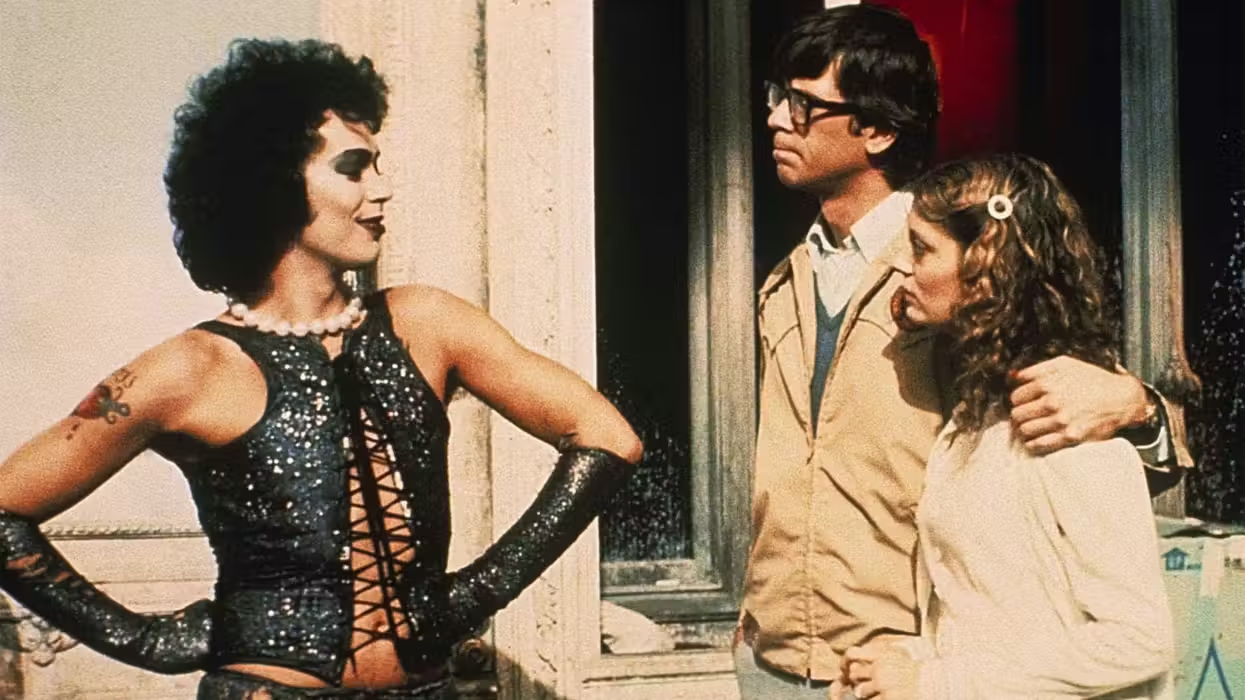
Tim Curry died on Aug. 26. The actor became iconic several times over during his illustrious career, but it all started with an offbeat musical in which he played a lead part.
Today’s quote comes from the 1975 film version of The Rocky Horror Picture Show, directed by Jim Sharman, from Richard O'Brien's 1973 stage musical. Curry played Dr. Frank-N-Furter, a role he originated on the London stage.
The film served as his film debut. What an entrance.
In the film, squeaky-clean engaged couple Brad (Barry Bostwick) and Janet (Susan Sarandon) get a flat tire in a storm and take shelter in a castle owned by Dr. Frank-N-Furter, a self-described "sweet transvestite from Transsexual, Transylvania," who's unveiling his lab-made creation, Rocky. They engage in seduction, murder, and an alien reveal. It’s a cult classic, one of cinema’s most iconic midnight movies.
The music and lyrics were composed by Richard O'Brien in 1972, while the original musical arrangements are by Richard Hartley.
The quote comes from a musical sequence near the end of the film, and it’s a five-world distillation of everything the character stood for.
- YouTube www.youtube.com
The Scene
This song is part of a three-song medley called "The Floor Show." It happens near the end of the film, when Dr. Frank-N-Furter hosts a cabaret-style show.
At this point, Frank has frozen his captives using his Medusa Tranquilizer. He unfreezes them, dresses them up, forces them into a cabaret in the RKO theater's pool, and leads the number that peaks on a refrain of "don't dream it, be it."
Frank sings the opening, emerging from mist, clad in a corset and mink. He descends onto an extended diving board and leaps into the smoke below, where the pool is revealed.
Give yourself over to absolute pleasure
Swim the warm waters of sins of the flesh
Erotic nightmares beyond any measure
And sensual daydreams to treasure forever
Can't you just see it?
Don't dream it, be it
Don't dream it, be it
Don't dream it, be it
Don't dream it, be it
Floating in the water, Frank delivers his manifesto. A few moments later, Riff Raff (O’Brien) leads a coup with Magenta (Patricia Quinn).
“It's all over,” Riff Raff says. “Your mission is a failure.”
Frank sings one last song, and Riff Raff pulls a ray gun, intending to kill him. Frank is crushed trying to escape. Rocky, devastated, grabs his body and leaps to his own death.
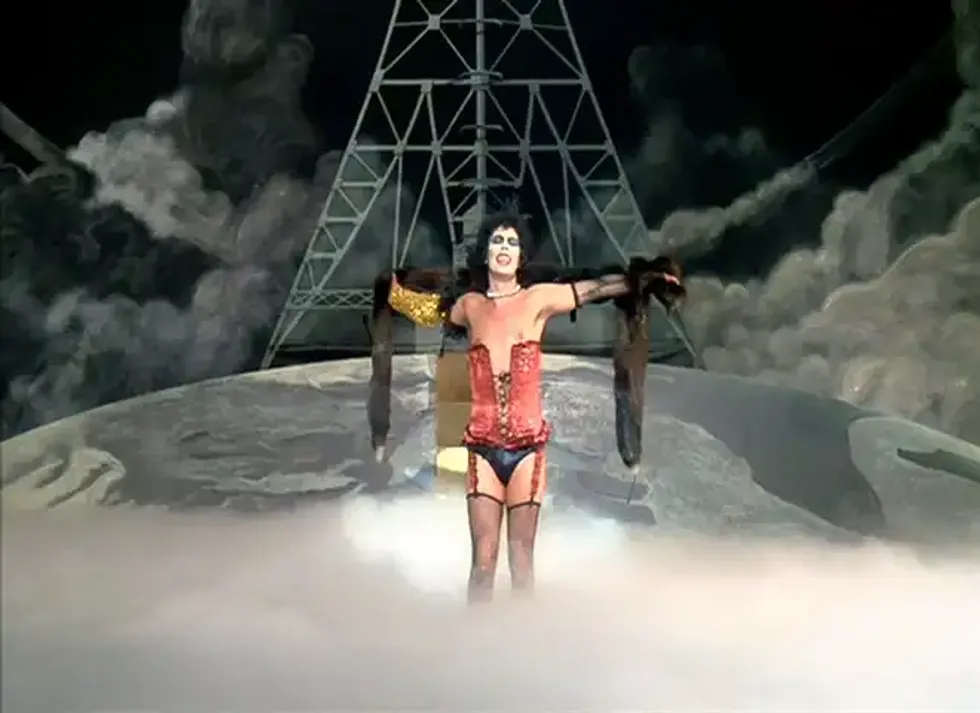 'The Rocky Horror Picture Show' Credit: 20th Century Studios
One Epic Performance
The song is the film’s ideological climax. The refrain isn’t complicated, but it’s everything Frank has aspired toward.
Curry was Royal Academy-trained, and he gives his all to the performance. He makes Frank big, operatic. He’s spent the film murdering and seducing and forcing others to become his playthings, yet he remains a tragic figure.
He’s technically the villain of the story, because he’s a killer and a mad scientist, but he’s also an icon who challenges the status quo and refuses to live in shame. And Curry commands the frame as the character.
As an antagonist, he’s charming, intelligent, and his look is so singular that he’s been a staple at Halloweens now for decades. Those fishnets!
You might not directly root for Frank or support his methods, but you know what he wants, and you might want him to get it because he’s just so dang magnetic and confident.
What the Quote Means to the Fandom
The film is a lot of things, including a parody of classic sci-fi/horror films that were often in the “so bad it’s good” category. It was happily a B-movie pastiche. As a stage show, it did pretty well, while the film adaptation was initially just too weird for mainstream audiences. It flopped.
About a year later, it got a second bow with New York midnight audiences. Fans started showing up for multiple showings, learning lines, dressing up, eventually leading to full casts acting out the film in a floor show of their own.
Now it’s a landmark of queer visibility, with its gender-nonconforming characters and cast of weirdos. It’s about outsiders and was eventually embraced by weirdos.
So, in a way, “Don’t dream it, be it” becomes a statement with real cultural weight, speaking to people who were often told to fall in line, to stop being themselves, to hide in the shadows. The fandom actually enacts the adage by living openly and finding each other.
The LGBTQ community made the film a home for self-invention. Curry embodied that creed on screen, and fans carry it forward now that he's gone.
Curry’s Total Commitment
Even though the film is pastiche, it takes itself seriously, including in the performances. Camp absolutely dies when it’s trying too hard to be camp. Curry isn’t winking at the audience as Frank. He’s simply and earnestly embodying the character. He has stage presence and vulnerability and is fully committed to the part.
The Hollywood Reporter put it exactly right in its remembrance:
The performance was outrageous without ever feeling unserious. Curry understood that the joke only worked if Frank believed completely in his own magnificence.
Curry performs conviction, and the camp takes care of itself.
The discipline underneath is easy to miss. For all the apparent abandon in his performance, Variety wrote:
Frank N. Furter arrives somehow as an extra-subversive presence in what is already a joyfully anarchic affair: At once beautiful and grotesque and frightening and rampantly sexy, he belts out his rock ‘n roll-infused showtunes with militaristically rehearsed precision.
One role can reset an actor's whole relationship with an audience. Frank was Curry's big-screen debut. He never seemed to resent how it defined him for many fans.
Writers, directors, performers—your stories can be weird. Not everyone will always get it, and that’s fine. Conviction, not irony, is what makes audacious material work. Commit like you believe it, or don't bother. Curry believed every second of his time as Frank. And that's what made that role so great.
Look back on the rest of Curry’s impressive career.