30 Years Later, This Is Still the Film That Changed Animation Forever
The hit Pixar classic did something entirely different with the medium.
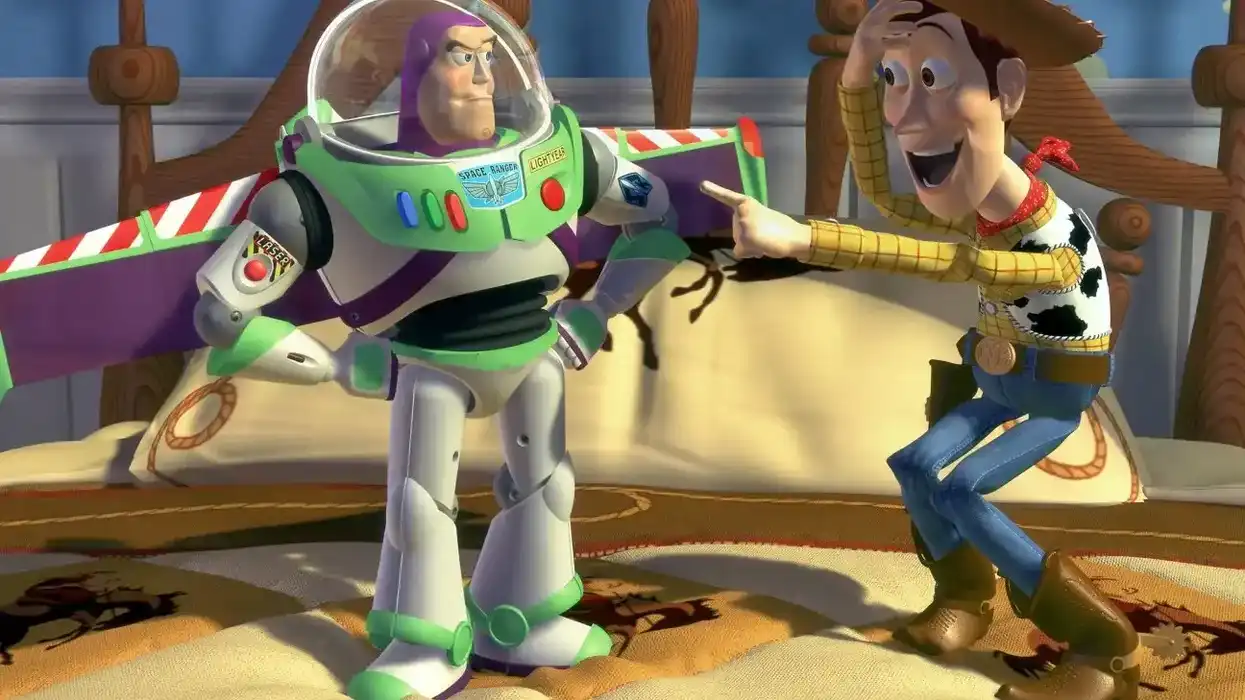
'Toy Story'
I was a little kid when the first Toy Story came out, and now, I am 39, and there's another new one in theaters. It's crazy how long this series has stretched over my life, so long that I can bring my own kid to see this iteration.
But what blows me away is that when the first one hit theaters, no one knew what it would be, and they definitely didn't know how important the movie they were seeing would be.
This was a film that would change animation forever.
Let's dive in.
- YouTubewww.youtube.com
Toy Story's Origin Story
Long before existential battles between analog imagination and modern technology, a small group of computer scientists and animators in Richmond, California, were trying to figure out a story that would get an audience to care about some plastic toys.
They knew they had nostalgia on their side; everyone had a favorite toy growing up. But how could they imbue these objects not just with our own connections to them, but a universal struggle that got audiences to buy into a magical world with real-life stakes and consequences?
Oh yeah, and they were going to do all this with computer animation, a medium no one had ever made a feature film in before, one that would be expensive. They desperately needed to make their money back to keep their company, Pixar, alive.
The Technical Mountain
To understand how revolutionary Toy Story was, you have to look at the sheer limitations of the hardware at the time.
Not to get too technical here, but computers in the 90s were like boxes with chips that were like 1/10 as powerful as your cellphone today. Maybe even less. They were not something anyone assumed you could animate a whole movie with, and were used for special effects like the ones you saw in T2 or Jurassic Park.
In order to make Toy Story, Pixar’s render farm consisted of 117 Sun Microsystems computers running 24 hours a day.
Each individual frame took anywhere from 45 minutes to 30 hours to complete, depending on how complex the movement was in the scene.
The computers had a lot of work to do, and Pixar actually designed the look ot Woody, Buzz, and company to be easier for them to render.
As the story goes, it was easiert ot get the animation to feel real when it was a toy than when it was a human. That's why Andy and his Mom are barely in it. And we only get a little bit of Sid. It made sense to have toys with geometric features as the protagonists and as assets in the storytelling as well.
Writing From Internal Need
Toy Story changed animation because of its technical prowess, but I think it changed the world and viewership because of its incredible story. It didn't rely on the traditional musical format that Disney had made their own. This was a straight narrative that had the structure of a classic buddy-comedy-turned-survival-thriller, like Midnight Run.
The film's timelessness comes down to how Pixar builds characters around internal needs versus external wants. On the surface, Woody wants to remain Andy's favorite toy. But internally, his character arc is an exploration of profound jealousy.
Buzz's arc is one of questioning what he actually is as a toy. He's coming to grips with his reality and his place in the world.
These are big questions that weren't over the heads of kids, but got parents involved and made this movie accessible to them. This was like huge questions that engaged them without talking down to the kids in the audience, too.
As Andrew Stanton recently pointed out on the In Proximity podcast, the script is about jealousy, but they never say the word. They just build the story about that, and assume the audience is smart enough to get it.
How Toy Story Left a Permanent Mark on Hollywood
When Toy Story debuted on November 22, 1995, it was a massive gamble, but decades after its release, we're still talking about it because it achieved everything it set out to do.
It made a ton of money at the global box office, changed animation, and put Pixar on the map as a cutting-edge studio ready to compete with the big boys.
The legacy of Toy Story can still be felt across the entire landscape of modern entertainment. It proved that 3D animation was a commercially viable art form, established the structural playbook for modern family cinema, and proved that audiences crave something new and exciting.
Summing It All Up
No matter how many technological shifts hit the industry, the original Toy Story remains an excellent reminder that CGI is just a tool; it's only powerful when you have people with immense imaginations behind it, telling a story that connects to human souls.
Let me know what you think in the comments.