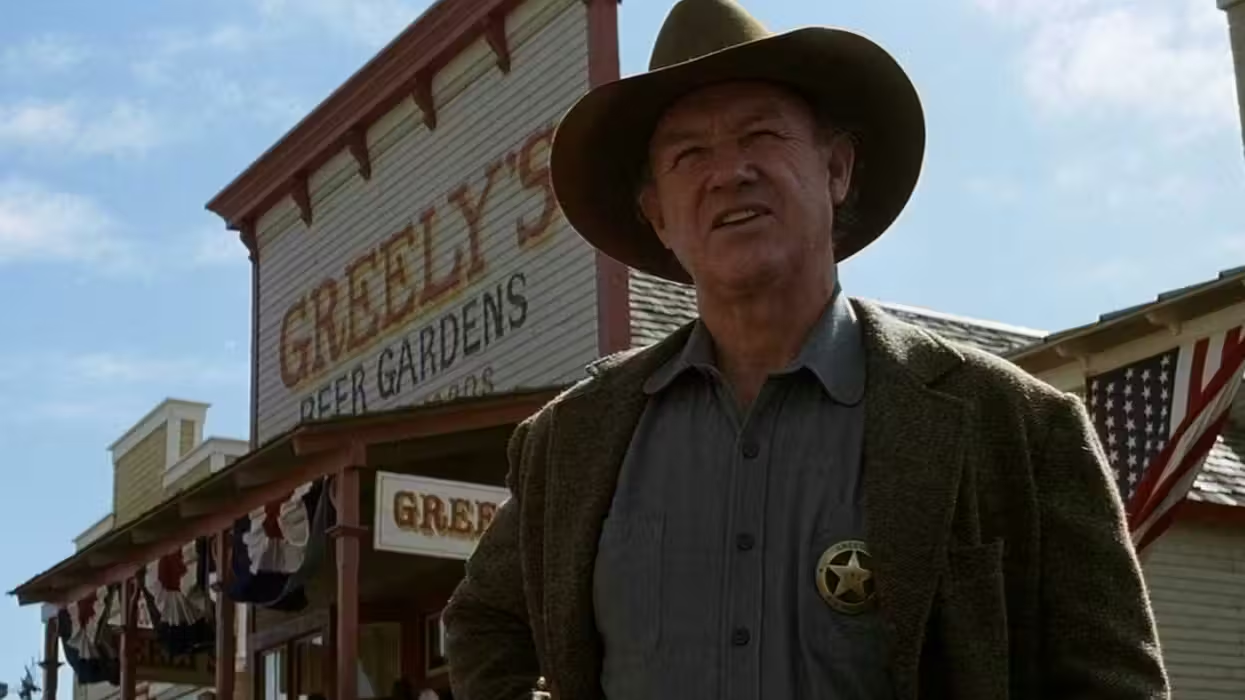
Writer David Webb Peoples created one of the best villains ever in the Western thriller Unforgiven.
If you were watching a cowboy drama and you heard there was a small-town sheriff as a character, you'd assume that character would be one of the heroes. That's not the case in Unforgiven.
In this 1992 movie, Little Bill Daggett is the central antagonist. He's a self-appointed lawman in the Wyoming town, strict and sadistic. Outwardly, he masquerades as chummy and folksy, but his words often betray his sadism and love of violence.
Today's quote is one such line. He seems warm, but the subtext is much darker, as he speaks with W.W. about his beliefs.
- YouTube www.youtube.com
The Scene
In the scene, which occurs on a terrible, rainy night in the town, Little Bill Daggett (Gene Hackman) and W.W. Beauchamp (Saul Rubinek) are at Little Bill's house.
In addition to serving as sheriff, Little Bill is a carpenter. He's in the middle of building his own house, and hasn't done a great job. The roof is leaking.
In the scene, we join Little Bill in the middle of telling a story.
"I said to him,' Jim, you are a liar and a horsethief.' Now when he seen them others wasn't gonna help him none, he started in to cryin' and sobbin' and just carrying on. He said, 'Oh, Bill, please! Oh, God! Please don't kill me, Bill! Please don't kill me, Bill!'"
Beauchamp is the fawning hagiographer who arrived in Big Whiskey with English Bob (Richard Harris). Little Bill has just publicly beaten Bob in the street, and now he's giving the writer a philosophy tour.
They're mocking the man in his story and laughing about it. W.W. takes notes on the tale while Little Bill dumps pots out the windows. He's been using receptacles to catch the leaks.
Little Bill continues to disparage the man, who was crying despite being armed. W.W. asks if he killed him.
"No," Little Bill says, "but I should have. I can't abide them kind. You see them in the taverns, you know? Tramps and drunk teamsters and crazed miners. Sporting their pistols and acting like they was bad men. But without any sand or character. Not even any bad character."
W.W. agrees and takes his notes.
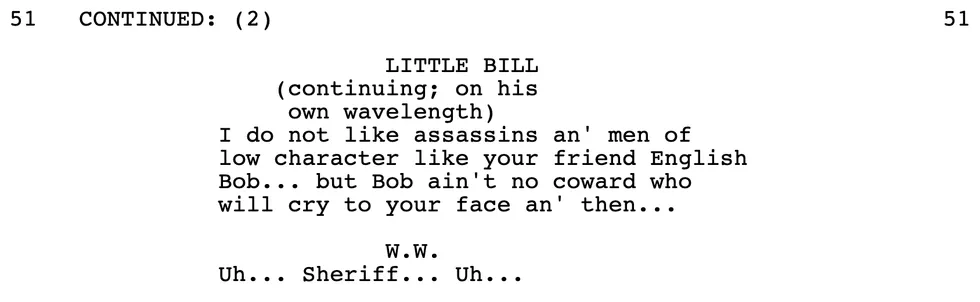
Little Bill says, "I do not like assassins. Or men of low character."
He points to English Bob as an example. W.W. complains of the wet, and a second later the men are interrupted.
 Credit: Warner Bros.
The Hypocrisy the Line Reveals
"I do not like assassins. Or men of low character."
I love a bad guy with no self-awareness.
Little Bill's hatred of bounty hunters and assassins has been well-established by this point. He's already beaten down English Bob for the crime of carrying a gun into his town. He'll later beat Munny (Clint Eastwood) for the same reason in the saloon, and he'll torture Ned Logan (Morgan Freeman) to death and leave his body as a warning to all bounty hunters.
His idea of law is violence and preemptive punishment. But because of this, he's an assassin of another kind.
Not to mention a man of low character. We probably don't need to explain why—but even the fact that he's mocking two different men in this scene, men on whom he's inflicted great pain, puts him in psychopath territory. And he's doing all this in a house he's built so poorly that he can't even keep the rain out, a fact that ends the discussion as W.W. complains about how damp it is.
The irony and hypocrisy work in this scene in Unforgiven because Little Bill is so oblivious to it all. The character doesn't know he's being hypocritical. Little Bill believes everything he's saying and believes in his version of morality. It's great character work.
It also allows the audience to read the subtext and laugh at him, making them feel superior to the villain.
Now, I probably wouldn't laugh to his face about this. The character is liable to pull out his gun for that, too.
A Character Sketch in One Sentence
Throughout the scene, Little Bill is puttering around, dumping out water, putting on a show for the writer. His grammar isn't proper. He puts on a voice to mimic his whimpering victim.
But when it comes to this line, his tone changes. He goes still. His voice is serious. He watches W.W. a moment, cocking his head.
"I do not like assassins."
The script calls for "do not," which Hackman delivers. Not "I don't," which would have followed the rest of the scene's informality. The formal tone reveals a man putting on airs, performing gentility for the writer. He says "assassins," which is more at home in political violence than in Wyoming.
"Or men of low character."
"Low character" is the verbiage of a man who looks down on everyone else. He's a self-appointed judge, jury, and executioner. He's above it all.
It's a moment that feels dangerous because of how quiet and performative it is. It breaks only because W.W. can't take the leaky roof anymore.
The performance here is so good. Hackman went on to win an Oscar for the role.
What to Steal for Your Villains
A mustache-twirling villain is all well and good, and Westerns have plenty of them. But sometimes a bad guy doesn't really know what he's doing, and his stupidity is a danger of its own kind.
Little Bill isn't self-aware, but he is articulate. He would tell anyone why he's right and be prepared to defend his philosophy, to a point. He does cling to power, but he also clings to the idea that he's better than everyone else. And it makes him scary in a very unique way.
Let your villain have a moment where he reveals how foolish he is, and trust the audience to pick up on it. We don't see W.W. react in a way to signal, "This guy's an idiot." The setting, the performance, and the line are all the signal we need.