Why This One Line in ‘Unforgiven’ Shattered the Western Myth Forever
Examine the heavy philosophical weight of a legendary outlaw’s perspective on death and what is stolen from the fallen.
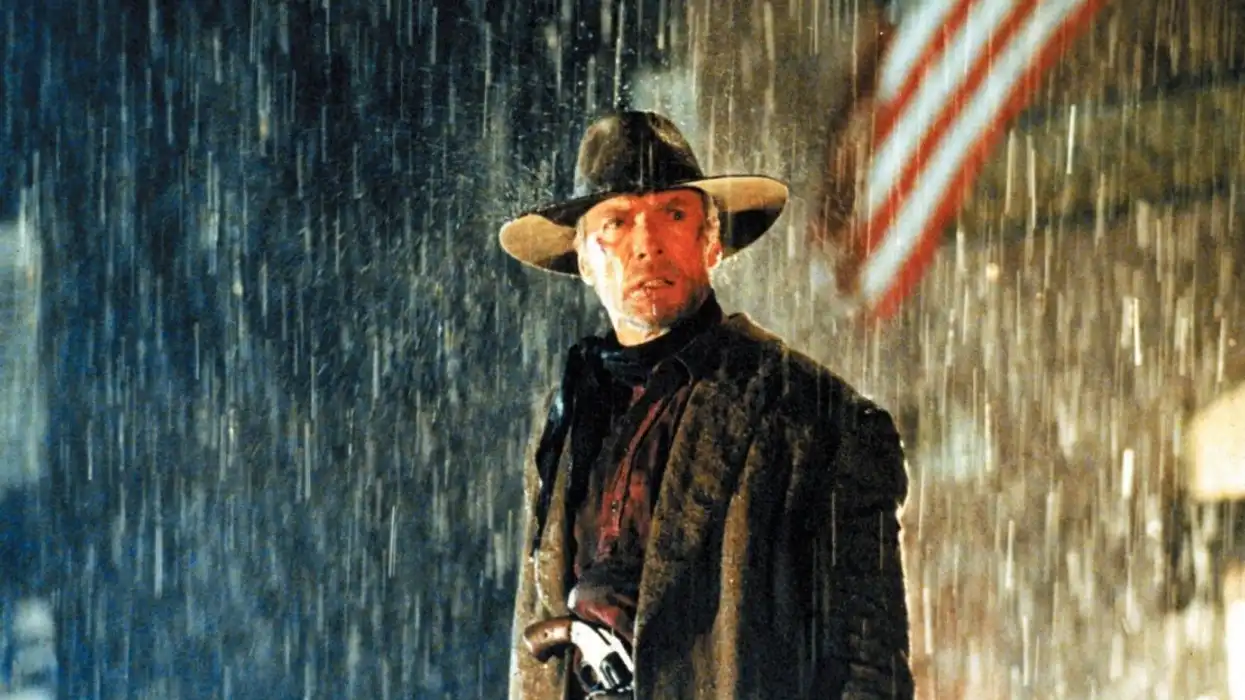
'Unforgiven' (1992)
You might think that, in the rugged terrains of the Old West, the frontier sensibilities around violence and death might not be as delicate as yours and mine are. And why not? Ever since the dawn of Westerns, all we have seen are hard-nosed “pistoleros” with nerves of steel. They shoot as if they are swatting flies, holster their guns, tip their hats, and ride off into the sunset without a single sleepless night.
But, in Clint Eastwood’s revisionist Westerns, things get ruffled. White-hat heroes become antiheroes, and antiheroes develop a conscience. They look rougher around the edges, but sometimes even former outlaws begin to think about the cost of what they’ve done.
The aging lead of Unforgiven (1992) fits that mold. He is no noble crusader riding in to fix the world. A worn-out ex-outlaw is what he is. He doesn’t hide his past, though—“I’ve killed women and children,” he says. Not exactly the résumé of someone you would expect to reflect on life and death poignantly.
Then again, maybe he is exactly the man who would be.
The Scene
William Munny (Clint Eastwood) is a former outlaw with a violent past but now an aging hog farmer. He is approached by the Schofield Kid (Jaimz Woolvett), who claims to be an experienced bounty hunter and requests Munny’s help in pursuing a certain bounty against two thuggish cowboys who maimed a prostitute. Munny agrees to help, not because he wants back into the game, but because his farm is failing and he needs money for his kids. They are joined by Munny’s friend, Ned (Morgan Freeman).
Munny has a hostile encounter with the town’s corrupt sheriff, Little Bill (Gene Hackman), who is protecting the cowboys. In this altercation, Munny gets beaten up. After he is back on his feet, the trio ambushes one of the cowboys, and Munny kills him. Ned decides to quit and leaves, but unknown to Munny and the Kid, he is later flogged to death by Little Bill. Afterwards, Munny guides the Kid and helps him kill the other cowboy.
Now, with Little Bill in pursuit, Munny and the Kid escape. While they are catching their breath, the Kid gets drunk and overwhelmed before confessing that he lied about being an experienced bounty hunter. He says the cowboy was the first kill he ever made and emotionally recounts his experience of killing the cowboy.
As he sees the Kid break down, Munny pensively comments, “It’s a hell of a thing; killin’ a man. You take away everythin’ he’s got… an’ everythin’ he’s ever gonna have.”
Why the Line Matters in the Story
The Weight of Munny’s Past
This line is Munny indirectly expressing his repentance for the atrocities he committed as an outlaw earlier in his life. When, while describing how he felt during his first kill, the Kid asks Munny, “Was you ever scared in them days?” And Munny replies, “I don’t remember, Kid. I was drunk most of the time.”
In the climax scene, when Little Bill scornfully identifies him as “Three-Fingered Jack,” who killed women and children, Munny, drunk again, admits to that fact, saying, “I’ve killed most everything that walks or crawls, and now I’ve come to kill you.”
But Munny is now essentially a different man. He is a farmer, and he is raising his children by doing honest work. This transformation was possible because he understood exactly what killing means. His words carry the weight of a painful memory rather than bravado.
The Schofield Kid’s Awakening
The Schofield Kid is introduced as a wannabe gunslinger. He is posing as a skilled bounty hunter and boasts about having killed five men. The experience of “actually” killing a man, followed by Munny’s wistful mulling on what it means, however, ends his fantasy. He drops his gun and declares he is not gonna kill again. Eastwood is flipping a common Western idea here: instead of earning respect through violence, the Kid walks away from it.
Conclusion
Death is final, and this line brings out that finality in a simple, unassuming way. It focuses on what gets stolen instead of what is gained. Putting a murder in a simple perspective of “thievery,” the film makes us confront the true cost of violence. Taking a life doesn’t make you a hero; it simply makes you a thief of someone else’s tomorrow.
- “Dying Ain’t Much of a Living”: The Meaning Behind the Gritty Philosophy of 'The Outlaw Josey Wales ›
- The Line That Made Clint Eastwood a Legend ›
- The Coldest Line Clint Eastwood Ever Delivered in ‘A Fistful of Dollars’ ›
- 12 Lines That Made Clint Eastwood a Legend ›
- This Brutal Line From ‘Unforgiven’ Is One of the Most Honest Moments in Cinema History | No Film School ›
- Why Clint Eastwood Cut the Original Final Scene of ‘Unforgiven’ ›
- The Quiet Truth Hidden In An Iconic ‘Unforgiven’ Line ›
- 7 Iconic Gene Hackman Quotes from the ‘70s ›
- The Brutal ‘Unforgiven’ Scene That Completely Destroys English Bob ›
- Clint Eastwood Filmmaking Quote ›
- Film Quote of the Day: The 1992 'Unforgiven' Line That Perfectly Captures Little Bill's Hypocrisy | No Film School ›