The 5 Westerns That Changed the Genre Forever
These cowboys helped shape all of cinema and continue to change what we think about The Old West.
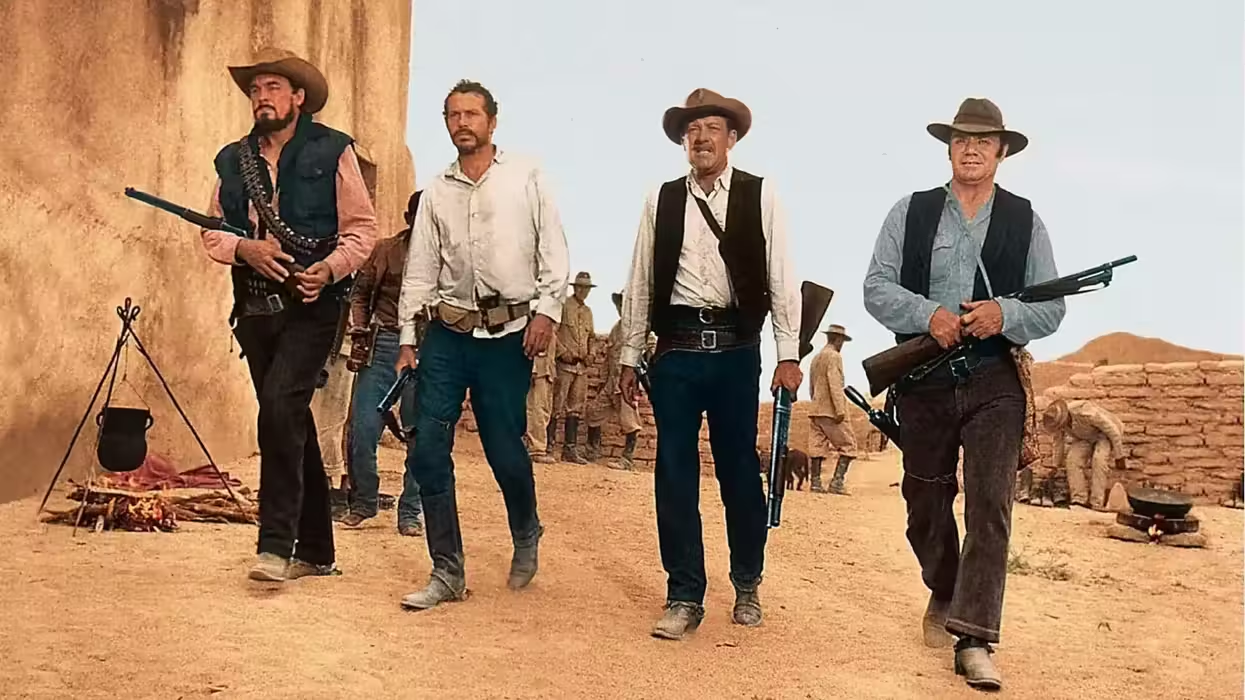
'The Wild Bunch'
American film owes a lot to the Western genre. It helped build the mythos of the country and also of Hollywood in general. Now, Westerns are mostly on TV, but there was a time when they helped film the transition through different periods and adapted alongside the country they represented.
From the silent era to the modern day, the story of the American frontier has served as a canvas for directors to experiment and audiences to reap the benefits.
Today, I want to talk about five Western films that changed the genre forever and also contributed something to filmmaking overall.
Let's dive in.
1. Stagecoach (1939) – Modern Visual Editing
- YouTube www.youtube.com
- Director: John Ford
- Writer: Dudley Nichols
- Cast: John Wayne, Claire Trevor, Thomas Mitchell, Andy Devine
- Editor: Otho Lovering, Dorothy Spencer
- Cinematographer: Bert Glennon
It feels like all Western movie history can be traced back to this one movie. Before Stagecoach, these films were seen as low-budget B-movies.
But when John Ford tackled this film, he pulled the reins and rode these cattle into something respectable and beautiful. Orson Welles famously watched Stagecoach more than 40 times while preparing to shoot Citizen Kane. He called it the ultimate textbook on film craft.
- Visual Deep Focus & Spatial Composition: Ford gave us what felt like the first super-wide establishing shots. And placed small subjects against vast landscapes to create a sense of scale and isolation within the story.
- Action Editing Rules: The famous climax, which features stuntman Yaqui Canutt jumping onto moving horses, sets a benchmark for continuity-driven action cutting.
2. The Searchers (1956) – Crafting the Anti-Hero
- YouTube www.youtube.com
- Director: John Ford
- Writer: Frank S. Nugent (screenplay), Alan Le May (novel)
- Cast: John Wayne, Jeffrey Hunter, Vera Miles, Ward Bond, Natalie Wood
- Editor: Jack Murray
- Cinematographer: Winton C. Hoch
By the mid-1950s, the Western hero was kind of played out. We had seen every clean-cut cowboy trying to tame the wild world. And many people had come home from war or were being sent to another one, and were more disillusioned about the America promised in the Western movies.
Enter John Ford again, ready to switch up what you believed a Western could be. He came back with John Wayne not as a happy hero, but as a jaded Civil War veteran exploring an America that was dangerous and that took everything from him.
The Searchers created one of the most complex character studies in cinema.
- Framing as Metaphor: Ford uses physical doorways to frame Ethan Edwards (Wayne) throughout the film, emphasizing his separation from different worlds. The iconic final shot that shows Ethan isolated outside the doorway as it shuts showcases a character fundamentally excluded from the civilization he fought to protect and to bring his niece back to, because of all the killing he's done.
- Complex Morality: Ethan is a deeply flawed ex-Confederate soldier driven by obsession and sheer anger. This shift laid the groundwork for complex anti-heroes across cinema. You can see direct influences from Martin Scorsese/Paul Schrader (Taxi Driver) and even in George Lucas (Star Wars).
3. The Good, the Bad and the Ugly (1966) – Extreme Close-Ups
- YouTube www.youtube.com
- Director: Sergio Leone
- Writer: Age & Scarpelli, Luciano Vincenzoni, Sergio Leone
- Cast: Clint Eastwood, Eli Wallach, Lee Van Cleef
- Editor: Eugenio Alabiso, Nino Baragli
- Cinematographer: Tonino Delli Colli
It's crazy that somewhere in Italy, there were a bunch of directors watching American westerns, and they decided to make their own, and those westerns are some of the best ever. In fact, they include a movie that many believe to be one of the greatest ever made, in The Good, The Bad, and The Ugly.
This spaghetti western, brought to us by Italian director Sergio Leone, brought an entirely new visual and sonic vocabulary that completely upended what we were seeing in Hollywood.
- Focal Cuts: Leone revolutionized tension through editing by cutting rapidly between wide establishing shots and extreme close-ups. We have this whirlwind climax where we get the Mexican Standoff from afar as well as eyes, holsters, and sweating faces.
- Musicology: Leone worked alongside composer Ennio Morricone to make the musical score part of the sound design. Morricone’s themes dictate the rhythm and pacing of the cuts. They carry the movie from scene to scene.
4. The Wild Bunch (1969) – Montage of Kinetic Violence
- YouTube www.youtube.com
- Director: Sam Peckinpah
- Writer: Walon Green, Sam Peckinpah, Roy Sickner
- Cast: William Holden, Ernest Borgnine, Robert Ryan, Edmond O'Brien, Warren Oates
- Editor: Lou Lombardo
- Cinematographer: Lucien Ballard
What's the most violent movie you have ever seen? For a long time, most people's answer to that question was The Wild Bunch. It was a brutal movie with an opening shootout that felt so ruthless and cold.
It gave a wild west no one had ever dared to show, one where human life was worth nothing. And it directly reflected the Studio System's collapse in the late 1960s.
- Multi-Camera Rhythmic Editing: Director Sam Peckinpah used multiple cameras running at different frame rates to capture chaotic gunfights, then cut them together to throw you off and make you feel the dizziness of being shot at from all sides. We saw people like John Woo and Quentin Tarantino use this later.
5. Unforgiven (1992) – The Genre Deconstruction
- YouTube www.youtube.com
- Director: Clint Eastwood
- Writer: David Webb Peoples
- Cast: Clint Eastwood, Gene Hackman, Morgan Freeman, Richard Harris
- Editor: Joel Cox
- Cinematographer: Jack N. Green
Outside of John Wayne, Clint Eastwood is probably the name people associate most with the Old West and Western movies. He was the author of so many of them, but they all had deep points.
As the West fell out of favor with audiences, Eastwood mounted his horse one last time to ride out and deliver this Oscar-winning masterpiece, which served as a eulogy for the genre. This is a film about the reality of violence and the toll it takes on a man to take someone else's life.
- De-Romanticizing Frontier Violence: Unforgiven strips away the spectacle of the shootout and makes it feel like a messy apology for peace.
- Subverting Genre Tropes: The film challenges the audience's desire for a heroic showdown and gives us a dark portrait of trauma, age, and regret. Sure, the bad guys get it in the end, but were there ever any good guys?
Summing It All Up
Western movies have made a helluva impression on Hollywood over the years. Even though we don't get the mas often now, it would be nice to see them come again to show us a story that feels like it resonates with today. The genre could use a real shakeup.
Time will tell if we get it again.
Let me know what you think in the comments.
- 6 Best Neo-Westerns Every Filmmaker Needs to Study ›
- The Western Genre in Film and TV (Definition and Examples) ›
- Story of the Rise, Fall & Wild Comeback of the Western Genre ›
- 5 Pathbreaking Revisionist Westerns That Redefined the Genre ›
- 5 Directors Who Changed the Western Genre Forever | No Film School ›