5 Directors Who Changed the Western Genre Forever
Five filmmakers whose arguments with the genre still shape it today.
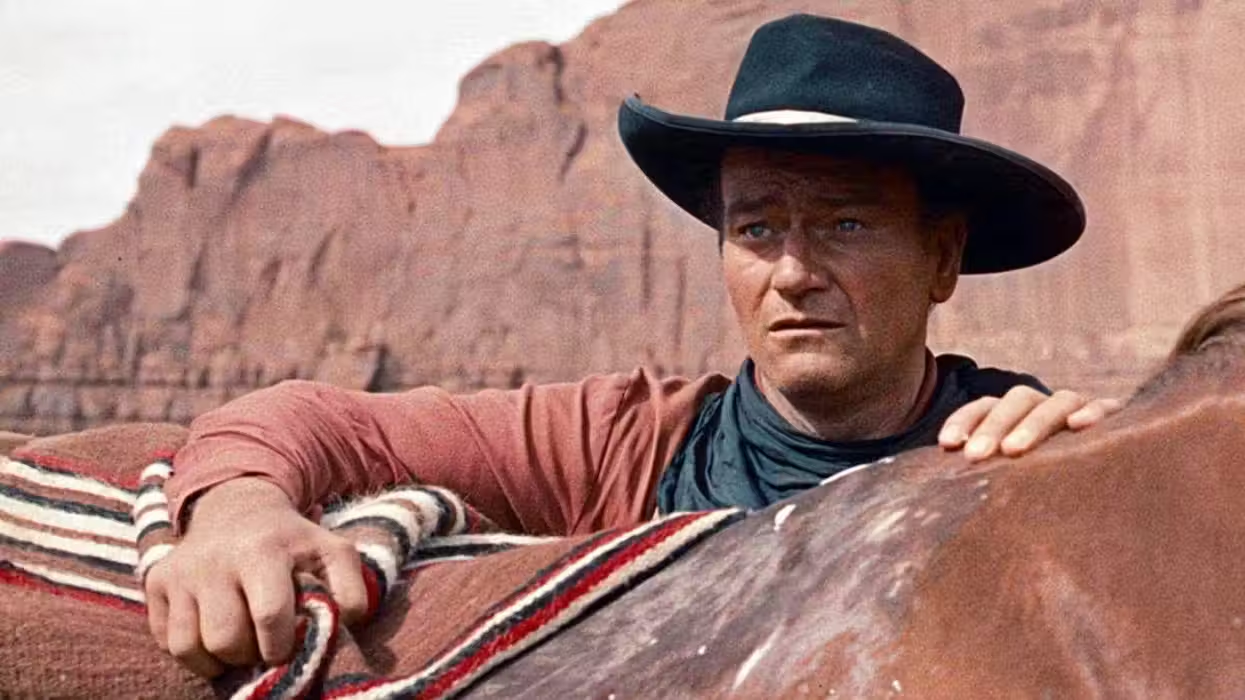
'The Searchers'
Many times over the years, the public has declared the Western genre dead and buried. There are no frontiers anymore, right? No need to tell stories about valiant lawmen fighting the enemies in black. No gold rushes, no wild horses, no high-noon standoffs.
But the love for the Western persists, and filmmakers keep evolving the genre into new shapes and putting stories in new settings with fresh characters, so it’s far from dead. It began as a platform for the American myth, but over the years we’ve seen the genre move across oceans to brand-new continents.
These five directors made that argument in different rooms and decades, and every Western made after them has their fingerprints.
We’re looking at this list as the filmmakers whose choices at the camera changed what a Western could do next. Each one did something new. Every one of them arrived at the material with a clear argument and used the camera to present that argument in exciting ways.
- YouTube www.youtube.com
John Ford
Where else would we start? This director created the visual grammar that everyone else either adopted or subverted. He was the one who made a landscape like Monument Valley a character. He crafted the whole romantic-then-melancholy arc across Stagecoach, My Darling Clementine, The Searchers, and The Man Who Shot Liberty Valance.
He’s a legend because he helped create the myth of the whole genre. He was iconic enough to introduce himself as, “My name’s John Ford. I make westerns.” This was stated to Cecil B. DeMille at a meeting of the Directors Guild of America, per BFI.
He was famously grumpy and practical about the actual work of directing. Elia Kazan wrote about Ford in A Life (via TV Tropes):
I was eager to have a long talk with Ford. I finally managed this and asked him how he got his ideas about how to stage a scene. “From the set,” he said. I didn’t understand what he meant. He was pretty grumpy that day, but I persisted. “Get out on the location early in the morning,” Ford said, “before anyone else is there. Walk around and see what you’ve got.” “Oh,” I said, “then look at the script and fit the scene into the location?” “No,” he growled, “don’t look at the fucking script. That will confuse you. You know the story. Tell it with pictures. Forget the words.” “What else?” I asked. “The actors,” he said. “Don’t let them act. Direct it like you were making a silent.”
Check out our favorite Ford works.
- YouTube www.youtube.com
Sergio Leone
You don’t have to be American to love the Western, which was the case for Sergio Leone, who made the genre his own. The Italian reappropriated an American form and handed it back as the Dollars trilogy plus Once Upon a Time in the West. He brought the action into extreme close-ups, used Morricone’s score for pacing, and reveled in moral ambiguity.
He said in 1987 (via American Suburb X):
"I was fascinated by all films, even the words of them. If I was to do a more-precise analysis of the situation, I have to admit that I was more entertained by the bad films than the good ones. Because when something is beautiful, it is there; it is finished; it is done. It doesn’t have to be touched or be worked upon. But if it is badly realized and not completely expressed, sometimes that is more provocative and interesting than when you see something that is perfectly and beautifully done."
Leone had never been to the American West when he made A Fistful of Dollars. The outside perspective helped.
- YouTube www.youtube.com
Sam Peckinpah
Now for the gritty realism of Peckinpah and The Wild Bunch. It was bloody, slow-motion, and shocking, and later became the template for directors like John Woo, Martin Scorsese, and Quentin Tarantino.
"We wanted to show violence in real terms,” the director told a shocked audience at one screening, per Roger Ebert. “Dying is not fun and games. Movies make it look so detached. With The Wild Bunch, people get involved whether they like it or not."
Peckinpah's argument was that a film's violence should hurt to watch. And the West wasn’t all fun and games, as he showed us.
- YouTube www.youtube.com
Clint Eastwood
The star of Spaghetti Westerns went on to make some of the genre’s best modern work. The genre had already been deconstructed by 1992, but Unforgiven was Eastwood turning his own screen legacy on its head and looking at what murder costs.
Dedicated to Don Siegel and Sergio Leone, the movie is Eastwood's own lineage catching up to him. He also directed High Plains Drifter, The Outlaw Josey Wales, and Cry Macho.
Eastwood said of Unforgiven (via Cinephilia & Beyond):
“I couldn’t tell you exactly why I wanted to make a Western again, because I didn’t have any reason to make one or not to make one; it wasn’t a decision that came out of a particular trend, there wasn’t any prior reason in fact, and that’s what made the project all the more exciting to me: I prefer to do things without giving myself a starting direction. So why a Western? That seemed to be the only possible genre the story was calling for, because in fact everything grew out of the story.”
- YouTube www.youtube.com
Kelly Reichardt
I’d argue Kelly Reichardt is one of modern cinema’s strongest and most thoughtful directors, period, and she’s worked across genres. Her neo-Westerns include Meek’s Cutoff and First Cow. Meek’s Cutoff is a female-centric story on the Oregon Trail, while First Cow trades gunfights for a milk-theft caper between a soft-spoken cook and a Chinese immigrant in 1820s Oregon.
"When I made Meek's Cutoff, I really felt the weight of the Western on me,” Reichardt told InsideHook. “I was working with bonnets, oxen, wagons, the whole thing. I felt like every time I set up my camera, I had to constantly ask myself the question, 'Am I in the footprint of the Western, or am I skewing that?' You have to keep mindful of what you're doing. The visual language of the genre is so strong. I didn’t really feel hampered by that on First Cow, though."
Genre is a visual language as well as a narrative language, which she let guide her on at least one project. She helped the Western become something quieter and more diverse.
If you made a Western, which example would you follow?