This 1997 Interview Explains Why Clint Eastwood’s Career Lasted So Long
How did he persevere as a director?
'Midnight in the Garden of Good and Evil'
Word broke to the film world this June that Clint Eastwood had decided to retire, according to his son Kyle, closing out a directing career that spanned 40 films and seven decades. This was originally reported in a Nov. 2025 interview with France Info (via Consequence).
That means that Juror No. 2, released in 2024, will stand as his last film.
This kind of longevity doesn't happen by accident, so we decided to look back at his career and see how he did it. In a 1997 press-tour interview he gave to Bobbie Wygant while promoting Midnight in the Garden of Good and Evil, he offers a few explanations for how he pulled off making the film and his career.
- YouTubewww.youtube.com
He Never Tried to Preserve Everything
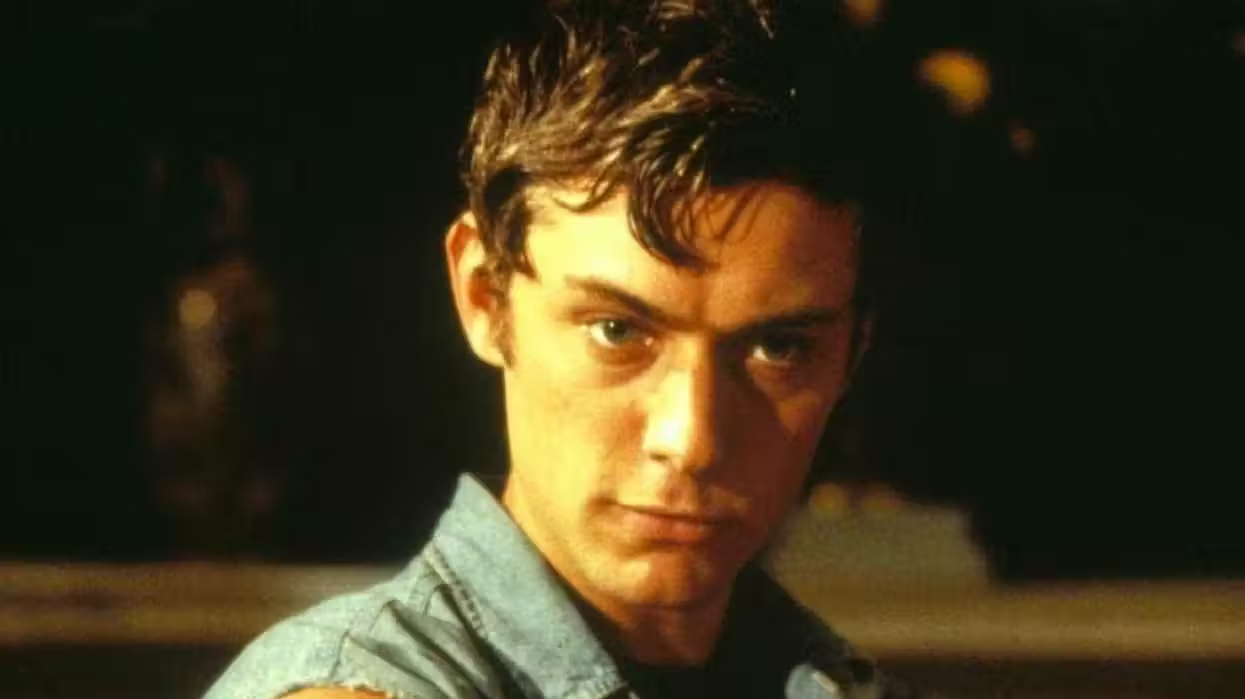
John Berendt's 1994 true-crime book Midnight in the Garden of Good and Evil is a non-fiction story about the 1981 shooting of male hustler Danny Hansford by antiques dealer Jim Williams in Savannah, Georgia. The film adaptation, directed by Eastwood, stars John Cusack, Kevin Spacey, Jude Law, and more.
Eastwood took on Berendt's sprawling, somewhat messy book, and he knew right away that if you try to keep every thread, the movie sinks. Screenwriters, take note, and cut ruthlessly if you’re trying to move a plot to the big screen.
Eastwood gave credit to the screenwriter who turned it into something they could capture on film.
"I think a lot of credit goes to the original material, but also to John Lee Hancock, who is also from Texas, I might say, our screenwriter, who interpreted it, did the translation. He did a very good job of translating it over, and it seemed to work," Eastwood said.
When asked about the process of adapting, he said he and Hancock worked together to make story decisions.
"We had quite a bit of film," he said. "I could have made the picture much longer, but this, I thought, was the proper length in the end result, and I had to try to balance it out so it didn't become just a courtroom drama or it didn't become just Savannah travelogue. At some point, you have to do a lot of balancing acts to get this out, to make it a movie, and you have to appeal also to people who haven't read the book."
This is the discipline a good adaptation needs. You don't owe the book a word-for-word copy, because that translation will usually not work for movie pacing. You owe the audience a movie that is cohesive and interesting. Sometimes that means cutting things readers loved. Eastwood did it with The Bridges of Madison County, and he did it again here. No hand-wringing required!
He Never Points to One Big Break
When asked to name the single moment that made his career, Eastwood wouldn't play along and give one.
"Everything in my life has been like that. If that hadn't happened, if I hadn't been there at that time, or done this or made that decision," Eastwood said. “I suppose early in the game, if I hadn't been someplace at the right time, I wouldn't have gotten Rawhide, a series that kept me occupied for six years or seven years. And if I hadn't gone to Europe to do a European interpretation of the American Western, this wouldn't have happened. And if I hadn't directed in 1970, Play Misty, I wouldn't be directing. Who knows?"
A TV show, a plane ticket to Europe, a first directing gig that could have flopped. Does that sound like a master plan? Or does it sound like a guy who just kept saying yes to what showed up?
Eastwood doesn't pretend he mapped any of this out.
"You pick different things, and you make decisions at a certain time in your life, and whether they're based on whim or whether they're based on some thought, in my case, mostly the prior, they just lead you in a different direction," Eastwood said.
He's saying the plan matters less than the willingness to move. If you're waiting for a perfect five-year strategy before you make something, just listen to Eastwood. He claims that his films and career decisions started with a whim, not a vision board. Although you’re more than welcome to do that, too.
- YouTube www.youtube.com
He Lets Go of a Film the Moment It's Released
Asked which of his own films he'd keep a single print of, Eastwood couldn't answer and explained why the question didn't really apply to him.
"Once I'm finished with the film, and it's released, it becomes not mine anymore, not my involvement. It's out there for other people to interpret, for better or for worse," Eastwood said.
In many cases, he said, he doesn’t even revisit his films after their release.
We’re not saying you have to be that dramatic, although plenty of filmmakers hate watching their project after they’re done (take Robert Eggers and The Witch). But the ownership thing, that's a boundary you should get used to. The cut you finish is the last thing you actually control. After that, the audience gets to decide what your film means. Eastwood sounds like he made peace with that long before this interview.
"I've just always been somebody who kind of lives in the present, and I figure the present and the future, where we're going, is where we are," Eastwood said. "Though it's fun to talk about the old days, you don't want to do that to a great degree because it takes away from the present."
For someone whose career just wrapped after several decades, that habit doesn't look like luck. It looks like the reason he kept making films for so long. Nearly 30 years after this interview, at 96, reports say he's finally stopped. But the instincts he described in 1997 are still the ones we can point to to explain how he lasted. Making a tight, accessible story, being open to opportunities, and not clinging to creative control or audience interpretation. It’s good to care about the craft, but it’s nice to be a chill director, too.
Have you seen this film?