The Coldest Line Clint Eastwood Ever Delivered in ‘A Fistful of Dollars’
“Get three coffins ready.” How, with a simple request, Sergio Leone traded traditional heroism for grit and created the ultimate anti-hero.
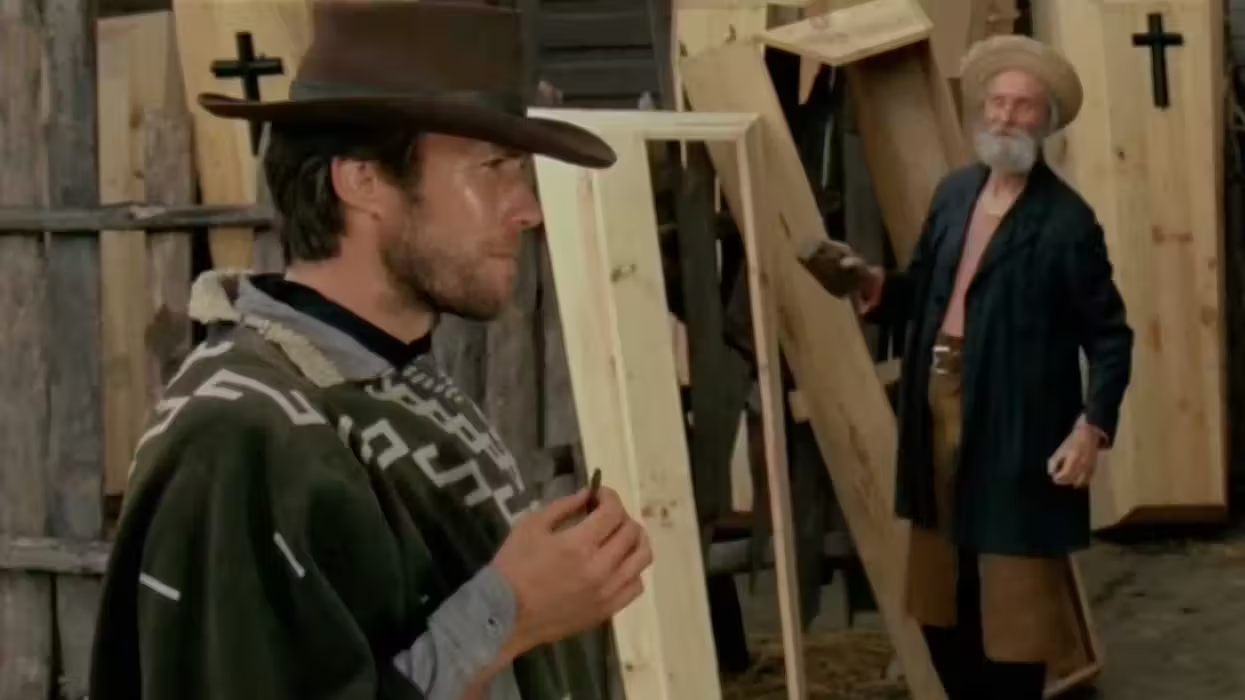
'A Fistful of Dollars' (1964)
Just like its sun-beaten atmosphere, San Miguel, a frontier town, bears the hot brunt of two feuding factions of goons. A nameless stranger offers to solve the problem in exchange for money. As a demo, he chooses three men who harassed him just a few minutes ago. He seals their fate, not through a dramatic proclamation, but in a cold demeanor that stands in stark contrast to his surroundings—with a funeral count.
And you can’t help but think that his cool, unruffled confidence is much more dangerous than the weapon he wields.
This scene from A Fistful of Dollars (1964) marks a pivotal moment in cinema, especially Westerns, as it transitions from the white-hatted heroes of the past towards a pragmatic and lethal anti-hero. The changed protagonist also changes his motive from justice to efficiency.
And this change matters far beyond its scene, as it impacted the entire genre of Westerns, in addition to defining Clint Eastwood’s career.
The Scene in Brief
A nameless stranger approaches the small frontier town of San Miguel. Even before entering, he witnesses a couple of peculiar details that suggest something is not right with the town. As he enters, a few goons harass him and fire shots at his horse, scaring the animal.
The stranger talks to the town’s innkeeper, who informs him that the town is embroiled in the “fight for control” between two smuggler families: the Rojos and the Baxters. The stranger sees this as a money-making opportunity and declares his availability to be hired for the job.
Then he walks towards the goons. On his way, he sees an old man making coffins. He matter-of-factly says, “Get three coffins ready,” and walks ahead toward the four men.
- YouTube The Rojos on one side of town, the Baxters on the other, and me right in the middle.
He coldly asks the men to apologize to his horse for firing shots at him. The men mock him again. The tension escalates, and before they can shoot him, the stranger kills all four of them in a second.
When he walks back and passes the coffin-maker again, he calmly says, “My mistake. Four coffins.”
The Death of the “Boy Scout” Hero
Subverting the Classic Tropes
Sticking to their “black and white” approach, the older Hollywood Westerns were defined by clear moral boundaries. You were either good or you were bad. The protagonist would usually be a “pillar of the community” who followed a strict moral code.
In this movie, however, the stranger is a mercenary, a hitman, someone who works for money. He has no lofty motives to “clean up the town for the sake of the law.”
For example, right before entering the town, the stranger witnesses a little boy being abused by a rough man. The man shoots in the boy’s direction as he runs away, scared and crying. The stranger only looks on curiously.
But when he hears about the feuding families, the first thing he remembers is, "Crazy Bill Ringer was right. There’s money to be made in a place like this.” Also, he follows up his subsequent proposition (to be hired) with an immediate side note: “I don’t work cheap.”
Put into perspective, the “three coffins” line is a calculated business move. He is keeping a “progress chart.”
The Poncho and the Poker Face
One important modification Eastwood brought to Westerns was a minimalist energy. He replaced the older, altruistic, dutiful, upright, honorable, and somewhat chatty cowboys with the one who maintained enigma through silence.
To be honest, he dresses kinda goofy; a poncho, but still, that doesn’t look out of place. He carries it well. And that poker face! After you have seen him, you don’t want to see emotions on that face, do you? That stoic face is half the magic. At most, he squints his eyes and chews his cheroot. That’s enough for me. His dialogues are sparse, and if he “has to” speak, he makes sure each word carries weight.
If you look at it, this line in context is effective because it is devoid of any emotion. He might as well be putting in a grocery order. And the fact that he is so casual around a situation where you might sweat and tremble (or, in my case, collapse) tells us—sorry, shows us—that he is a man to be feared.
Conclusion
You know the feeling, how with each new update, iPhones and Android phones get rid of “boxy” features and make their software look sleeker and more functional? That’s what happened here, but in the context of Westerns. It stripped away all the vanity and verbosity and turned a cowboy into a lean, mean killing machine that was entertaining on another level.
Sometimes, the most badass lines are not speeches. They are cool calculations and decisions. They are spoken once and never walked back.
- 10 Best Westerns of the 1970s: Ranked ›
- The Line That Made Clint Eastwood a Legend ›
- 10 Best Movies Starring Clint Eastwood, Ranked | No Film School ›
- Clint Eastwood’s Top 10 Must-Watch Directorial Hits | No Film School ›
- The ‘Dirty Harry’ Line That Made Clint Eastwood Untouchable ›
- 12 Lines That Made Clint Eastwood a Legend ›
- The Spaghetti Westerns of Sergio Leone - A Video Essay ›
- “I Reckon So”: Josey Wales’ Three Words of Steel in ‘The Outlaw Josey Wales’ ›
- “A Man’s Got to Know His Limitations”: The Power of Boundaries in Clint Eastwood’s Magnum Force ›
- Why This One Line in ‘Unforgiven’ Shattered the Western Myth Forever ›
- The Lethal “Mule” Gag: How ‘A Fistful of Dollars’ Introduced a Legend ›
- More Than a Threat: The "No-Nonsense" Irony of the "3 Coffins" Gag in ‘A Fistful of Dollars’ ›
- 6 Lessons from the 6 Films Clint Eastwood Loves Most ›
- Clint Eastwood Classic Became John Wayne's Biggest Regret ›
- This Interview Explains Why Clint Eastwood’s Career Lasted ›