What do Katy Perry, Charles Dickens, and the Bible have in common?
According to writer Mark Forsyth, they're all leaning on the same handful of ancient formulas or patterns of language that have been making memorable lines for millennia.
Forsyth laid out his case in conversation with David Perell, and while he's talking about poetry and pop lyrics, every device can also apply to dialogue, voiceover, and loglines. We've written about rhetorical devices before, so this is a great overview with some new ones thrown in, one device at a time.
- YouTubewww.youtube.com
Progressio
“Progressio” strings together a repeating pattern built on opposites. “This, then its reverse,” over and over, until the rhythm itself starts to carry meaning.
Dickens opens A Tale of Two Cities this way, and so does the "a time to weep, a time to rejoice" passage in Ecclesiastes.
For a screenwriter, this is a structure for a monologue or voiceover that needs to cover a lot of emotional ground fast. It also works as a scene-rhythm tool. Check out more on how dialogue rhythm drives momentum on the page.
Antithesis
Antithesis is the single building block progressio repeats. One idea is set directly against its opposite in the same breath. "You're hot, then you're cold" is antithesis. If you string several together, it becomes progressio.
In a script, antithesis is how you compress a character's internal conflict into one line instead of a paragraph of internal monologue you can't film. Two characters arguing from opposing worldviews (the kind of scene we broke down in Lonesome Dove's "it ain't dying I'm talking about") is antithesis playing out across an exchange.
Diacope
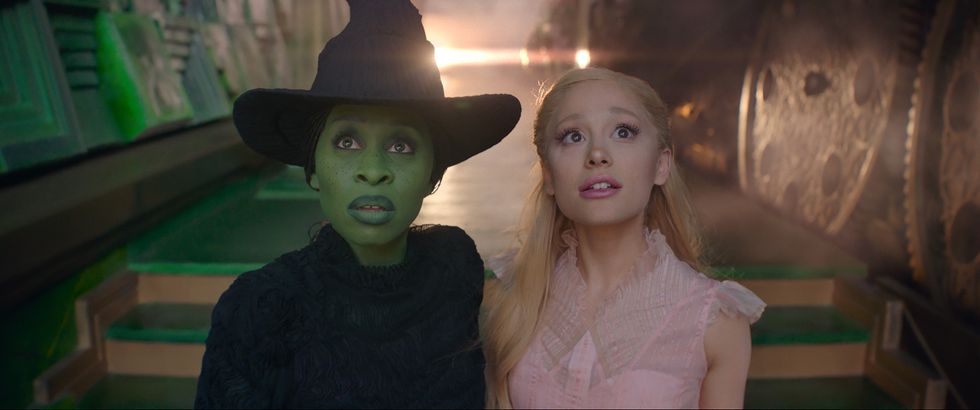
Diacope repeats a word or phrase with something else wedged in the middle. "Bond, James Bond" is the textbook case. Forsyth's favorite example is the Wicked Witch saying "fly, my pretties, fly" in The Wizard of Oz.
However! The line was never actually said. She only says "fly, fly, fly, fly," but diacope is such a strong pattern that audience's memory rewrote it. (The Mandela effect in action.)
Compare it with how the most-quoted movie lines tend to rely on repetition rather than novelty.
 Wicked Credit: Universal
Chiasmus
Chiasmus mirrors a sentence's structure in reverse across two halves. Say something, then say it flipped. JFK's inaugural address runs on it repeatedly.
In dialogue, chiasmus is the formula behind the line that sounds like a piece of wisdom the character has clearly said before, or one they arrive at in the moment and immediately believe.
Law professor Ward Farnsworth breaks down exactly how rhetoric like this can teach dialogue, with screenwriting-specific examples worth studying alongside Forsyth's.
Tricolon
Tricolon groups three things together. You know it—the rule of three. Three is the shortest sequence that reads to a listener as a complete thought moving toward a conclusion.
If your character needs to make a list, feel decisive and short, cut it to three items. It's part of the same toolkit as the other patterns in what rhetorical devices actually are and how to avoid overusing them.
Anaphora
Anaphora repeats the same word or phrase at the start of consecutive clauses or sentences. Churchill's "We shall fight" passage is a memorable example, along with MLK’s “I have a dream” speech.
For a script, each repetition raises the stakes of the one before it, which makes it a solid fit for a speech. It won’t sound the most natural in common speech unless the character is supposed to be pretentious or affected.
Epistrophe
Epistrophe is the opposite of anaphora. The repeated phrase lands at the end of each clause instead of the start. Where anaphora builds momentum, epistrophe builds inevitability. Each clause changes, but keeps arriving at the same place, which makes it effective for a character circling back to a conclusion they can't escape.
Farnsworth's breakdown, which we mentioned above, covers both devices side by side with film dialogue in mind.
 Star Wars: Episode V—The Empire Strikes Back Credit: Lucasfilm
Anadiplosis
Anadiplosis takes the last word of one clause and makes it the first word of the next. Think Yoda's "fear leads to anger, anger leads to hate.” It's a writing device to show causality as inevitability.
The same precision shows up in how Tarantino plans dialogue rhythm down to the phrasing.
Epanalepsis
Epanalepsis opens and closes a sentence, or a verse, with the same word. It starts where it ends, giving a line a sense of completion even when nothing is resolved. It's a strong option for a scene's final line.
The device works because repetition at both ends makes an audience register the distance traveled in between, which is part of why certain movie lines outlive the films they came from.
Isocolon
Isocolon pairs two phrases with matching grammatical structures. "To err is human, to forgive divine." The symmetry itself creates the sense of balance.
For a screenwriter, isocolon is useful anywhere a character needs to sound decisive or aphoristic without sounding rehearsed. Our dialogue-writing checklist covers other ways to build lines that land with this kind of precision.
Polyptoton
Polyptoton reuses the same root word in different grammatical forms within one line. For example, "Give us this day our daily bread." "Day" becomes "daily." It creates cohesion without literal repetition of “day.”
In a script, it's a subtle way to tie a recurring theme or object to a character's arc, the same idea returning in a new grammatical form each time. (Plus, what a fun one to say! Puh-LIP-toe-tahn.)
Adynaton
Adynaton is hyperbole built from a list of impossible things. "When pigs fly." “When hell freezes over.” It's a device for love, threat, or vow, anywhere a character needs to express something too large for literal language. It’s also a common way to inject humor into your writing because of its absurdity.
Periodic sentence
A periodic sentence holds its main verb back until the very end, stacking clause after clause before finally resolving the thought. Kipling's “If—” is built almost entirely this way.
For a filmmaker, this is a structural trick as much as a sentence-level one. Withhold the payoff and keep adding conditions, and the delay itself builds tension. It's the same instinct behind a script's first ten pages, holding back information to keep a reader leaning forward until you reach the inciting incident. Periodic sentences just do it at the level of a single line instead of scenes or acts.
- The Psychological Brilliance Behind Doc Holliday’s Iconic “I Have Two Guns” Response ›
- Screenplays Aren't Novels, So Stop Writing Them Like They Are ›
- This Law Professor Broke Down Movie Dialogue Better Than Most Writing Gurus ›
- What Are Rhetorical Devices? Examples That Make Ideas Stick ›
- Patrick Swayze's Monologue in 'Point Break' is Way More Poignant Than You Remember ›