The Psychological Brilliance Behind Doc Holliday’s Iconic “I Have Two Guns” Response
How Doc Holliday’s line, “I have two guns. One for each of ya,” in Tombstone (1993) defines his fearless persona on screen.
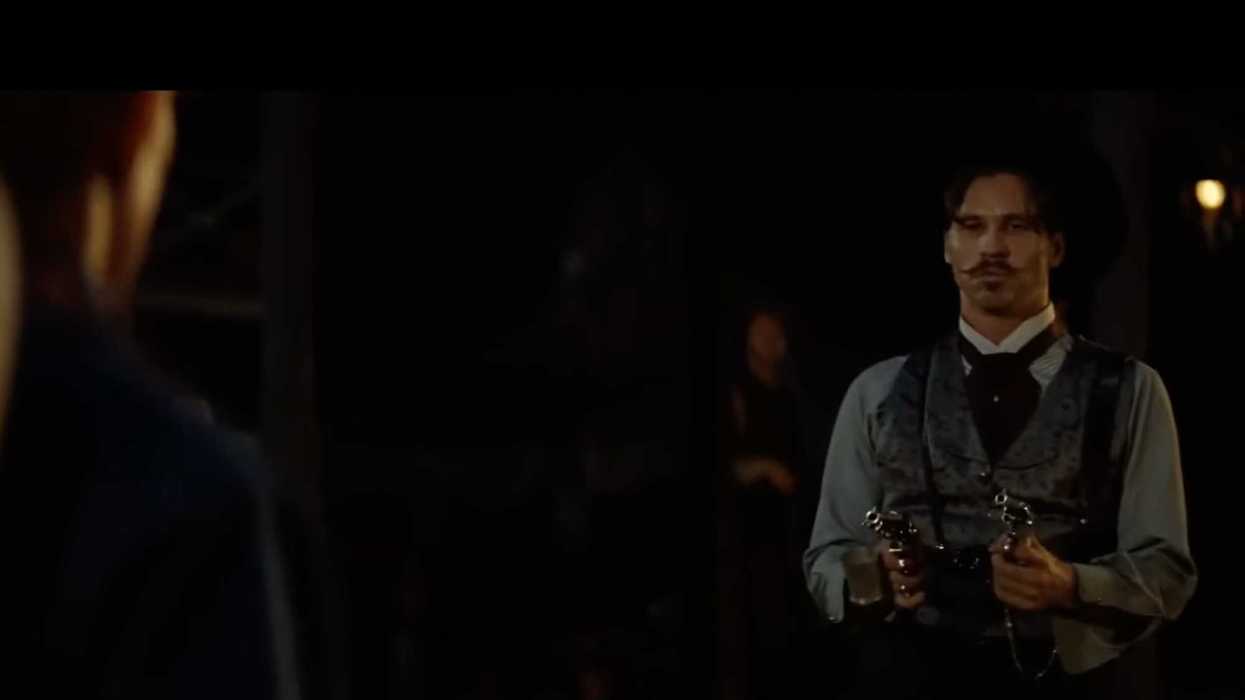
'Tombstone' (1993)
In Westerns (or any action films, really), it is expected of the protagonist to carry the “cool” effortlessly. Now, when we think of Westerns, we immediately think of John Wayne and Clint Eastwood, and for the right reasons. But, if we have to think about who carried that torch with the same precision during the fading wave of Westerns, then I have to say it’s Val Kilmer in Tombstone (1993).
Instead of trying to ooze cool or taking drastic pauses, he simply “gives an update.” “I have two guns. One for each of ya.”
There is no dramatic windup, no dramatic posture, no yapping about honor and justice. It’s very ordinary, and that’s what makes it special. It gives exactly what the scene needs: a sick gambler calmly informing that he has done the math and he is ready. The line has a hidden threat, but it’s more than that. It’s a declaration of presence.
Despite its mundane nature, the line has become quite legendary. Here, we are going to see why it resonates so deeply with the viewers.
The Context
The Scene
It’s the late 1870s. A violent gang of outlaws, “the Cowboys,” is rampant in the Pima and Cochise counties of Arizona. Wyatt Earp (Kurt Russell), along with his brothers Virgil (Sam Elliott) and Morgan (Bill Paxton), and an old friend, Doc Holliday (Val Kilmer), have settled in the town of Tombstone in Cochise County. Their past background as lawmen and peace officers has prompted the townspeople to expect them to get rid of the Cowboys.
One night, “Curly Bill” Brocius (Powers Boothe), the leader of the Cowboys, gets high on opium and starts shooting erratically in the streets. Marshal Fred White (Harry Carey Jr.) lawfully tries to contain him and confiscate his guns, but Curly Bill shoots him dead. Wyatt knocks him out. The villagers gather and demand that Curly Bill be hanged, while the Clanton brothers, Ike (Stephen Lang) and Billy (Thomas Haden Church), the members of the Cowboys, demand that he be let loose. Wyatt is in an ultimate standoff: holding down Curly Bill with one hand and holding Ike at gunpoint with the other, while Billy is still thinking of making the move.
Doc Holliday appears on the scene and aims his gun at Billy. Billy, however, doesn’t take him seriously. He mocks him, saying Doc is a drunk and is probably seeing double. This is when Doc removes another gun, both pointing at Billy, and says, “I have two guns. One for each of ya.”
The Logic of Seeing Double
Doc, the Drunk, and Billy, the Bully
Doc Holliday is shown to suffer from tuberculosis. During Victorian times, there was no cure available for it. The only option was the sanatorium regimen, which involved rest, fresh air, good nutrition, and high altitude. It was more of a “die peacefully” option, rather than a treatment. Considering Doc’s persona—a rugged gunslinger—it’s understandable (not justifiable) why he chooses to drown his miseries in alcohol instead of “traveling to high altitude” and die peacefully. That’s what defines the Western heroes, anyway. Doesn’t it? The masculinity and machismo. Well, here it is.
Be that as it may, Doc drinks constantly, and his health is in decline. And if there is someone who you can depend on for looking down on others, it’s the tyrants. Their defining qualities are that they are conceited and supercilious. And, being a member of the Cowboys, that’s what Billy is. A tyrant. A miscreant. So, it’s no wonder he makes fun of Doc and mocks him, saying he might be seeing two Billies instead of one. It’s a classic bully tactic: launching personal attacks to embarrass and demoralize someone in public.
Doc’s Witty Turn of the Tables
While Billy mocks his alcoholism, Doc deals with him like bullies need to be dealt with: by turning their own weapons against them. He denies neither Billy’s statement nor its logic; he leans into it. “Yes, I am a drunk, and yes, I see double. Happy?”
And then he gives it his own spin: “That’s why I carry two guns. One for the real Billy and the other for his ghost.“
Conclusion: Billy will die.
Defining the Fearless Persona
The Psychological Edge of the Gambler
In the scene, Billy is seen taking out his knife. You must know the adage: “Bringing a knife to a gunfight.” Well, Billy’s knife has significance here, not a literal one, but as a visual metaphor.
His opponent is wielding “wit,” while Billy has brought nothing but his conceit and vanity. So, there is no surprise that Doc uses his wit to dismantle Billy’s misplaced confidence. He accepts Billy’s “double vision” rhetoric and offers a literal solution: I have got two guns. I will simultaneously shoot both the real person and the optical illusion.
Only those who are comfortable with their mortality can find the comedy in a life-or-death situation.
Legacy of the Two-Gun Line
Doc Holliday has achieved a legendary status, not unlike Wyatt Earp himself. He has been portrayed in films, TV series, documentaries, songs, and other fictional and non-fictional content. But none is as well-known and as well-received as Val Kilmer’s version. It’s considered definitive.
Kilmer’s Holliday tells us that (in Westerns, at least) there is absolutely no need for a hero to be a stoic pillar of morality. He can be a drunk, he can stagger, he can have blurry vision and see double; it’s all good. Because, sometimes, a witty, dual-wielding gambler with a sharp tongue is all that a lawless town needs.
Conclusion
The 90s gave us quite a few iconic one-liners, and this “two-guns” line remains one of its highlights. It has been proven, time and again, that humor and threat go very well together. And it doesn’t hurt that the line shows a man turning his weakness into a tactical advantage. That’s always a winner.
Ultimately, it’s an empowering picture that says, “Be yourself, own it, and handle your bully with style and a bit of dark humor.”
- Read and Download the 'Tombstone' Script PDF | No Film School ›
- The Meaning Behind “Maybe Poker’s Just Not Your Game, Ike” in ‘Tombstone’ | No Film School ›
- What Does 'I'm Your Huckleberry' Mean From 'Tombstone'? | No Film School ›
- Did Kurt Russell Actually Direct 'Tombstone'? | No Film School ›
- 7 Most Iconic Lines From 'Tombstone' Ranked ›
- “You’re A Daisy If You Do”: How A ‘Tombstone’ Line Turned A Taunt Into Legend ›
- Walking Over Your Grave: Doc Holliday’s Deadliest Line in 'Tombstone' ›
- 10 Coldest “Before I Kill You” Lines in Cinema ›
- 7 Kurt Russell Movie Quotes That Define His Screen Legacy ›
- Decoding Doc Holliday’s “Terminal” Loyalty in ‘Tombstone’ ›
- Tombstone vs. Wyatt Earp: Two Westerns, One Legendary Showdown ›
- The 'Tombstone' Line That Became Timeless Wisdom ›
- The Wyatt Earp Line That's One of Cinema's Coldest Comebacks ›
- 13 Writing Formulas Every Screenwriter Should Know ›