The 40 Most American Movies of All Time: Your 4th of July Watchlist (Part 4)
Join us for a celebration of quintessentially American films.
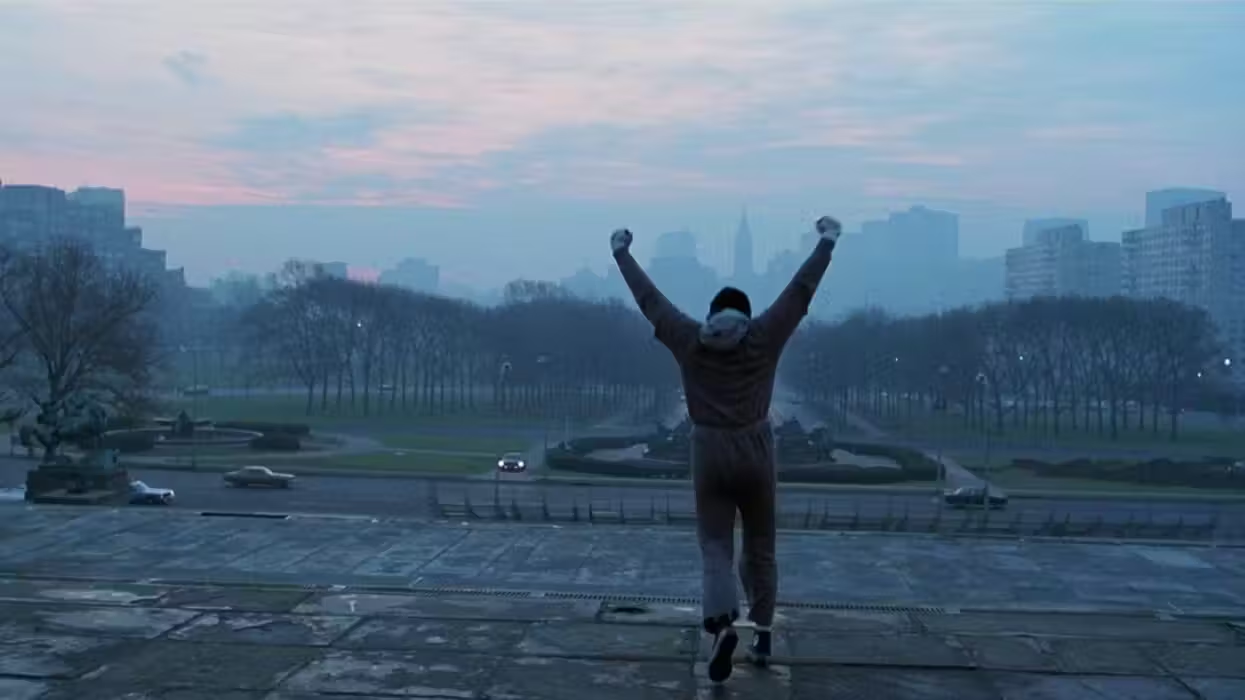
'Rocky'
It's the week of America's 250th birthday and almost the Fourth of July, so what better time to look back on some of cinema's most iconic films about our country and talk about what makes them part of our cultural quilt?
This whole week, we have been picking 40 films that we think shaped America as we know it. And we tried to only pick one movie from each director, so it was a challenge that drove us a little crazy.
We finally have our final ten; we picked them all in no particular order. They'd make a helluva watch list, thought.
Let's dive in.
Check out Part 1, Part 2, and Part 3!
Citizen Kane (1941)
- YouTube www.youtube.com
Everyone knows the story: Orson Welles was only 25 when he made this masterpiece. To me, this is the quintessential American movie, a rags-to-riches story about the meteoric rise and lonely fall of a media tycoon who can't buy back his youth or pay for happiness.
It was written by Welles and Herman J. Mankiewicz. They took inspiration from real-life press baron William Randolph Hearst, who was so furious that he tried to buy up and destroy every print of the film.
It is an incredible feat whose story and cinematography changed Hollywood forever.
The Godfather (1972)
- YouTube www.youtube.com
If I had to pick one movie to represent this country, it would be this story of immigrants, crime, and corruption.
It feels like one of those beautiful takes of what can only happen in this country, if you put your mind to it. We get the dark side of American capitalism via Francis Ford Coppola's eyes.
Coppola and co-writer Mario Puzo framed the Corleone family as corporate titans operating in a corrupt society where there really are no good people, maybe aside from Kay. This was not an easy movie to make. Coppola initially fought the studio on casting Marlon Brando and Al Pacino, two gambles that resulted in two of the best performances in Hollywood history.
"It seemed to me that Michael Corleone in the first Godfather, like America, started really with some ideals, freshness, and although he came from Europe, as America really was born out of Europe, there were these new ideals and new directions which was so inspiring," Coppola said in 1991.
Rocky (1976)
- YouTube www.youtube.com
It's hard not to buy into Rocky. We have a completely broke Sylvester Stallone writing a screenplay to save his own career. People read it and were obsessed, but he refused to sell the script unless he was allowed to play the lead.
“I just wrote about what I knew. I was writing about this little kind of mentally challenged guy who happened to have a lot of heart,” Stallone said of his early Rocky Balboa character to THR.
America was built on underdog stories, and our greatest movie about them is Rocky. It's against the gritty, blue-collar backdrop of pre-Bicentennial Philadelphia, so it's only fair we pull it back for the 250th.
The film struck a massive chord with a cynical, post-Watergate audience looking for something to believe in again.
And they have, all the way through all the sequels and spin-offs.
On The Waterfront (1954)
- YouTube www.youtube.com
A lot of the movies we tried to pick are mirrors at a certain time. The Hollywood blacklist and naming names are a scar on America, but out of that conflict, we got some great art that took those very ideas on and had contradictory feelings about them.
Maybe the best example of that is how Elia Kazan directed Budd Schulberg’s script about moral compromise on the docks of Hoboken, New Jersey. It is, in its heart, a movie about naming names, something Kazan did that much of Hollywood didn't like.
This is a complicated movie about an even more complicated world. At its center is Terry Malloy, played by Marlon Brando in a performance that permanently transformed acting.
He's a former prize fighter who "coulda been a contender" but instead runs errands for a ruthless mob boss controlling the longshoremen and his brother.
This movie is about standing up for your beliefs and doing the hard thing, even if it might cost you your life.
Badlands (1973)
- YouTube www.youtube.com
Terrence Malick’s debut feature takes a dark piece of Americana. It's based on a real story of a midwestern teenage killing spree that's rooted in that listless feeling that the country is not headed in the direction people want.
At its heart, the film unpacks the killers' childlike innocence. The acting in this movie is incredible. You get Sissy Spacek’s deadpan voiceover that highlights how easily the American media can twist horror into fantasy.
Like she says in the movie, "Kit and I were taken back to South Dakota. They kept him in solitary, so he didn't have a chance to get acquainted with the other inmates, though he was sure they'd like him, especially the murderers. Myself, I got off with probation and a lot of nasty looks. Later, I married the son of the lawyer who defended me. Kit went to sleep in the courtroom while his confession was being read, and he was sentenced to die in the electric chair. On a warm spring night, six months later, after donating his body to science, he did."
We also get Martin Sheen's detached demeanor, which uses his charisma to cast a spell on her and to drag her with him until the end.
It's a lyrical story about loneliness at the heart of America.
No Country for Old Men (2007)
- YouTube www.youtube.com
We all knew the Coen brothers were amazing directors when this came out, but this kind of put them on another level, one I'm not sure other young American directors have achieved since, maybe PTA.
This was Joel and Ethan Coen adapting Cormac McCarthy’s brutal novel into a modern Western that plays out like a grim postscript to the American myth of progress. It kind of says humans are done evolving, and now we're going to start picking each other off unless we pursue something pure.
You get Javier Bardem's chilling portrayal of Anton Chigurh. He's the proverbial unstoppable force who decides human fates with the flip of a coin. Juxtapose that against Tommy Lee Jones' moral conscience as an aging sheriff who no longer recognizes the world and now understands evil.
Chinatown (1974)
- YouTube www.youtube.com
There are so many great American movies; we chatted for a long time about what should be on there. And this was the first one everyone simultaneously agreed on.
You get Robert Towne’s Oscar-winning screenplay, taking us into the history of Los Angeles via private eye Jake Gittes. He gets pulled into a web of deceit that leads directly to the city’s water supply and the corrupt oligarchs who own the future.
I wish this movie weren't still so relevant!
The ending of Chinatown is so bleak, but director Roman Polanski delivers one of cinema's most devastating final notes. The movie is a masterpiece of paranoia. We see American systems manipulated by the rich in order to consolidate power.
Is it any different today?
Mr. Smith Goes to Washington (1939)
- YouTube www.youtube.com
Okay, so how do you pick one Frank Capra movie to represent America? We went back and forth because, really, Capra could have had like five movies on this list. But I figured the one about the United States government had to take the cake.
Jimmy Stewart delivers an iconic performance as Jefferson Smith, a hopelessly idealistic young patriot appointed to the U.S. Senate, only to discover that his political heroes are bought and paid for by corporate monopolies.
Again, I decry, why does this have to be so relevant, still?
You probably have seen clips of the climax, a grueling, exhausted 24-hour Senate filibuster, but you really should watch the whole thing.
Capra claimed in his autobiography that some senators walked out of the premiere, and a few even criticized the movie's public, but the public came to it, and it caused them to ask a lot of questions bout what life should be like here. And the movie was even banned in Hitler's Germany, Mussolini's Italy, and in Franco's Spain.
The Best Years of Our Lives (1946)
- YouTube www.youtube.com
William Wyler's masterpiece bypassed the triumphalism of WWII propaganda to explore the painful reality of psychological trauma and veteran homecoming. The film follows three soldiers from different social classes returning to the same Midwestern town, only to find themselves strangers in their own lives.
It's not easy for any of them, and we get the unfiltered version, as they even have a handicapped veteran in a starring role. It forced the general public to examine the price we pay to send citizens to battle.
Wyler himself went to battle to direct combat documentaries, and you can tell he loves these characters and the people on whom they're based. Gregg Toland’s deep-focus cinematography captures the emotional distance between characters, even when they occupy the same room.
We went in-depth on The Best Years of Our Lives in a full article.
Mudbound (2017)
- YouTube www.youtube.com
To me, this is an unheralded movie that would have been much bigger if it had gone to theaters. Dee Rees co-wrote and directed this sweeping adaptation of Hillary Jordan's novel. The story confronts the foundational rot of Jim Crow America. And I don't think many studios are brave enough to tell these stories, even though they are very necessary.
The story is set in the muddy, unforgiving Mississippi Delta during and after World War II, and it intersects the lives of white landowners and Black sharecroppers. They are tied together by the land and their futures, weaving in and out of conflict.
Rachel Morrison's historic, Oscar-nominated cinematography captures the suffocating weight of the dust and rain as a metaphor for racism and inequality.
Rees told Variety, “For me, inspirations were an artist named Whitfield Lovell, a contemporary artist, and there’s a sculptor named Mary Frank, who does a lot of things that unite bodies and landscapes.” She continued, “And then Rachel had Dorothea Lange and all these old WPA photos. We really kind of worked from there and wanted the film to feel very candid, very honest, in a way. We wanted the film to have a very moving-at-the-speed-of-life feel, so it doesn’t feel presentational or stagey, which can be the catch with a lot of period pieces.”