The Auteur Comeback: Why Movies Feel Like Movies Again
A YouTube video essay, a stalled merger, and Harry Styles walk into a bar.
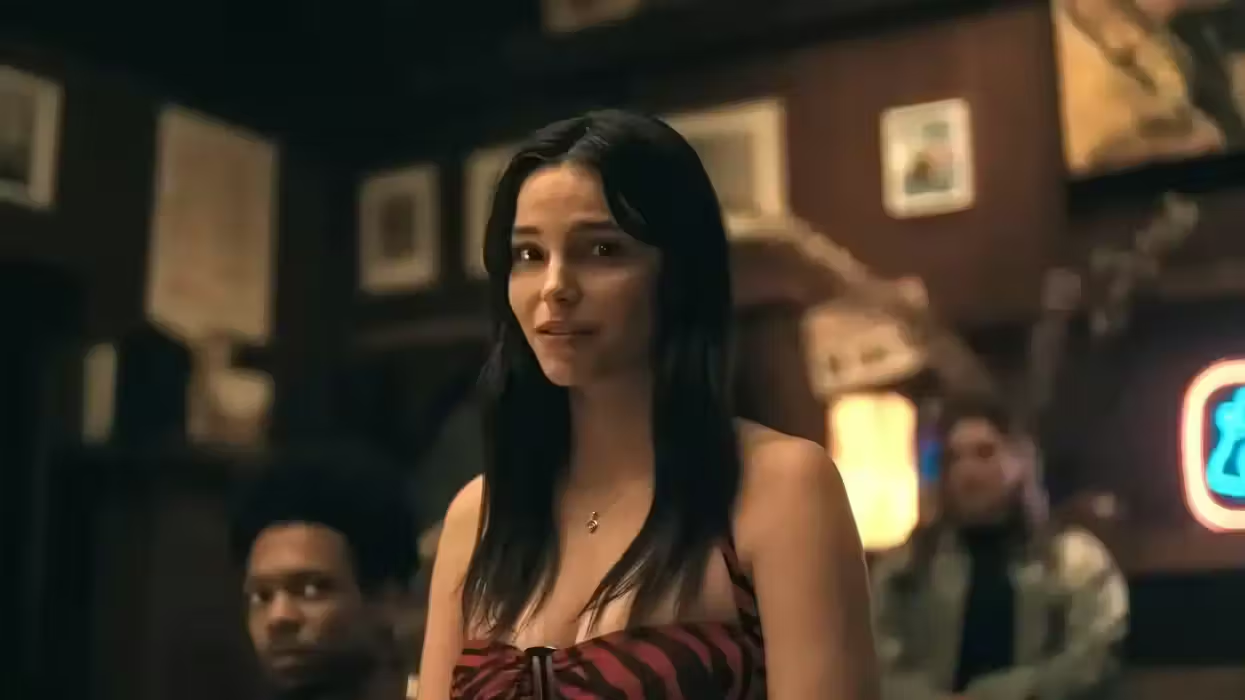
'Obsession'
Do you remember how fun the press tour for Don't Worry Darling was? Not the movie itself, just the press tour. I recall so vividly how dramatic the red carpet was when the film premiered at Venice, and with this year's Venice just kicking off this week, I was reminded of all that wonderful online discourse.
Years later, I'm still quoting star Harry Styles when he talked about working on the film. "My favorite thing about the movie is, like, it feels like a movie. It feels like a real, like, you know, go-to-the-theater-film movie," he said during one press call (via Newsweek).
It was not a deep quote or anything, and it was widely memed and mocked. But he is actually saying something here that I and many other cinema fans yearn for in film. I want a movie to feel like a movie. I want it to dredge up all the emotions that a visit to a theater can bring. Sometimes you go to a movie, and it doesn't feel like a movie.
Are we back in a time when movies feel like movies? Archer Green on YouTube thinks so. Let's dive in.
- YouTube www.youtube.com
Where Are We Now?
For years I've been dreaming of a time when indie films and audacious auteurs might be given their flowers and lifted above studio fodder like in ye olden times, aka the 1970s.
But check out what's been in theaters in the last couple of years. Christopher Nolan's The Odyssey, the first feature shot entirely on IMAX 70mm film. Ryan Coogler's Sinners. Curry Barker's Obsession, a $750,000 horror film that has out-earned almost every low-budget movie in history. Paul Thomas Anderson finally getting a big budget and turning it into One Battle After Another.
These are director-driven, big-swing films, and audiences are showing up in ways that don't fit the "superhero fatigue means people are done with theaters" narrative.
In the video, Green argues that Hollywood is at a crossroads between films built by directors and films optimized as content. Content, meaning units of viewable material engineered to hit metrics and eventually slot into a streaming grid. And that fear is founded after years of Netflix and Prime Video driving a lot of the action.
But then we're inundated. And everything tends to look the same, thanks to the overused look of what's been termed Netflix lighting.
I was just over at a friend's house, and we went through every streaming service looking for something to watch, until we finally landed on a 4K restoration of a Harry Dean Stanton movie I'd never even heard of, UFOria. It wasn't on streaming; it was a disc.
But are the tides turning? Maybe. Green's fear is that as Paramount Skydance tries to swallow Warner Bros. Discovery in a $111 billion merger currently paused by 12 state attorneys general, the studio most willing to say yes to the auteur bet could get folded into a machine that has already promised 30 theatrical releases a year.
This particular pipeline doesn't really favor a director with a weird vision or unique story. So the question filmmakers should be asking right now isn't "What's working?" It's, "What are we losing if this shift doesn't stick?"
Is the Marvel Machine Doomed or Not?
Green brings up Avengers: Doomsday as an example of what many see as moviemaking cynicism. The Russo brothers are back, Robert Downey Jr. is back (as Doom this time), the old X-Men are back. Every choice feels defensive, almost, rather than creative.
However, there's a counter. Spider-Man: Brand New Day, which just released.
Destin Daniel Cretton took a Sony/Marvel project that had every excuse to be autopilot content and delivered something contained, character-first, and shot with actual intention. Just read our take on why it plays to the MCU's most contained strengths.
It opened to $168 million domestically, the biggest opening day ever, per Variety. So when Doomsday opens Dec. 18 against Dune: Part Three in what many have been calling "Dunesday," I'm wondering if there's a possibility that the auteur infection is spreading, even inside the franchise world. We'll have to see.
- YouTube www.youtube.com
What Filmmakers Can Take from This Whole Thing
If you're an indie filmmaker, you're probably not interested in ticking boxes for a company and making content. But if you're worried you're in that territory, here are a few things to remember.
First, cinematography is a decision, not a spec. Movies like The Odyssey, Sinners, The Batman, and Obsession are all beautiful in their own way, and they involve a DP and director deliberately choosing contrast, texture, and format.
"The cinematography in all of these auteur-driven blockbusters is the opposite to the low-effort, bare-minimum ethos of the Netflix look," Green says.
You can think about this on any budget, using any camera. Get some contrast into your shots and consider how your choices support your story.
Second, you have to be able to feel that a person made the movie, not a machine. It shouldn't just tick boxes or feel algorithmic. That's the whole thing people are bumping on.
Coogler put off Black Panther 3 to make the vampire movie he'd been sitting on. Barker made a YouTube feature, released it himself, and showed what his voice was and that he could do it. Then he turned around and made a bigger movie, and did it well, and it's grossed over half a billion. Kane Parsons has been building the Backrooms universe on his own channel since he was 16. He did it for nothing at first, just because he wanted to. Now he's an A24 filmmaker.
Whatever the reason you're making your film, it has to show up on the screen. You need to care about the story; don't just hit beats you're told to. Cast the right people. Don't rush. Have fun, but also think about theme and emotion.
If a viewer can't feel why you specifically had to make your project, you're already losing the battle. Let your movie feel like a movie. Would a metaphorical Harry Styles be excited to work on your project? He should be.