How 'House of the Dragon' Pulled Off the Massive 'Battle of the Gullet'
All it took was Previz, Gimbals, and millions of gallons of water.
'House of the Dragon'
Game of Thrones has always been an ambitious show, not afraid to film some of the biggest battle scenes you have ever seen.
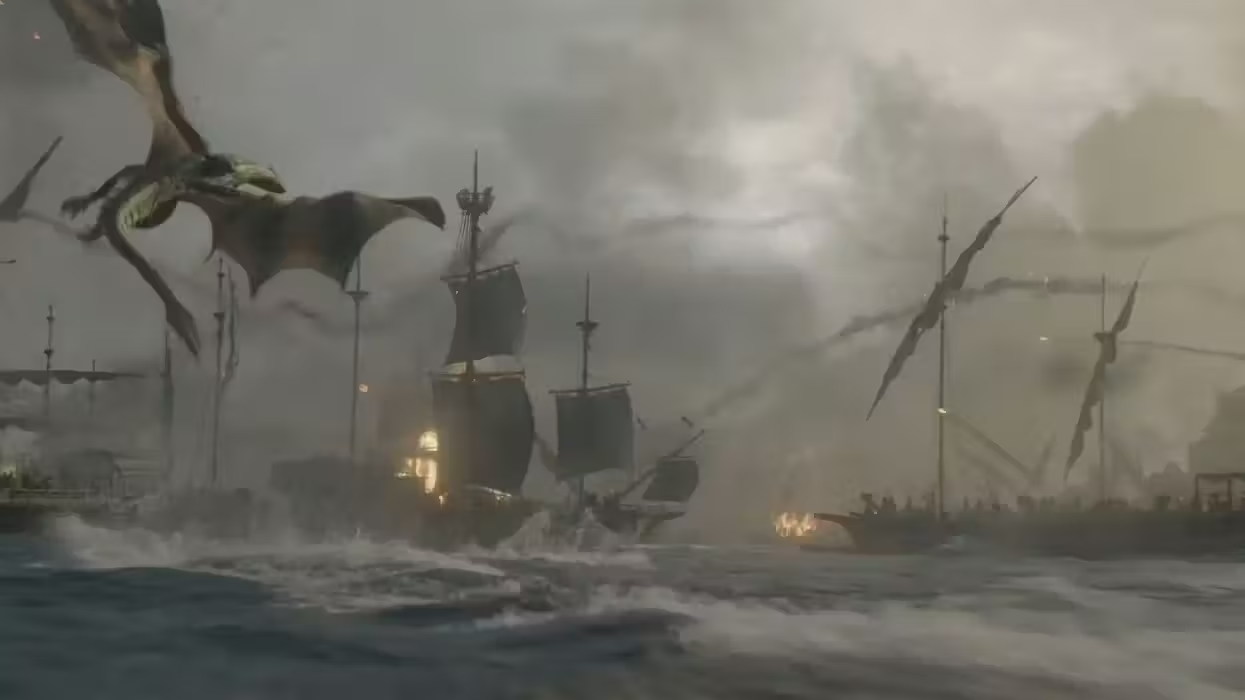
But this past Sunday, in the House of the Dragon spinoff, we got one of the biggest battles anyone has ever done on TV, and this one takes place entirely on the water.
In a recent behind-the-scenes featurette for the House of the Dragon Season 3 premiere, the HBO production crew broke down exactly how they brought the infamous Battle of the Gullet to life.
And spoiler alert: it was really hard!
Let's dive in.
- YouTube www.youtube.com
Ground the Chaos in Multi-Theater Previz
When an action sequence has dozens of moving parts, you cannot just show up on set and "wing it."
You want to have a plan moving forward and get people all on the same page so things can be shot efficiently and safely.
Showrunner Ryan Condal and his directing team approached the Battle of the Gullet by structurally dividing it into three distinct storytelling "theaters" and then using previz to plan each of them down to the smallest details.
- The Aerial Theater: The dragon riders (Jace, Baela, and Rhaena) are navigating the airspace.
- The Sea Theater: Corlys Velaryon, Alyn, and the Triarchy forces clashing on the waves.
- The Point-of-View Character Arcs: Grounding massive spectacle in specific, emotional character losses (like Jace's tragic descent).
The production took each of these theaters and then animated them before a single camera rolled. They brought the editorial team into the fold and locked down the pacing to ensure that the choreography of the digital dragons seamlessly intersected with the practical action happening on the ship decks.
We actually do this a lot on commercials, so there are no wasted shots, and you can be rendering the effects while shooting the practical stuff, too.
Dry Tank vs. Wet Tank
The House of the Dragon team took inspiration from some crew members who worked on James Cameron's Titanic. These are people who know how to film something out on a massive oceanscape.
They dug two massive holes on their backlot to create a dual-tank system. Each of them provided the crew with a different way to shoot things.
The Dry Tank
To capture the wide shots of a 125-foot flagship navigating rough ocean waters with over 100 background actors on deck, they built the vessel inside a "dry tank" mounted on a massive rolling sea gimbal.
If the camera is mounted on the moving ship, the motion appears visually flattened. To create the illusion of intense transit and heavy waves, the crew kept the cameras off the ship and let the massive structure pitch and roll from bow to stern across the frame.
The Wet Tank
I know this seems crazy, but when characters are physically interacting with water, it has to be wet. For close-up combat, crashing waves, and sinking ships, they moved to a wet tank filled with water.
The production actually built a below-deck set that mechanically submerged on command, forcing the actors to fight in chest-deep water.
Because of strict safety protocols for cast and crew, the production had to pump and filter 6 million liters of water daily through massive on-site silos.
Don't Hide from Practical SFX
The thing I admire most about this show is that they do not shy away from doing things practically, and it makes the world feel real.
Even with dragons spitting fire, the stunt team executed a 10-man practical fire burn directly on the rigging and dressing of a moving ship.
Every burn was kept to a strict 10-second count, with safety teams strategically camouflaged within the set dressing, ready to smother the flames the moment "Cut!".
It made those big scenes pop.
Use Your Specialized Tech
A show like this has a lot of money and a lot of cool gear, and they used all of it for this sequence.
They also employed some cool strategies to keep it grounded and real, too.
Rather than framing tightly on an actor already seated on a dragon, they physically built boulders, handholds, and stirrups onto the side of the mechanical buck, which they used to fake the dragonback flying.
This allowed the actors to physically climb up the dragon's side in-camera during a single, continuous shot.
And when it came to the underwater scenes, they played with a gimbal in cool new ways.
See, mechanical gimbals are strictly designed to stay dry. But the dragons were designed to get hit and to sink. So these gimbals had to be in the water with them.
The team engineered a specialized, waterproof variant capable of thrashing, tilting, and submerging the actor completely underwater to capture real, terrifying jeopardy.
They were then able to simulate a dragon drowning and dragging its rider under and get that visceral worry and fear.
The Takeaway for Filmmakers
The Battle of the Gullet works because the spectacle never suffocates the performance. We get all the human stories up front, and the spectacle is like the icing on the cake.
I mean, even watching the behind-the-scenes, I still care about all the people, even as I'm in awe of the dragons and ships and waves and epicness of everything in the forefront.
It makes me excited for where this show can go in the future.
Let me know what you thought of the battle in the comments.