What if the future isn’t bright, but bleak?
That’s the question dystopian films keep dragging back to the table. No utopias here, just broken systems, dead cities, and futures run by fear, tech, or both. These stories tap into the anxiety beneath the surface. What if the worst-case scenario isn’t fiction, but a forecast?
These films matter because they challenge power. Whether it’s governments, corporations, or ideologies, dystopian films ask who’s really in control and what happens when we stop questioning them.
The best dystopian films build worlds that feel lived-in and eerily possible. They drop us into collapsing societies, force impossible choices, and leave us wondering what we’d do in the same situation.
This list brings together 13 of the most unforgettable entries in the genre. They may not predict the future exactly, but they definitely make us think twice about where we’re headed.
1. Metropolis (1927)
Written by: Thea von Harbou
Directed by: Fritz Lang
In a towering city split by class, the workers toil below ground while the elites float in privilege above. When Freder (Gustav Fröhlich), the son of the city’s ruler, discovers the grim lives of the laborers, he teams up with Maria (Brigitte Helm), a prophetic figure calling for unity, only to be thwarted by a robot doppelgänger, class sabotage, and a near-collapse of the system.
Metropolis remains essential because it established the visual language of science fiction cinema. The geometric skylines, human conveyor belts, and eerie machine-Maria became foundational elements that filmmakers still reference today. Lang’s vision was so ahead of its time, even modern directors still crib from his visual grammar.
A filmmaker watching Metropolis today learns that style and message can go hand in hand. If you’re going to critique the system, do it with grandeur.
2. A Clockwork Orange (1971)
Based on the novel by Anthony Burgess
Written and Directed by: Stanley Kubrick
Alex DeLarge (Malcolm McDowell) leads a gang of ultra-violent delinquents in a grim future Britain where moral decay meets state repression. After a string of crimes, Alex is captured and subjected to an experimental "rehabilitation" program that turns him into a passive shell of himself.
Kubrick's film remains one of the most unsettling portraits of free will ever put on screen. Drenched in stylized violence, satirical wit, and eye-searing aesthetics, it’s a dystopia not through destruction, but through forced morality. The Ludovico Technique is psychological warfare. Kubrick handles it with clinical detachment that only sharpens the discomfort.
Kubrick's dystopia doesn't rely on ruined cities or obvious decay. Instead, he questions whether eliminating crime is worth destroying free will, a more subtle but equally disturbing vision of societal collapse.
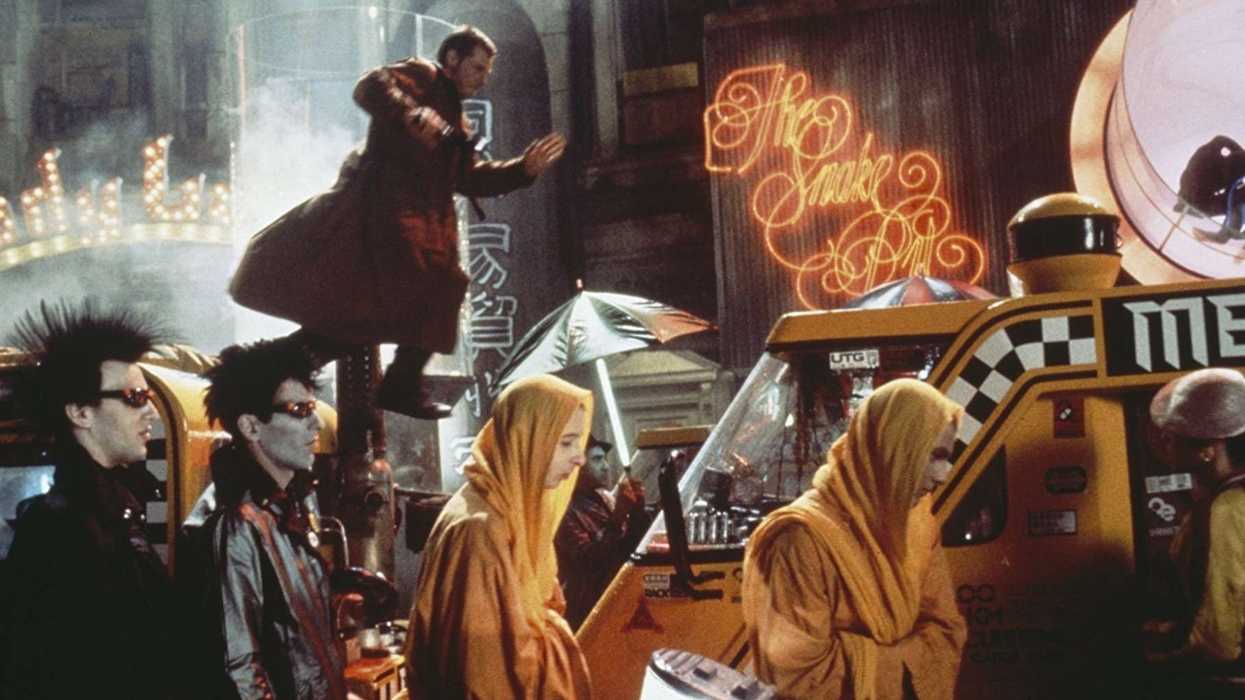
3. Blade Runner (1982)
Based on the novel by Philip K. Dick
Written by: Hampton Fancher, David Peoples
Directed by: Ridley Scott
In a rainy, neon-lit Los Angeles, former cop Rick Deckard (Harrison Ford) is pulled out of retirement to hunt rogue replicants—synthetic humans who’ve escaped from off-world labor colonies. But as he tracks them, especially the introspective Roy Batty (Rutger Hauer), the lines between man and machine begin to blur.
Ridley Scott's Blade Runner defined the cyberpunk aesthetic while redefining what science fiction could feel like. Haunting synths, decaying high-rises, moral ambiguity—it’s not a future you want to live in. The final monologue by Batty wasn’t even in the script; Hauer improvised the now-legendary “tears in rain” speech.
If you're crafting a dystopia, Blade Runner tells you how to create the atmosphere. It teaches you that mood is a vital part of worldbuilding. Not every answer needs to be clear, but every shot should make you feel something.
4. 1984 (1984)
Based on the novel by George Orwell
Written and directed by: Michael Radford
Winston Smith (John Hurt) lives in a gray, oppressive world where the Party watches everything, rewrites history, and punishes even the thought of rebellion. When Winston begins a secret affair with Julia (Suzanna Hamilton), he briefly tastes freedom—only to learn that in Oceania, there’s no such thing.
Michael Radford’s adaptation strips away spectacle in favor of bleak precision. Shot in the actual year Orwell prophesied, it’s a film drenched in despair. Hurt’s haunted performance makes Winston’s quiet resistance feel seismic. And Richard Burton, in his final role as O’Brien, embodies the cold logic of totalitarianism with terrifying calm.
This film drives home a crucial storytelling point: sometimes, less is more. For filmmakers, 1984 is a reminder that horror can be bureaucratic, and the scariest villain might be the one who thinks he's saving you.
5. Brazil (1985)
Written by: Terry Gilliam, Tom Stoppard, Charles McKeown
Directed by: Terry Gilliam
Sam Lowry (Jonathan Pryce), a low-level bureaucrat with big dreams, gets tangled in a nightmarish labyrinth of paperwork, mistaken identity, and rogue air ducts in a surreal future where the government is incompetent, paranoid, and endlessly inefficient.
Gilliam’s Brazil is a dystopia with a dark sense of humor and a warped sense of logic. Inspired by Orwell but dripping with Monty Python absurdity, it turns paperwork into warfare. Gilliam fought Universal's studio interference, even taking out newspaper ads to protest their edits. The director's cut ultimately won Best Picture from the LA Film Critics Association, vindicating his vision.
What’s the takeaway? Don’t be afraid to blend tones. Gilliam shows that satire can bite as hard as tragedy.
6. Fahrenheit 451 (1966)
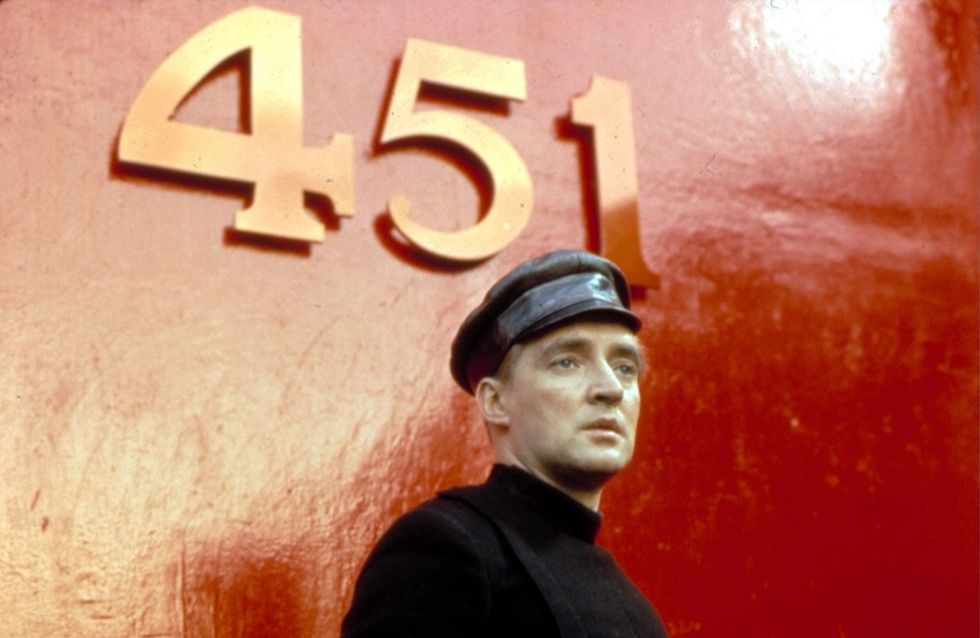 'Fahrenheit 451'Credit: Rank Film Distributors
Based on the novel by Ray Bradbury
Written by: François Truffaut and Jean-Louis Richard
Directed by: François Truffaut
In a society where books are banned and burned, Guy Montag (Oskar Werner) is a fire fighter whose job is to ignite the banned material. But after meeting the curious Clarisse (Julie Christie), he starts to question the system, falls in love with forbidden knowledge, and risks everything for a future that might never come.
Truffaut’s adaptation is quieter than you’d expect—but deliberately so. Instead of explosive action, it leans into melancholy, with long takes and a haunting Bernard Herrmann score. It’s dystopia through the lens of the French New Wave.
For creators, Fahrenheit 451 is a lesson in restraint and resonance. If you’re building a world where words are dangerous, make every one of them count.
7. Children of Men (2006)
Based on the novel by P.D. James
Written by: Alfonso Cuarón, Timothy J. Sexton, David Arata, Mark Fergus, Hawk Ostby
Directed by: Alfonso Cuarón
In 2027, the world has lost the ability to reproduce. Nations have collapsed, and refugees are caged like animals. Theo (Clive Owen), a jaded bureaucrat, is roped into protecting Kee (Clare-Hope Ashitey)—a miraculously pregnant woman—and smuggling her to safety through a crumbling Britain.
Alfonso Cuarón's direction doesn’t flinch. Long takes, handheld chaos, and apocalyptic backdrops pull you into a world that feels one bad year away. The infamous single-shot car ambush and the building raid were so logistically complex that they’ve become textbook examples of immersive filmmaking.
8. V for Vendetta (2005)
Based on the graphic novel by Alan Moore and David Lloyd
Written by: Lana and Lilly Wachowski
Directed by: James McTeigue
In a fascist Britain ruled by propaganda and fear, Evey (Natalie Portman) is saved by V (Hugo Weaving), a masked vigilante who speaks in Shakespearean riddles and explosives.
V for Vendetta blends political revolution with superhero spectacle. The Wachowskis' script sharpens Alan Moore’s graphic novel into something cinematic, radical, and unusually eloquent. Its iconic imagery (Guy Fawkes masks, the “Remember, remember” chant) has been adopted in real-world rebellions from Occupy protests to Anonymous.
What creators can draw from this is how myth and politics can collide. A dystopian narrative, when done right, can move beyond the screen and into the streets.
9. Snowpiercer (2013)
Based on: Le Transperceneige
Written by: Bong Joon-ho, Kelly Masterson
Directed by: Bong Joon-ho
After a climate catastrophe renders Earth a frozen wasteland, the last of humanity survives on a perpetually moving train. At the back: the poor. At the front: the elite. When Curtis (Chris Evans) leads a revolt through the train cars, each section reveals a new layer of social rot, and a devastating truth at the engine.
Bong Joon-ho turns a high-concept premise into a relentless class war on wheels. Tilda Swinton delivers a brilliantly grotesque performance as a deluded bureaucrat.
Use your setting to tell the story. Snowpiercer shows what confined world-building looks like—no exposition dump needed.
10. Battle Royale (2000)
Based on the novel by Koushun Takami
Written by: Kenta Fukasaku
Directed by: Kinji Fukasaku
In near-future Japan, society is crippled by youth rebellion. The government passes the BR Act: one randomly selected high school class is sent to a remote island and forced to fight to the death until only one survives. Shuya (Tatsuya Fujiwara) and Noriko (Aki Maeda) must navigate this nightmare, dodging death and friendships turned lethal.
Before The Hunger Games, there was Battle Royale. Fukasaku's direction is raw and chaotic, with handheld camerawork and jarring tonal shifts that mirror the absurdity of the premise. The film shocked Japan's establishment and was nearly banned in several countries, yet it struck a nerve globally and earned cult status.
11. Akira (1988)
Based on Manga by Katsuhiro Otomo
Written and Directed by: Katsuhiro Otomo
In post-apocalyptic Neo-Tokyo, biker gang member Tetsuo (Nozomu Sasaki) acquires telekinetic powers after a government experiment goes wrong, threatening to tear apart the city and reality itself. His friend Kaneda (Mitsuo Iwata) races against collapsing order, rogue scientists, and the echoes of an older catastrophe named Akira.
Otomo's Akira revolutionized animated filmmaking within the dystopian genre. The animation quality was unmatched in its day, and the film’s dystopian scope, blending body horror, politics, and philosophy, still stuns. Neo-Tokyo is a cyberpunk megalopolis that influenced everything from The Matrix to Inception.
Filmmakers often think “animated” means “less serious.” Akira crushes that assumption. It’s a reminder that dystopia is a tone, not a medium.
12. The Road (2009)
Based on the novel by Cormac McCarthy
Written by: Joe Penhall
Directed by: John Hillcoat
After an unspecified cataclysm, the world is gray, cold, and empty. A father (Viggo Mortensen) and his son (Kodi Smit-McPhee) travel south across the ruins of America, scavenging for food, dodging cannibals, and clinging to a last thread of morality.
The Road achieves its power through restraint. Hillcoat shoots in desaturated tones that make every tree, sky, and roadside feel lifeless. The performances are raw and unguarded. Without a manipulative musical score, the film's emotional impact largely stems from the performance and imagery.
What makes this film essential for creators is its emotional core. It proves you don’t need an elaborate setup or visual effects to make a dystopia terrifying.
13. Gattaca (1997)
Written and directed by: Andrew Niccol
In a near-future society where genetic engineering determines your worth, Vincent (Ethan Hawke) is a “natural-born” trying to infiltrate the elite space program reserved for the genetically perfect. With borrowed DNA from Jerome (Jude Law), Vincent beats the system—but not without sacrifices, secrets, and a daily war against his own biology.
Niccol’s Gattaca is sleek, sterile, and eerily plausible. The production design is minimalist but symbolic; everything is “clean” and curated. In a world obsessed with perfection, Law’s bitter performance as a “valid” who’s lost everything is tragic.
For science fiction filmmakers, Gattaca demonstrates how to create a compelling dystopia through low-tech, high-concept storytelling. The film succeeds by presenting a terrifyingly logical extension of current genetic science.
Conclusion
Dystopian films compel us to look harder, rather than offering an escape. They confront what happens when systems fail, when power goes unchecked, when people stop caring. These 13 movies are warnings drawn from the present.
Their strength lies in discomfort. They challenge us with questions about control, survival, and the cost of progress. And even when the world ends, they ask, “What kind of people will we be when it does?”
- Making her Dystopian Sci-fi World a Reality: Danishka Esterhazy on How She Finally Made ‘Level 16’ ›
- 'Black Mirror': How Directors Joe Wright and Owen Harris Built Dystopian Worlds That Look Like Our Own [PODCAST] ›
- Finding Heartfelt Dystopian Satire With 'Future Date' ›
- Can't Get Enough 'Black Mirror'? Watch These Dystopian Sci-Fi Shorts ›
- 'Station Eleven' Avoids This Dystopian Storytelling Trope (And Is Better For It!) ›
- All The Best Movies of 2025 Are About Our World Crumbling Around Us ›
- The Single Line That Made ‘Gattaca’ the Ultimate Film About Grit ›
- 10 Greatest Sci-Fi Movie Characters to Ever Grace the Screen ›