7 Most Unforgettable Interrogations Ever Put on Film
When words hit just as hard as fists.
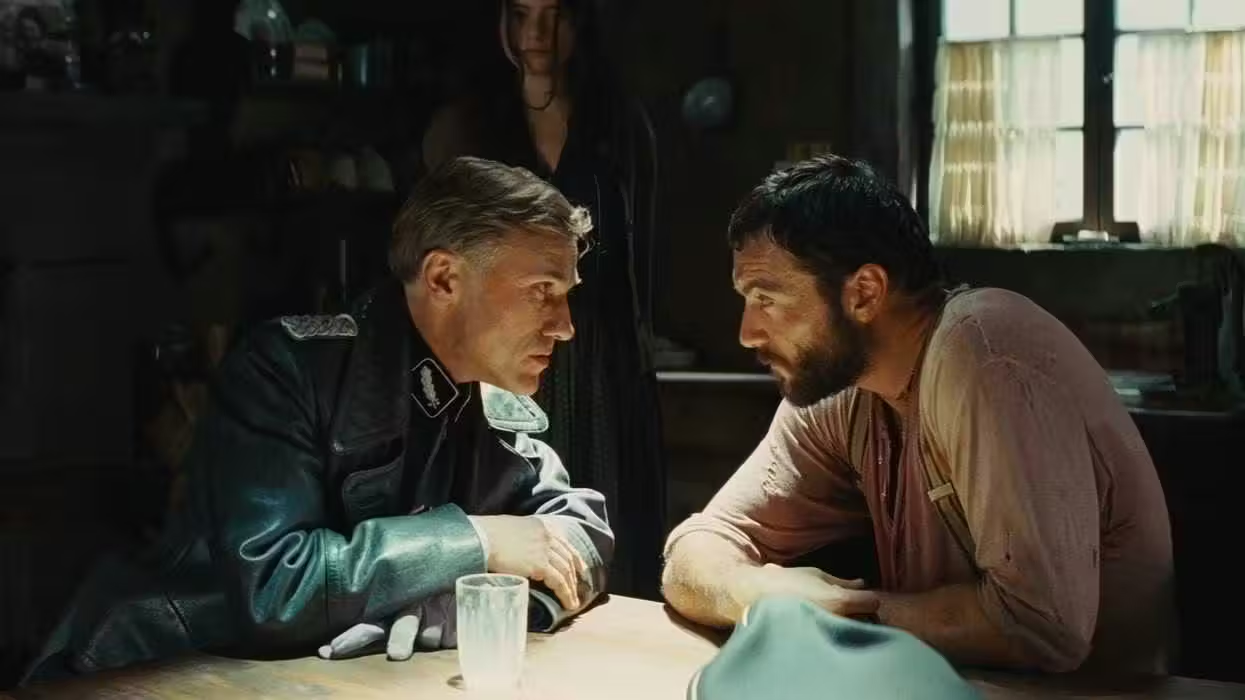
Inglourious Basterds (2009)
A good interrogation scene is like a cage fight with words.
The atmosphere tenses up, the air grows thick with tension, and the weight of every word, every chosen silence, feels heavy and powerful. The question of what comes next looms large as movie characters battle it out by playing their cards close to the chest.
You want a conclusion, but you also want to stay in that room and feel every bit of the pressure.
Here are seven interrogation scenes that stay with you.
7 Best Movie Interrogation Scenes
Here are seven absolutely unforgettable interrogation scenes from movies.
1. The Dark Knight (2008) - Directed by Christopher Nolan
- YouTube www.youtube.com
Everyone remembers the metal table in Gotham’s holding room, with the Joker on one end and Batman, in full armor, on the other. The Joker, played effortlessly by the late Heath Ledger, laughs and mocks Batman (Christian Bale) throughout the scene. Batman demands that the Joker reveal the location of Harvey and Rachel, while initially only looking for Harvey.
Every time he refuses, Batman delivers a hard blow. Nolan builds the atmosphere to be tense and claustrophobic, allowing two of the finest actors to do what they do best. The Joker’s philosophy comes through brilliantly in this scene, and his refusal to budge continues to make him terrifyingly likable.
The physical and mental chaos multiplies over the course of this interrogation. Hans Zimmer’s terrific background score is a big reason for how well we perceive the scene’s increasing exhilaration. The dialogue is continuously sharp, decisive, and iconic.
One of my favorite lines from this scene is Batman saying, “Why do you want to kill me?” and the Joker laughs, in his typical, maniacal manner, and says, “I don’t want to kill you. What would I do without you?”
2. Inglourious Basterds (2009) - Directed by Quentin Tarantino
Tarantino’s exceptional opening sequence in this film is a lesson in building cinematic suspense. Colonel Hans Landa, played by Christoph Waltz, visits a dairy farmer’s family, looking for hiding Jews. Landa’s undeniable charm hides his unforgiving brutality. He enters the farmer’s house, takes his time by toying with his pipe and drinking fresh milk. His tone is friendly, but suspensefully dark.
With every moment, the tension builds further. We know something bad is going to happen, but we don’t know what it is. As the farmer realizes that his secret is no longer a secret, his eyes moisten with tears, and the tightness of the scene reaches its peak.
Politeness meets terror to create a lethal combination that you aren’t quite prepared for, so early in the film, but it sets the tone for Landa’s character and for the film, going forward. Landa’s multilingual mastery, put forth by the brilliance of Christoph Waltz, adds a strangely satisfying quirkiness to the scene and makes it more unpredictable.
Even though this intense sequence culminates in gunshots, the entire sequence itself feels like a gun battle. Tarantino’s writing, coupled with his direction and Christoph Waltz’s breathtaking performance, makes this scene one of the greatest opening scenes in recent memory.
3. The Usual Suspects (1995) - Directed by Bryan Singer
- YouTube www.youtube.com
This iconic interrogation takes place in a cramped, smoky LAPD office. Verbal Kint, played by Kevin Spacey, is a limping, fragile criminal, at least to our knowledge. Detective Dave Kujan interrogates Kint, who is vulnerable and seemingly harmless.
Verbal spins a story so effortlessly that we, or Kujan, can't know that it is even a story. He picks up details from around the room, jumbles them together in solid detail, hooking us in a fictitious tale of Kyser Söze, a criminal of legendary status.
What I love most about this scene is how disinterested we are, as an audience, in Kint’s storytelling, until we are hooked, because we’ve been conned, just like the Detective. As Kujan learns that he has been taken for a ride all this time, he drops his coffee mug, and he is baffled in disbelief, while one of cinema’s favorite con artists walks away freely. The genius, visual storytelling aspect of this scene is a lesson in how the most obvious details often hide, literally, in plain sight.
Spacey masterfully embodies the transformation, becoming the legend he told tales of, and in the scene following this interrogation, pulls off a world-class disappearance. Unlike the other examples in this list, this particular interrogation scene feels rather routine until the end, when the audience realizes that it was anything but.
4. Heat (1995) - Directed by Michael Mann
Before we get into why this scene is one of the finest interrogation scenes of all time, we have to understand what a big deal it was (and is) to have two legendary actors together in a scene of this nature. Robert De Niro plays Neil McCauley, a master thief, and Al Pacino plays Vincent Hanna, the police man who wants to catch him and stop him.
To have both these actors in an interrogation scene with each other was a treat for global audiences, and it remains a treat today. The power and impact of the scene are elevated by these two men playing these characters.
Now, getting to the importance of the scene, I think Michael Mann’s choice of placing this scene in a restaurant and not a typical interrogation room amplifies the chaotic and tense nature of this exchange. While people move about around them, the two men are stuck together in a conversation that is led by Hanna, as a warning to Neil. The scene is brimming with an overriding emotion of two men competing with each other, but not even for a second does their mutual respect falter.
Both men lay their philosophies bare. Family, freedom, and the 30-second rule:
“Don’t let yourself get attached to anything you are not willing to walk out on in 30 seconds flat if you feel the heat around the corner.”
Even though the scene is short, it deservedly became the most iconic scene from the film simply because of how raw and hesitation-free its pressures were.
5. True Romance (1993) - Directed by Tony Scott
In this darkly humorous scene, written by Quentin Tarantino and directed by Tony Scott, the tension builds along with the humor in a surprising manner. Clifford Worley, played by Dennis Hopper, sits handcuffed and knows he is most likely going to die.
Vincenzo Coccotti (Christopher Walken) leans in and asks Clifford about his son. What follows is an initially polite and subtle conversation about Sicilians and Moors. Clifford injects his words with exponentially increasing racial venom that is darkly amusing.
Two master actors deliver a timeless exchange in a scene that, in a definitive Tarantino way, increases the pressure with every second. Tarantino’s words are like daggers covered in sheaths of humor and rage.
Walken’s anger burns through every smirk and every smile. Meanwhile, Hopper’s willingness to, in some sense, die with his head held high, is weaponized by his use of humor at such a conflicting moment.
6. Se7en (1995) - Directed by David Fincher
In this Fincher classic, which raised the bar for serial killer movies in many ways, John Doe, played by Kevin Spacey, is interrogated on the way to an undisclosed location. From the very beginning of the film, we are taken through the dark, tormented madness of a broken criminal mind.
This scene is a culmination of all of that. A moment where viewers want answers but only get more questions. Brad Pitt’s Detective Mills and Morgan Freeman’s Detective Somerset take different tones.
Mills’s anger and frustration are understandable considering his age and inexperience. However, they reach a peak at this point, where he cannot control his consistent jibes at Doe, who remains calm and easy, leaving us more agonized with every facial expression. His dialogue delivery, which is almost layered with boredom, makes this a uniquely terrifying interrogation scene.The interrogation is almost half-hearted because the detectives are desperate to get to the location. But in that half-heartedness is a curiosity and exceptionally dark suspense that keeps tightening its grip on us, topped off with one of the most disturbing endings in film history.
7. The Silence of the Lambs (1991) - Directed by Jonathan Demme
- YouTube www.youtube.com
It’s difficult to make a list of the greatest interrogation scenes without mentioning The Silence of the Lambs. In this scene, FBI trainee Clarice Starling walks through a long corridor of jail cells. She stops at the last one.
Dr. Hannibal Lecter, played by Anthony Hopkins, stands motionless in the centre. Clarice offers Miggs’s attack as leverage, but Lecter counters her with a quid pro quo game. He goes on to dissect her childhood in a soft, polite, but daunting tone. Intimidated, Clarice tries to remain composed, but Lecter turns each question back at her.
The glass wall serves as a strong metaphor for a man who is caged yet controlling, dominant, and able to express himself seamlessly. Hopkins’ stillness in this scene amplifies the terror. It commands attention, respect, and even fear.
The scene is petrifying but compulsively watchable. It turns an interrogation into a chess game. Each line is delivered like a chess move, precise and calculated. Like in every good interrogation scene, you do want to know who comes out on top, but most importantly, you want to be there, for every moment, when it happens.
Final Thoughts
The fiercest battles in cinema aren’t necessarily action scenes. Some of them happen in closed rooms or in restaurants. In a jail cell or in the back of a car. Long after the credits roll, you are still thinking about these moments, and many of them live long in your memory.
What are some of your favorite interrogation scenes? Tell us in the comments below!