6 Best Movie Adaptations of Sci-Fi Novels
From Dune to Blade Runner, these films brought sci-fi classics to life.
'Dune'
Filmmakers face a unique challenge when adapting science fiction novels for the screen. While it might seem straightforward (the story already exists, after all), the reality usually proves more complex.
Books and films serve different purposes. Literature invites readers to imagine worlds, characters, and technologies through the use of descriptive language. Cinema, however, must show these elements directly.
Science fiction novels often feature vast, intricate worlds and cutting-edge technologies that strain production budgets and effects technology.
Every reader brings their own mental image of characters, settings, and technology to a beloved novel. Filmmakers must create one definitive version that satisfies diverse audience expectations while staying true to the source material's core themes.
Despite these challenges, some adaptations succeed brilliantly. The following six science fiction films demonstrate how skilled filmmakers can overcome technical limitations and translate literary works into cinema.
6 Best Movie Adaptations of Sci-fi Novels
1. Denis Villeneuve’s Dune (2021)
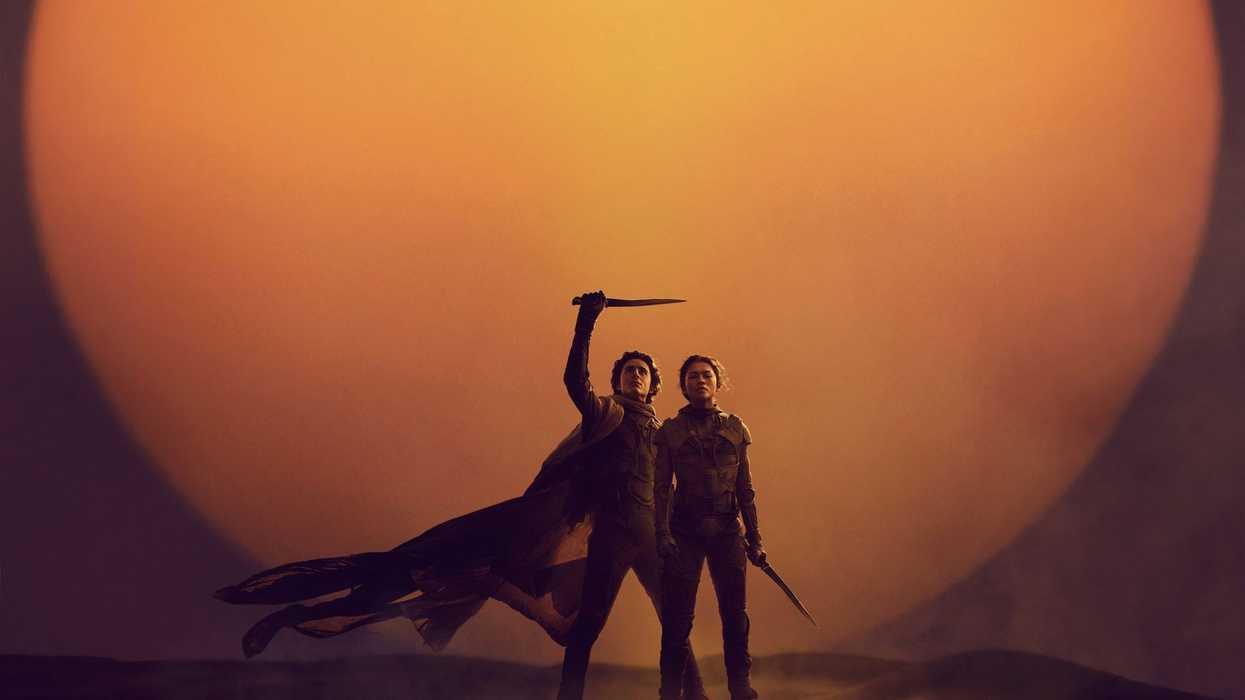
The Dune franchise is based on Frank Herbert’s 1965 sci-fi novel. Set in a distant future, it follows Paul Atreides, who moves with his family to the desert planet Arrakis to oversee its valuable spice. They fall prey to a devastating conspiracy. Paul’s arc is a classic hero’s journey, but with a tragic twist.
Denis Villeneuve’s adaptation of Dune (2021) features Timothée Chalamet as Paul. The franchise examines the dangers of charismatic leaders, illustrating how society’s yearning for saviors can lead to disastrous consequences.
Villeneuve’s adaptation is praised for capturing the spirit and thematic depth of Herbert’s work.
2. Ridley Scott’s The Martian (2015)
Based on Andy Weir’s novel, Ridley Scott’s The Martian follows astronaut and botanist Mark Watney (Matt Damon), who is stranded on Mars after his crew is forced to leave him behind. Watney fights to survive on Mars by using his scientific knowledge to grow food and create water. He is rescued after nearly two years of isolation.
Scott’s adaptation is largely faithful to the novel, striking a balance between scientific details and emotional storytelling. The book delves deeply into the technical minutiae of Watney’s survival tactics. Scott condenses and simplifies these scientific explanations to keep the science engaging.
The Martian is lauded for translating the novel’s core themes of ingenuity, resilience, and optimism into a visually compelling and emotionally resonant cinematic experience. The film demonstrates how a story rich in technical details can be transformed into a thrilling cinematic experience centered on human emotions.
3. Stanley Kubrick’s 2001: A Space Odyssey (1968)
A classic piece of cinema widely misunderstood upon its release, Stanley Kubrick’s 2001: A Space Odyssey revolutionized the world's perception of science fiction movies, and today, it is hailed as one of the greatest science fiction films ever made.
Kubrick has significantly modified Arthur C. Clarke’s narrative. Discovery One, the spaceship, travels to Jupiter instead of Saturn (per the novel). Kubrick ditched Saturn as it was becoming quite challenging to render Saturn’s rings with the special effects of the time.
Kubrick deliberately steers clear of explaining the science in too much detail. He compensates for the ambiguity with heavy emotional subtext, showcasing complete trust in the audience’s emotional and philosophical curiosity. At the same time, 2001 employs minimal dialogue, inviting viewers to contemplate at every step.
2001 is celebrated for its visual grandeur, open-endedness, and sensory storytelling.
4. Steven Spielberg’s Jurassic Park (1993)
Adapted from Michael Crichton’s sci-fi thriller, Jurassic Park centers on an island theme park that features genetically engineered dinosaurs. Things get out of hand when a disgruntled employee sabotages the system, leading to a security breach.
Spielberg focuses on simplifying the idea for his audience while interweaving emotional beats, keeping us on the edge of our seats at all times. The filmmaker seamlessly distills the novel's core themes, including the illusion of control, chaos theory, nature’s power, and ethical genetic engineering.
Despite notable modifications to the original narrative, Spielberg ensures that his adaptation remains accessible to all audiences and doesn’t dilute its essence.
5. Ridley Scott’s Blade Runner (1982)
Ridley Scott’s adaptation of Philip K. Dick's Do Androids Dream of Electric Sheep is not a literal adaptation, but rather an interpretive one, quite unlike his adaptation of The Martian.
Scott made extensive modifications to the original narrative. Unlike the novel, which is set in post-apocalyptic San Francisco, Scott’s neo-noir is set in a dystopian 2019 in Los Angeles.
The narrative follows Rick Deckard (Harrison Ford) as he hunts down bioengineered replicants. Deckard becomes infatuated with Rachael (Sean Young), a replicant who believes she is human.
Scott omits several key elements from the narrative, including Mercerism, a synthetic religion, and heavily relies on ambiguity, as he uses Rachael to drive the plot forward. Unlike the novel, which is satirical and philosophical, Scott’s Blade Runner is an action drama.
6. Doug Liman’s Edge of Tomorrow (2014)
Doug Liman’s westernized adaptation of Hiroshi Sakurazaka’s novel All You Need Is Kill exemplifies how to adapt a novel effectively for mainstream cinema. Liman ditches the novel’s introspective and psychological tone, opting instead for a mix of action and suspense elevated by dark humor.
Edge of Tomorrow follows Major William Cage (Tom Cruise), a military PR officer who is forced to fight on the frontlines in a war between humanity and an alien species called the Mimics. Cage dies as he kills an Alpha Mimic, but the exposure to alien blood traps him in a time loop, forcing him to relive his last day over and over again.
Cage utilizes the time loop’s repetition to hone his combat skills and gain knowledge of the enemy, eventually teaming up with war hero Rita Vrataski (Emily Blunt) to take down the Mimics once and for all.
In the original novel, the Japanese protagonist kills Rita. Liman changed the ending from bittersweet to uplifting, with Cage destroying the Omega and resetting the timelines to save everyone.
Edge of Tomorrow presents a straightforward and effective adaptation of a sci-fi novel’s high-concept premise, steering clear of the novel’s ambiguity, and following character arcs that resonate with the audience.
Which is your favorite film in the list?
- Deconstructing the Science Fiction Genre in Movies and TV ›
- 75 Science Fiction Writing Prompts To Rile Up The Future ›
- 4 Lessons from Eric Heisserer on Writing Science Fiction ›
- How to Fix One of Science Fiction's Most Pesky Problems, Relatability ›
- From 'Alien' to 'Blade Runner': 3 Sci-Fi Aesthetics and How to Create Them ›
- 10 Movies That Are Actually Better Than the Book ›
- 10 Greatest Sci-Fi Movie Characters to Ever Grace the Screen ›
- Two Words That Still Define ‘The Lord Of The Rings Trilogy’ 20 Years Later ›
- Why “Imagine What You’ll Know Tomorrow” Is The Smartest ‘Men In Black’ Line ›