Here’s Why the Canon EOS C50 is Going to Change the Game for Videographers
Featuring a newly developed 7K Full-Frame CMOS sensor and 3:2 “Open Gate” sensor mode, the Canon EOS C50 might just change the professional videography industry as we know it.
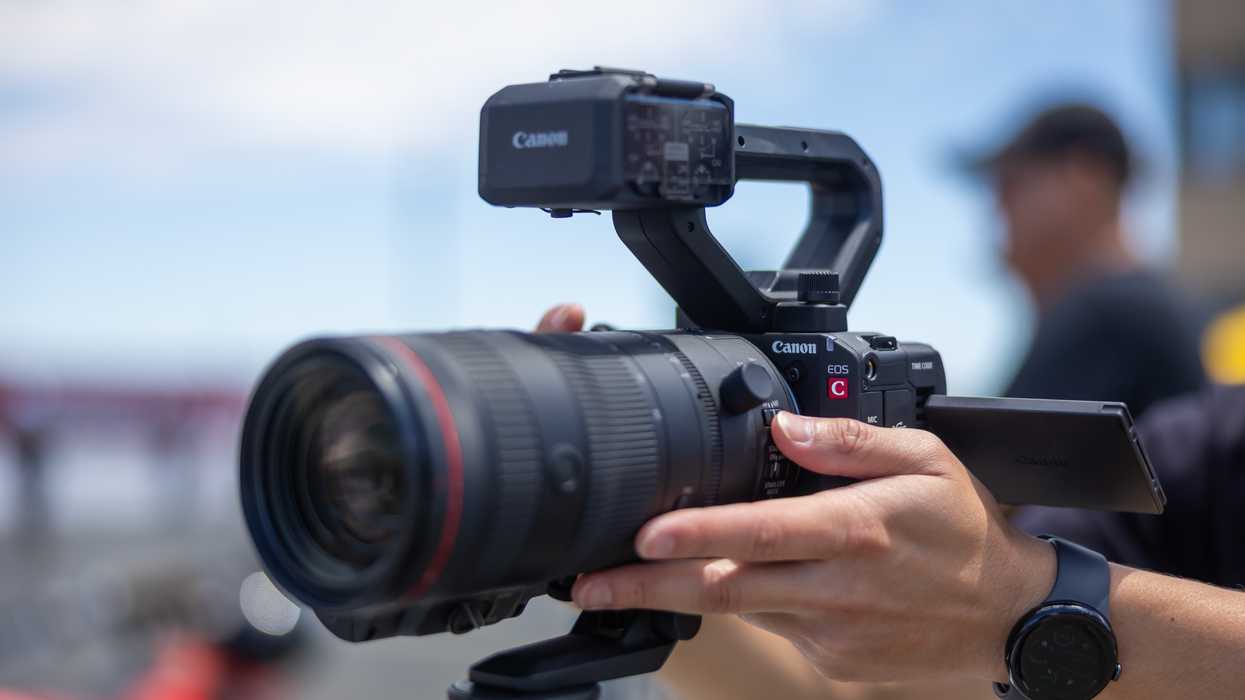
Canon EOS C50
Canon’s cinema camera lineup might have finally cracked the code for what an optimal professional video camera will look and perform like. The new Canon EOS C50 is designed to truly help shooters maximize their creative freedom.
Featuring a compact, full-featured camera body that includes Canon's newly developed 7K full frame CMOS sensor with 3:2 open gate internal recording capabilities, 4K/120P, and Cinema RAW Light up to 7K/60P, the EOS C50 is unlocking specs and capabilities never considered before for a camera of its price and size.
Here are some of our thoughts on the EOS C50 and—in our honest opinion—where we see this camera stacking up in the current camera marketplace for videographers.
A New 7K Full-Frame CMOS Sensor
Many of the most exciting specs and features for the Canon EOS C50 really have to do with its newly developed 7K full-frame CMOS sensor. This new sensor is set to bring exceptionally low noise, which will enable it to excel in a wide variety of lighting situations and maximize the camera’s full dynamic range. The high resolution and realism of 7K will also enable richer creative expression as well as greater flexibility in workflows, including oversampled 4K 60P.
The EOS C50 is the first Cinema EOS camera to feature open-gate recording options unlocked by using the full dimensions of the sensor. By selecting Full Frame 3:2 from the Sensor Mode section of the main menu, professional videographers can shoot using the full area of the sensor and then use that information in post to crop and re-frame their footage to the aspect ratio of their choice. (An especially valuable feature when shooting with full-frame anamorphic lenses.)
And speaking of anamorphic shooting, the EOS C50 provides desqueeze magnification options, including OFF/2x/1.8x/1.5x/1.3x, which will make it more possible to utilize flare and bokeh effects that cannot be achieved with ordinary lenses.
7K 60P Internal RAW Recording
Looking at the recording specs and features, the EOS C50 is set to be able to record up to 7K 60P Cinema RAW Light with an additional three 12-bit Cinema RAW Light recording modes: HQ, ST, and LT.
The camera will also feature several other recording options, including Canon’s standard XF-AVC codec, which can record in 10-bit 4:2:2 and create rich detail and smooth imagery at frame rates up to 120P, without cropping the image from the sensor. For slow or fast motion recording, the EOS C50 can also support up to 4K 120P and 2K 180P.
On top of that, the EOS C50 features the XF-AVC S and XF-HEVC S recording codecs. These formats feature an easy-to-manage naming system and folder structure, while recording in the familiar MP4 format and preserving metadata.
HFR Recording and Improved Autofocus
We’re skipping over some other killer features like dual base ISOs of 800 and 6400 in Canon Log 2, which will allow shooters to maximize the full dynamic range of the sensor in almost any shooting scenario. But we have to talk about how the EOS C50’s Dual Pixel CMOS AF II will enable shooters to keep their subject in focus during slow or fast shooting at speeds up to 4K/120P or 2K/150P.
The EOS C50 is also tailored for those shooting high-end social content by allowing users to use simultaneous crop recording when shooting in 4K DCI or UHD, allowing them to record at their chosen aspect ratio while also recording a cropped portion of the frame in 2K.
Plus, when shooting in simultaneous crop mode, video pros will have up to three format options, depending on their shooting mode: 9:17, 9:16, or 1:1. This will help to reduce turnaround time when formatting videos for different deliverables.
Thoughts on the Canon EOS C50
Overall, we're very impressed with just how many specs and usability (specifically for videographers) that Canon has been able to jam into this new EOS C50 model. In a market where it can feel like everyone is trying to make the one true Sony FX3 killer, the EOS C50 succeeds where many others have failed.
If you're looking for a compact cinema camera option that feels comfortable but performs like a high-end cinema camera, then you're going to love working with the EOS C50. Plus, if you've been a Canon shooter in the past, it's hard to argue against going with what you already know, as the EOS C50 will feel very familiar and operate similarly to other Canon cinema or mirrorless cameras, too.
At the end of the day, we're excited to see what a new generation of filmmakers can achieve with cameras like the EOS C50, a cinema camera that harkens back to the earliest days of Canon 5D run-and-gun filmmaking, yet with a new level of sophistication, specs, and features that should make shooting creative short films and features as well as being a workhorse for your budding videography careers.
Price and Availability
Ultimately, with a highly competitive price that is well below the rest of the high-end cinema camera market, the Canon EOS C50 has uniquely positioned itself to be a realistic pro option for videographers looking to grow their careers.
Here are the full specs and features:
- Newly developed 7K full-frame CMOS sensor
- Variety of sensor modes including Full-frame 3:2
- Dual Base ISO
- 7K 60P internal RAW recording and 4K 120P high frame rate recording
- Various recording modes including simultaneous 2K crop recording
- Dual Pixel CMOS AF II
- New, light and compact body design including detachable handle with built-in XLR inputs, REC and Zoom control.
- Adobe Frame.io Camera to Cloud in-camera integration
- 32MP still photo capture in Photo mode