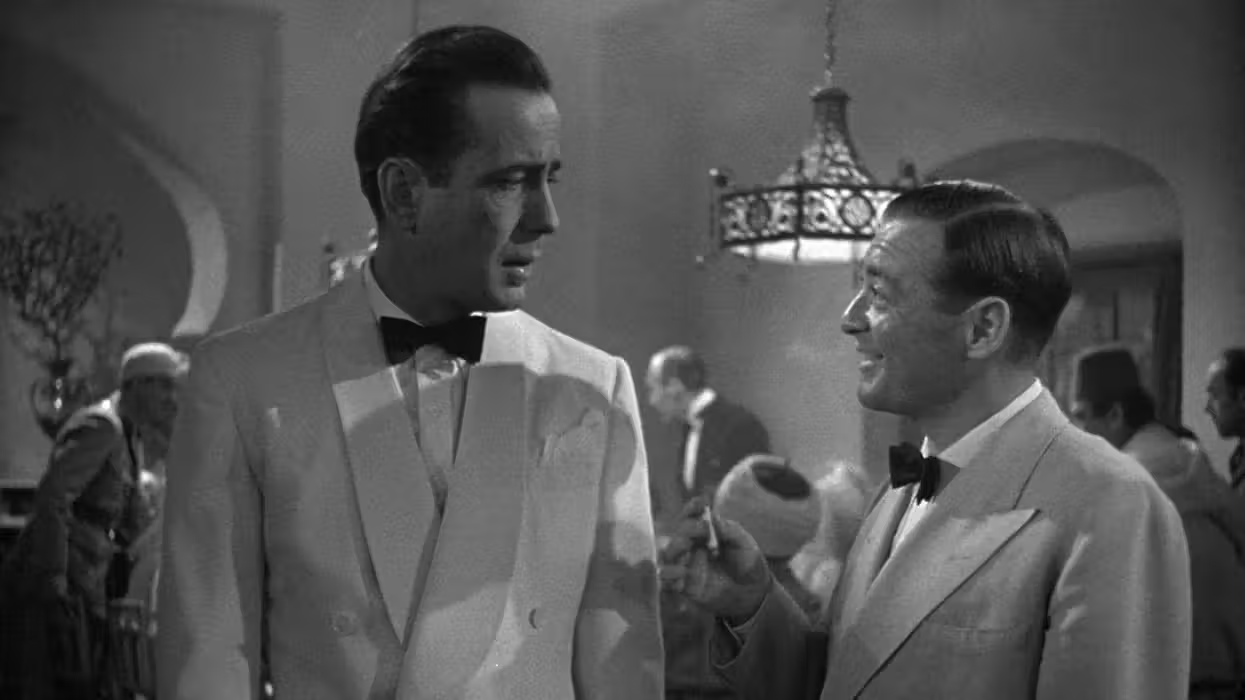
"I don't mind a parasite."
The 1942 classic Casablanca is set in Morocco during the early days of World War II. So much of the film is quotable, but today we're looking at a moment you may have missed.
The film was directed by Michael Curtiz and written by Julius J. Epstein, Philip G. Epstein, and Howard Koch (from the unproduced play Everybody Comes to Rick's). The film went on to win several Oscars, including Best Picture.
In December 1941, Rick Blaine (Humphrey Bogart) runs a nightclub in Vichy French territory, attracting all types of seedy clientele, officials, and refugees. Rick purports to be neutral, but has been a revolutionary in the past, and allows people from all sides to pass through his doors. Including a man named Ugarte (Peter Lorre), a small-time crook. This man has recently obtained some travel papers from murdered Germans. He convinces Rick to keep them for him.
Before that moment, they have a barbed conversation in which Rick lands one very important insult that reveals much about his own character.
Pull up a chair.
- YouTube www.youtube.com
The Scene
Rick is in the process of turning away a haughty Deutsche Bank executive when Ugarte slips into the smoky bar like a rodent, greeting Rick warmly. When Rick is done and turns back, Ugarte is chummy, while Rick is prickly. Ugarte follows him to his table anyway, where Rick plays chess. They briefly discuss the two dead German couriers.
"Will you have a drink with me?" Ugarte asks.
"No."
"I forgot. You never drink with anyone," he says.
Ugarte asks if Rick hates him, but Rick claims he doesn't even think about him. Fishing still, Ugarte insists he's helping "all those poor refugees" who wouldn't have exit visas without him.
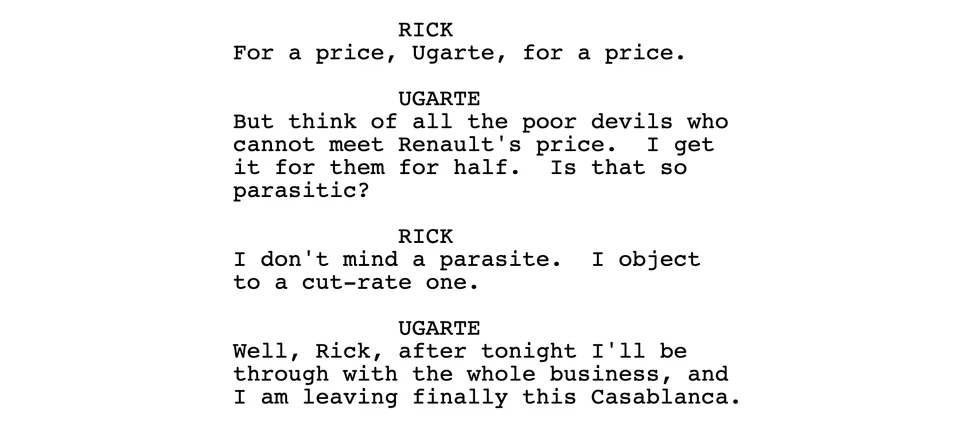
"For a price, Ugarte, for a price," Rick says.
"But think of all the poor devils who cannot meet Renault's price. I get it for them for half. Is that so parasitic?"
"I don't mind a parasite. I object to a cut-rate one," Rick says.
Stung, Ugarte says, "Well, Rick, after tonight I'll be through with the whole business, and I am leaving, finally, this Casablanca."
He gives him the stolen letters of transit and is arrested and killed shortly after. It's this kind of dialogue that makes the story one of the golden age's best scripts.
The Mechanics of a Wisecrack
Rick's reply is actually quite a funny joke. It's one of reversal. In humor writing, a reversal is when you lead the listener down one path of thinking, but then turn the concept on its head.
Ugarte teases the word "parasitic," teeing up a moral judgment. You expect Rick to either condemn or excuse him. Instead, Rick accepts the premise ("I don't mind a parasite") and moves the goalposts.
He'll take a rat. His objection is to the fact that Ugarte isn't even that good of a rat.
The surprise is the comedy. The redrawn axis is totally Rick's character, who is a parasite in another way. He just might not be ready to condemn himself.
A wisecrack that ends on the hardest, most unexpected word is doing extra work. It's funny, it's surprising, and it tells us a ton about Rick's worldview all in one go.
The lesson for your own scripts is about structure. The pivot has to come last, so the audience commits to the wrong expectation before you pull the rug out from under them. Rick could have opened with his objection to "cut-rate parasites" and killed the joke. Instead, he grants the premise, then swings the turn onto the final word. Get the order backward, and you won't give the audience a surprise to laugh at.
 Credit: Warner Bros.
What the Line Is Really Saying
As mentioned, Rick is probably rude to Ugarte and others because he can see a little bit of himself in weasels like them. He knows he's playing all sides while claiming neutrality. He's still taking their money. He's not clean in all this.
Rick's cynicism is a performance, and the joke here keeps Ugarte (and the world) at arm's length. Then "I object to a cut-rate one" hints at the truth. Rick is a man with standards and a private code. The line's real meaning lives under the surface, and it's subtext that deepens our understanding of the character.
It's an important line because it's one of the first we actually hear from Rick. We've heard others talk about him, how he never drinks with customers, and we've seen how cool and collected he is as the owner of the bar. He stands up to the banker without batting an eye but allows other criminals to patronize his establishment.
He views Ugarte as beneath him, but still gives him more time and attention than anyone else in the film prior to that point. They're more equals than he might let on, and Ugarte, aware of Rick's disdain, still respects him.
It's also the Bogart persona we love. It's charm-and-wit-as-armor that fans loved to see him play.
How the Movie Came Together
Casablanca was written in real time on set by a rotating team, including the Epstein twins, Howard Koch, and other uncredited pens. It was rewritten throughout production, with pages arriving on set and the ending undecided until filming.
Frank Miller, who wrote Casablanca: As Time Goes By, said in one interview (via The Blacklist):
“There were lots of problems on the set. Arguments with Curtiz. Curtiz’s bullying of lesser players. But the major issue with Ingrid Bergman was her uncertainty about how the film would end. She didn’t know how to build to the ending because movies are made illogically … in end scene first/status she didn’t know which man would win her. Curtiz kept telling her to play it ‘in-between,’ which is what she did. And it made the film work better than if she’d known the ending.”
Like many scripts of the time, the aim with dialogue was economy, letting the fewest words carry the most.
This insult in this scene is a great example of the principle. Before the romance, before Rick's reluctant heroism, a few words of banter tell you everything you need to know about the character.
- Why the Final Goodbye in ‘Casablanca’ is Actually a Heroic Beginning for Rick Blaine ›
- “As Time Goes By”: The Song That Defines Casablanca’s Timeless Love ›
- That One Line From ‘Casablanca’ That Still Breaks Hearts 8 Decades Later ›
- Beyond the Iconic Line: “Here’s Looking at You, Kid.” – Casablanca ›
- Iconic Film Character Intros: How 'Casablanca' Teaches Us to Reveal a Protagonist | No Film School ›