The Greatest Shot Ever Filmed on TV: ‘Connections’
Why a single, irreversible moment from a 1978 BBC series, Connections, still outclasses modern spectacle.
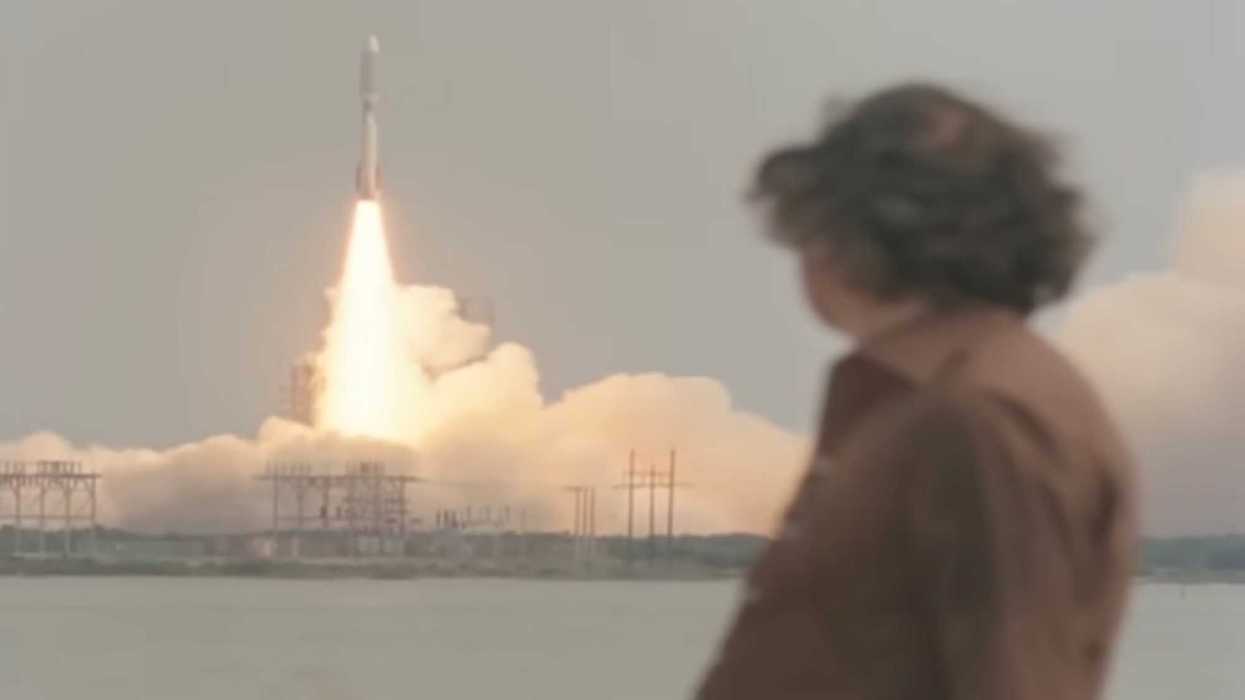
Connections (1978)
If you’re into filmmaking, or at the very least, informed about it, you might be able to understand what a comfort it is—the concept of retakes. We call that a “do-over” in real life. A second chance. If put in perspective, against mistakes and bad luck, you know a second chance is a valuable thing to have.
Imagine you have a “dope” concept, on which you are making a “sick” film, and for which you have planned a “killer” shot. The only thing is, the privilege of retakes is taken off the table. Now what?
That’s what James Burke was dealing with while shooting the priceless climactic shot for an episode of a BBC science education TV series, Connections (1978). And no, the “retaking” privilege wasn’t taken away by some jerkass producer or executive. It was a logistical issue, something that couldn’t be repeated.
After all, an actual rocket launch was involved.
This is a story of capturing a rare moment while perfectly aligning it with human performance.
Context Before the Shot
Connections and Its Ambition
Broadcaster and author James Burke came up with an interesting idea for a series: linking historical inventions with modern technology. The objective was to explain how the modern world came to be by showing how past inventions, decisions, and even accidents played a part in it. The idea didn’t depend on a “lecture from a desk” format. Burke strived to give a full experience. He walked, touched, and demonstrated.
It was quite a complex exhibit of a “cause-and-effect” chain, but Burke trusted the audience to follow it anyway. Whenever words fell short, he let reality do the talking.
The series was a huge success, obviously noted for Burke’s succinct and passionate commentary, but also benefited from his dry wit, historical reenactments, and intricate working models.
Episode 8: “Eat, Drink, and Be Merry…”
Episode Eight, titled “Eat, Drink, and Be Merry…,” centers on an unexpected chain of cause and effect that begins with “credit” and ends in space travel.
To quickly run you through it: The duchy of Burgundy came up with the system of credit to fund larger armies and other luxury purposes. The Swiss, to combat the increasing Burgundian army, invented Pike Square, a new military formation. The French Revolution forced France to enlist even unskilled peasants in its army. Since feeding such large armies was a problem, the French came up with the concept of bottled and canned food. Since “bad air” was considered responsible for food spoilage in the cans and bottles, they came up with the idea of refrigeration and air conditioning. This idea was later expanded to keep food cold as well as hot, as needed. So came the thermos. Ultimately, the thermos idea led to the construction of a large thermos flask for solid fuel (also hydrogen and oxygen) combustion. And finally, this “thermal flask” logic was later applied to rocket propulsion. Indeed, a chain reaction, isn’t it?
The Shot
What Happens in the Frame
As you can see, there are three shots in total.
Shot 1 - Burke walking across the length of another rocket laid horizontally (44 seconds)
Shot 2 - Burke in the foreground and the propelling rocket in the background (23 seconds):
Shot 3 - A close-up of the flying rocket (4 seconds)
In the first shot, Burke explains how liquid gases are stored in a thermos. In the second shot, he explains that if you mix these gases in a confined space and set them on fire, you get… that. Boom! And that’s the “great” shot we are discussing here. The third shot follows up on the rocket’s visual in close-up.
What’s Great in the Shot
In a nutshell, the greatness of the shot lies in the high-stakes synchronization between James Burke and the NASA launch schedule, timing, and Burke’s professional composure.
At first glance, you may not realise the stakes involved here. But look closely. Burke delivers a dense, technical monologue. Considering the high-value visual he is chasing, he doesn’t seem to lose his composure. While he is speaking, the ground begins to shake, but he doesn’t get confused or nervous about “losing the mark.” He turns just a tiny instant before the fire emerges from underneath the rocket. His move and the rocket’s launch fit like two perfect jigsaw puzzles.
And it’s not Burke alone. The cameraman also contributes. The composition is vital here. The camera captures Burke in the foreground while the rocket ascends in the distance. It provides a sense of scale that no studio could replicate.
You gotta realise, the launch wasn’t staged for this shoot. It was an independent event. A rocket launch is a gigantic affair in every sense: money, logistics, manpower, and more. Even if you don’t consider the shoot, a rocket launch itself is a “now or never” situation. I mean, not never. They can try again. But since each launch costs around a couple of billion dollars, in addition to heaps of research and preparation, I will stick to “now or never.”
The shot was a gamble. The presenter’s timing had to be perfect to the “millisecond.” And it’s not like they used a green screen or post-production. Since we live in the age of deepfakes, I guess we can appreciate the authenticity of the moment. When Burke finishes his line, "You get… that,” the rocket ascends right on cue. It’s as if James Burke were choreographing the launch and not some hotshot NASA scientist.
Summing Up
Today, we are used to things like deepfakes and AI. On the surface, this shot shouldn’t surprise us. But if you look closely, it does. And the secret is its authenticity. This shot still goes “viral.” The clip continues to circulate because once you know there is no gimmick involved, it almost feels impossible. Come on, tell me, in a world of over-edited content, seeing a presenter nail a one-take wonder feels very satisfying. Doesn’t it?
Everything is about marketing today, but when we call this shot “great,” it’s not marketing; it’s recognition of the sincere, unfeigned attempt to capture something amazing.
- The 10 Funniest Mockumentaries Ever Made | No Film School ›
- How to Make a Documentary: A Step-by-Step Starter Guide | No Film School ›
- Skip Film School and Learn the Basics With These Free Resources | No Film School ›
- 7 Great War Documentaries You Must Watch ›
- How To Edit A Documentary With a Personal Impact | No Film School ›
- Here's How to Get Your Documentary on Television | No Film School ›
- How to Get Your Documentary on Public Television | No Film School ›