Cutting the Comedy 'That Friend' with Josh Land
Love, drugs, and the perfect assembly that turned this Tribeca film into a hysterical story of friendship and growth.
'That Friend'
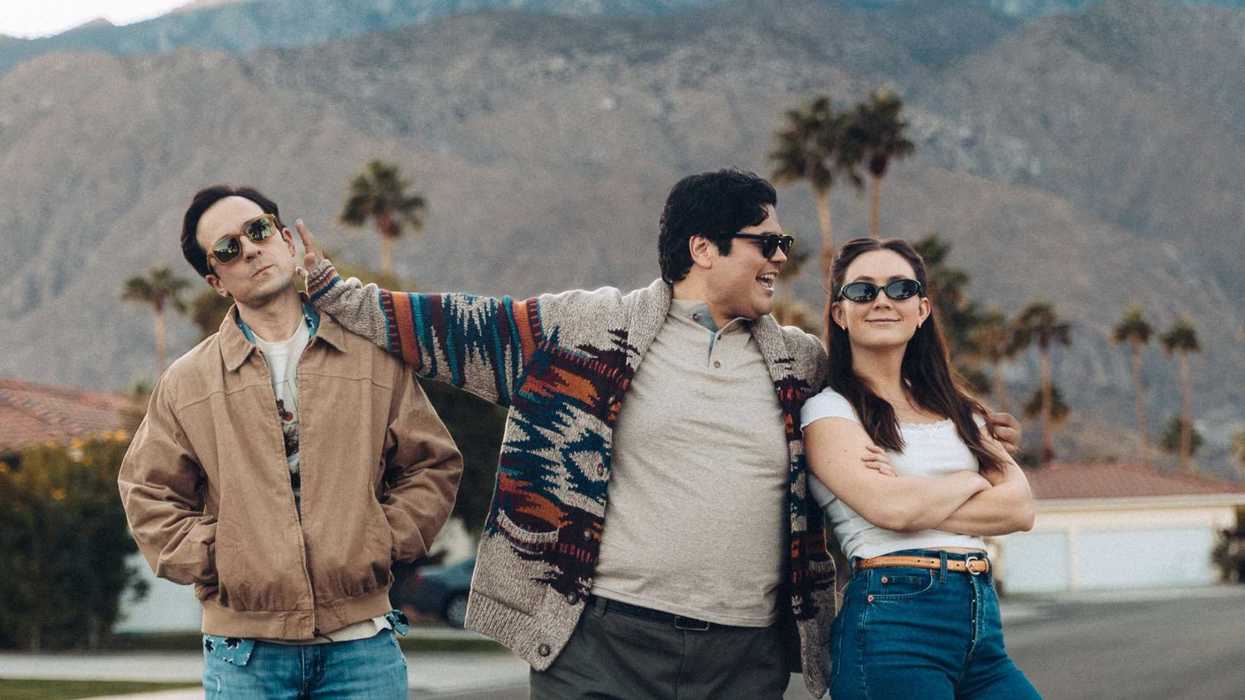
New couple Henry (Josh Brenner) and Penny (Billie Lourd) head to Palm Springs for a romantic getaway, only for their new flame to be put to the test when their wild-card of a friend, Paul (Harvey Guillén), tags along. When this larger-than-life personality inadvertently third-wheels and misplaces his pack of questionable cigarettes along the way, things go awry in this new comedy from Alex Wall and Will Sterling.
Editor Josh Land worked closely with Wall and Sterling from the start, acting as both a Digital Imaging Technician during production and the only editor in post. After rough-cutting all the scripted scenes on his own in Premiere, Land worked with the directors to weave in the funniest improvised takes throughout, while still staying true to the original plot. “This was a pretty delicate balance to get right, because if you're not careful, you can easily lose the script's momentum and lose sight of the actual story,” said Land. In a film with as many improvisations and moving parts as That Friend, interchangeability and ease of export proved invaluable.
Read more about the making of That Friend below.
Tell us about how you became involved on That Friend.
I'd had a working relationship with the directors, Wall and Sterling, in the past, and I wanted to come on board with the project as soon as I knew they'd secured the money to shoot it. To be honest, I probably would have edited any project they'd sent my way—it’s a great time working with them.
How did you prepare to edit this film? Did you do anything differently when setting up your workflow for this project?
With this project, I was also the Digital Imaging Technician (DIT) on set, which meant I could organize my own footage during production in preparation for the edit. I didn't have an assistant editor or a lab, so when the project began, I started with those top-line tasks—creating proxies, syncing audio/video, organizing bins, comments, markers, etc. After about a week or two of prep work, I was able to get started on the actual edit.
What conversations did you have with the directors to align on the creative vision for this film? What did collaboration look like throughout production and post?
I talked with Wall and Sterling mainly about the balance of our actors' improv vs. what was on the page. This was a pretty delicate balance to get right, because if you're not careful, you can easily lose the script's momentum and lose sight of the actual story.
I started by cutting together each scene one by one with no music/sound design, and then I'd send exported QTs to both our directors at the end of each day. We'd hop on the phone and talk through each scene: what's working, what's close, and what needs to change. Once we'd tackled all 70-or-so scenes, I strung them all together as a longplay and then cut the film into four reels. This is when we stopped treating the film as a collection of individual scenes, but rather as one fluid, contiguous story.
Tell us about a favorite scene or moment from this project, and why it stands out to you.
As most editors will probably understand, my favorite moments are when an out-of-the-box idea just "clicks" and makes the film significantly better. For example, we have a scene where the main characters realize they've accidentally just sent a young man named Spencer away with their pack of drug-laced cigarettes. In the script, this scene continues on for a few minutes after this realization, but I eventually found that simply cutting out a significant chunk of this scene would actually create one of the funniest moments in the entire film.
To elaborate, Henry asks Penny, "Do you have any idea where he [Spencer] went?" and rather than staying in this scene, I then just cut straight to a shot of Spencer, drugged out, in a taxi, his face/eyes glossed over. So not only had we removed a few minutes from the film, but we also created a funny visual joke that didn't exist in the script previously. It's fun when you find things like that.
What Adobe tools did you use on this project, and why did you choose them?
We kept it really simple with this one – I used Premiere Pro for the edit, and Ben Nichols used After Effects for our 40-or-so VFX shots.
One of the main reasons I use Premiere is that it essentially skips the need to online/offline the movie. And when you're working on a very small project, wearing a lot of hats and tackling a lot of tasks on your own, every shortcut you make becomes even more helpful.
In this case, being able to edit the movie using 1080p proxies—while still being able to export rough cuts at full native 4K resolution with no onlining—was invaluable for us. Not to mention it made delivering the final film to Fotokem a complete breeze.
What were some specific post-production challenges you faced that were unique to the project? How did you tackle them?
Not having a lab for dailies and not having an assistant editor definitely make the job more time-consuming. Also, having only a small budget for needle drops also necessitates cutting scenes many times over, especially our opening party sequence. That scene was designed to be cut around any "upbeat, energetic" needle drop, but I think we changed the song 8 different times before we secured the rights for "Shake Your Groove Thing."
Who is your creative inspiration?
Oh, there's a lot. I've always been very inspired by the musical, kinetic editing Tom Cross pulls off in Whiplash, or Kirk Baxter & Angus Wall's work in The Social Network. More recently, I thought Greg O'Bryant's editing in the movie "Tuner" was incredible. I'd also be remiss if I didn't mention Curry Barker's recent movie Obsession. What he was able to pull off for that budget was really inspiring to me (plus he edited the film, too).