5 Essential Sam Neill Movies That Defined His Career
Remembering the late, great actor.
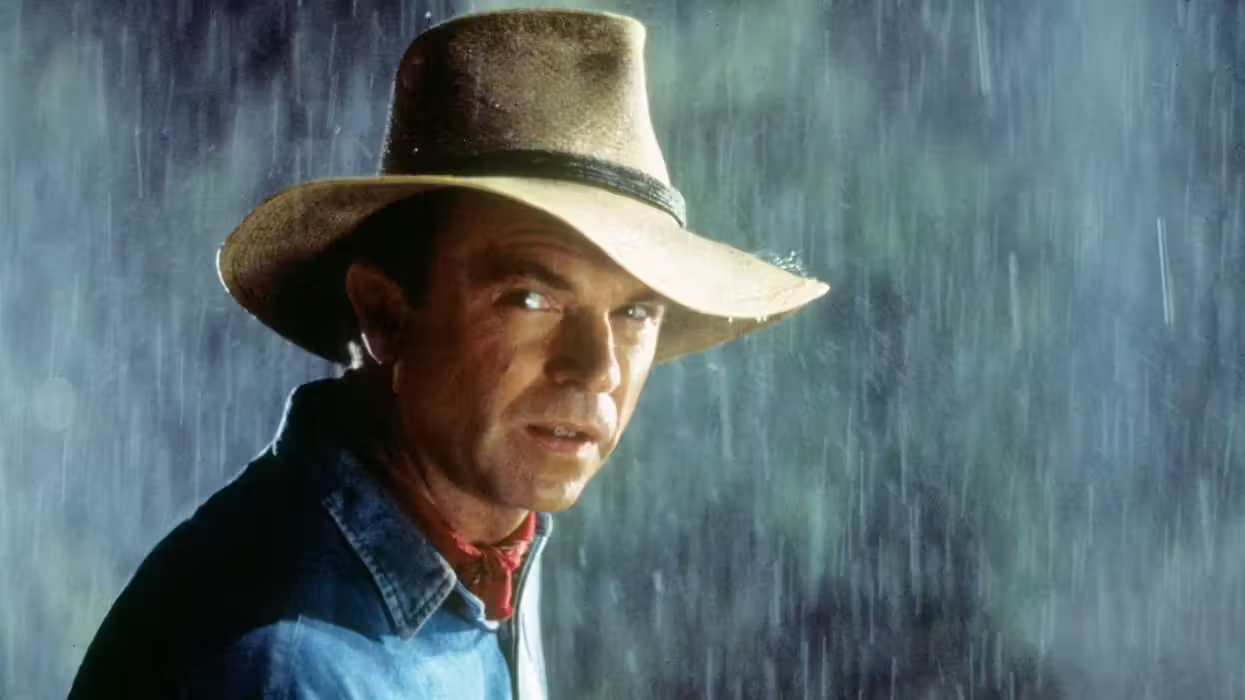
'Jurassic Park'
Sam Neill died on Monday, July 13, in Sydney. He was 78. His family shared the news in a statement, calling the loss sudden but noting he had remained cancer-free after years of treatment for a rare blood cancer.
If you grew up loving movies, you knew his face. Probably as the cynical paleontologist stumbling over in wonder when he's faced with herds of real-life dinosaurs. We've lost a true legend and one of our generation's greatest performers.
Alan Grant was just one of many, many people he played. Neill could do warm, cold, funny, and completely unhinged. He served the story, took the unglamorous parts, and trusted directors most actors would have run from. Today, we're remembering the actor through five performances that show his full range.
Possession
- YouTube www.youtube.com
Before Hollywood knew what to do with him, Neill made probably the weirdest film of his life. Andrzej Żuławski's Possession is a long, meandering divorce drama that twists into full-blown body horror, and Neill plays a husband going mad, disintegrating while his wife (Isabelle Adjani, who won Best Actress at Cannes for it) does something worse than just leave him.
He never softened his account of it. "I call it the most extreme film I've ever made, in every possible respect, and he asked of us things I wouldn't and couldn't go to now. And I think I only just escaped that film with my sanity barely intact," Neill said in a 2021 BBC radio interview, describing a shoot that pushed both leads. And yet he never disowned the result. In his memoir, he called it "one of the best films I was lucky to be in" (via IndieWire).
What can we learn? Well, they made an iconic movie, in spite of it all. Total commitment to a singular vision can produce something no other film could. Possession is a cult object that Ari Aster cites as an influence on Midsommar. But the set is also where limits must be established and upheld, and Neill spent decades talking about how this one went too far. Despite that, it's now part of his legacy, and he could look back on it proudly.
The Piano
- YouTube www.youtube.com
Same decade, but switching to a completely different gear. In Jane Campion's Palme d'Or winner, Neill is Stewart, the cold husband to Ada (Holly Hunter). It's a thankless part by design, because he's the obstacle, not the heart, and Neill plays it without trying to win the audience's sympathy.
The shoot isolated him, largely because his character stands removed from everyone else on screen. He pointed to Campion as the reason it held together. He wrote in his memoir (via IndieWire):
"It was an uncommonly lonely job for me. Holly and I got along fine. But she was of necessity remote. I understand it. She commits to a role, and any joking around, the everyday currency I’m used to, would’ve been a distraction for her. Playing our scenes together was disturbing for me. I never knew whether it was Holly looking at Sam, or Ada looking at Stewart. The lines between life and fiction were blurred and it was not in any way comfortable."
He served the story even when the story wasn't about him, and let a good director carry him through the parts that hurt. The Piano went on to eight Oscar nominations, and Neill was proud to have been the quiet, unloved corner of it. If you want to see where it lands against her other work, we ranked Campion's films here.
Jurassic Park
- YouTube www.youtube.com
Yes, 1993 gave us both The Piano and this stunner of a summer blockbuster. Spielberg's first choice, Harrison Ford, passed on the role of Dr. Alan Grant, and the part went to Neill only weeks before cameras rolled. He anchored the film as a paleontologist who hated kids (but grew into a protector, one of my personal favorite tropes). The film rewired what a hit could be, and he sensed it while it was happening.
"We were literally breaking new ground. It wasn't just another job. We felt like this might be a milestone in the history of cinema. And I think it was. I mean, we weren't making anything particularly profound. It wasn't a heavy art film. It was popular entertainment … But that combination of people, animatronics, and CGI, which was brand new, transformed the way in which movies were made," Neill told Den of Geek.
Neill spent four weeks building an American accent for Grant. Spielberg had him drop it on set, then asked him to land "somewhere in between" his own voice and the one he'd rehearsed.
Neill also reflected on the movie decades later, questioning whether its patient, slow-build pacing would fly with audiences today—we got into that here. We also broke down how those dinosaurs were actually built, a blend of Stan Winston's animatronics and ILM's brand-new CGI.
Peaky Blinders
- YouTube www.youtube.com
Two decades on, Neill reminded everyone he could scare the daylights out of you. As Inspector Chester Campbell across the first two seasons of Peaky Blinders, he was sanctimonious, sadistic, and weirdly magnetic, a bully hiding behind a badge and a Bible.
When the news of his death broke, the show's team called his Campbell "one for the ages."
The character worked so well that it became a problem. When creator Steven Knight called for Campbell to be written out, Neill pushed back. Knight told Express the actor's reply was simply, "I don't want to die." Campbell went anyway, killed in a phone booth by Polly Gray in one of the show's great acts of payback. That's catharsis, baby.
When a villain is this fun to watch, nobody wants him gone, and the audience half-roots for the worst person on screen. That's the trap a great antagonist sets, and Neill set it beautifully.
Hunt for the Wilderpeople
- YouTube youtu.be
Let's end on the warm one. In Taika Waititi's adventure film, Neill is Hec, a gruff loner saddled with a motor-mouthed foster kid named Ricky (Julian Dennison).
Ostensibly, it's a road-trip comedy with some soft action, but lands with something like quiet heartbreak, and Neill was insistent about that distinction.
"That's why I always insist it's not a comedy," he told Collider. "I certainly never felt I was in a comedy. I was in something that was much more substantial than a comedy."
Waititi saw exactly what Neill gave the film. He told Den of Geek:
"Well, he’s a very generous person. I think you’re right, it is a generous performance. Early on, he mentioned that his character isn’t as funny as some of the others, but you really need that—he’s the grounding force in the film. He’s the one that retains a sense of reality. He’s very much the eyes of the audience, the way he reacts to everything."
It became the highest-grossing New Zealand film ever made, and it works because its biggest name refuses to hog the spotlight.
If you want more of where Waititi's instincts come from, we pulled together his screenwriting lessons here.
What's your favorite Sam Neill role?