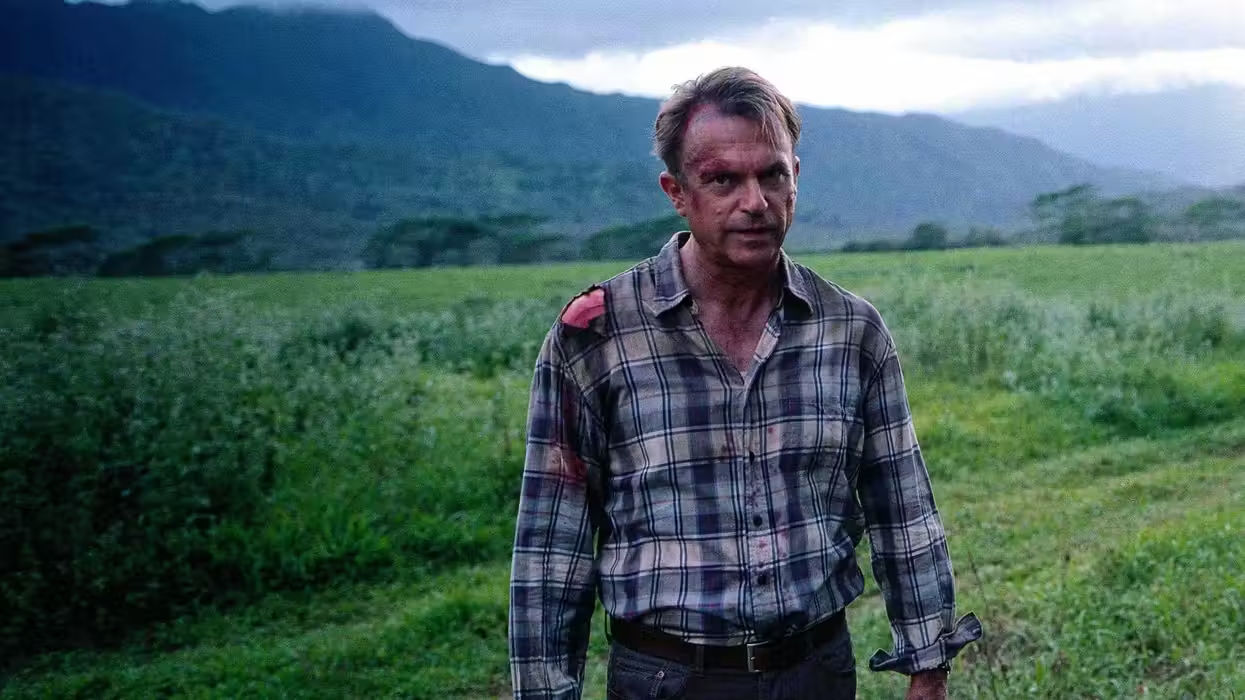
Sam Neill died on Monday, July 13, in Sydney at the age of 78. His family said the loss was sudden, though he had stayed cancer-free after years of treatment.
For a lot of us, he'll live on in the iconic role of Dr. Alan Grant, the grumpy paleontologist who becomes a reluctant protector. This week, we looked back at five performances that defined his career.
But one of Grant's lines keeps coming back to us because it presents the audience with the franchise's thesis in a single sentence.
He says the line in Jurassic Park III, which came out in 2001. "Some of the worst things imaginable have been done with the best intentions." Three decades into this series, that idea still runs underneath every entry.
Let's watch the scene together, then dive into the theme.
- YouTubeyoutu.be
The Scene
By the third film, Grant knows better than to set foot on an island full of these monsters again, and he says so to anyone who'll listen. But of course, he gets dragged back anyway, lured by a wealthy couple who are hunting for their missing son.
Dr. Grant and his assistant, Billy Brennan (Alessandro Nivola), have just outrun a Spinosaurus late in the film with the reunited family. They rest inside one of the old facility buildings.
Dr. Grant tries to plot their next move.
"Alan, you want to give me the bag back?" Billy asks.
"It's okay, I got it," Dr. Grant says.
"Please, give me the bag," Billy says. "It's not safe."
Dr. Grant realizes the subtext. He unzips the bag and finds—
"Raptor eggs," he says. "Did you steal raptor eggs? Now it all makes sense."
Billy looks apologetic. The raptors have been stalking the group ever since he took them, and people have died as a result. When Grant works out why, Billy's confession spills out.
"I swear, if I'd known you were going to end up with them… It was an impulse; I thought they'd be worth a fortune. Enough to fund the dig site another 10 more years. You have to believe me. This was a stupid decision, but I did it with the best intentions."
Grant is not moved. "'With the best intentions.' Some of the worst things imaginable have been done with the best intentions," he says. "You know what, Billy? As far as I'm concerned, you're no better than the people that built this place."
That last line is like a knife. Grant has spent years defining himself against the people who built the park. Now he's pointing the phrase at someone he cares for.
This Has Been a Warning Since 1993
Grant's disgust isn't new here. It's the same alarm Ian Malcolm sounded in Steven Spielberg's 1993 original, when he warned the park's founder that his scientists were so busy asking whether they could bring dinosaurs back that no one stopped to ask whether they should.
We've called that first film a perfect movie for how cleanly it deals with that idea, and for how its framing sells the hubris of people convinced they can control what they've made.
Grant is the series' designated skeptic, the man who was right the first time and hates being proven right again. By 2001, the franchise gave him the line that states the thesis out loud. The science, the hope, the wonder always seem to become danger and disappointment, over and over, usually because someone meant well.
That's why the line still holds more than 30 years on. Every sequel has been a fresh variation on it. Cloning for profit, raptors trained as weapons, a park reopened because of nostalgia in a kind of meta-commentary. Someone was sure this time would be different. The good intentions shift from science to money to excitement to childhood memories, but it always ends in disaster. Grant's line is like the franchise's warning label, and each new movie tests it.
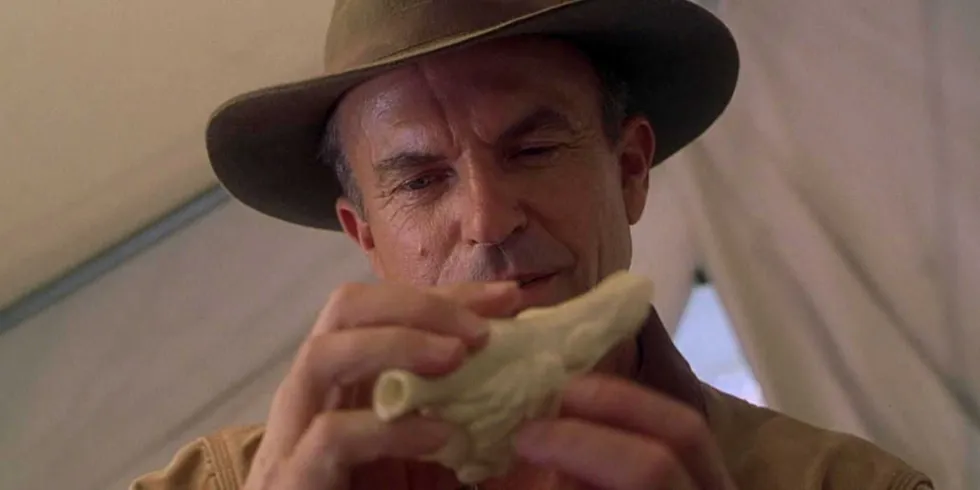 'Jurassic Park III' Credit: Universal Pictures
Why the Line Works
You should have an idea of what your script's theme is, because every scene challenges the characters against that theme. But if you're stating the theme in dialogue, it needs to be placed well.
If Grant kicked off Jurassic Park III by announcing that good intentions pave the road to ruin, that would just suck and feel on-the-nose. The film takes us on a journey with the man who has watched this exact mistake unfold, then puts him in a scene with someone who just made it again, and it's someone he thought he could trust.
Notice also that Dr. Grant never explains himself. He doesn't unpack the idea or tie it back to the first film. A franchise this big could easily lose its spine over six-plus movies. What keeps this one coherent is that clear argument, restated through different characters and different catastrophes. Malcolm frames it as chaos theory. Grant frames it as contempt for hubris. The later films show it as corporate greed.
Dr. Grant Needed the Right Actor
None of this works without Sam Neill. On the page, Grant could read as bitter and scolding, the guy who refuses to stop being correct. Neill played him dry and a little weary instead, a scientist who takes no pleasure in the told-you-so and would rather be back at his dig.
He sold the kind of patient, slow-build pacing he himself wondered would even fly with audiences today. Grant is grumpy, but Neill made sure he was never cold. Which is probably why so many of us loved him as kids. Maybe he would have pretended to slice open our guts with a raptor claw for a giggle. But if we were in danger, he would have stepped up for us. That's what most kids want to be able to trust in an adult.
As we learn from him here, good intentions aren't a defense, especially when a character's ultimate motivation is greed or money, even if they hope to use that money to fund paleontology. Billy literally puts everyone in danger and tries to justify it by claiming it's to help Dr. Grant. It's not good enough.
With this line, Neill delivered that truth with calm tension, and more than 30 years after he first dropped onto Isla Nublar, it still hits.
- 5 Essential Sam Neill Movies That Defined His Career ›
- 'Jurassic Park III' Shows Us How to Make a Great Standalone Franchise Sequel ›
- 8 Best Characters in the 'Jurassic Park' Movies, Ranked ›
- Why The Lunch Scene In ‘Jurassic Park’ Is More Important Than The Action Sequences ›
- Film Quote of the Day: The James Bond Line That Delivered a Perfect Insult | No Film School ›