Charlie Kaufman and Michel Gondry's Eternal Sunshine of the Spotless Mind, from all the way back in 2004, has so many gut-punch lines as we see these characters' relationship fall apart.
"Constantly talking isn't necessarily communicating."
Jim Carrey's Joel Barish says it to Kate Winslet's Clementine. During the course of the film, both of them find themselves at the end of their relationship and undergo a futuristic medical procedure to erase each other from their memories. Joel can feel it happening as he relives each moment while it's taken from him, lending the film a specific kind of grief and horror, even in scenes like this. Read the whole exchange, and the line is doing something other than dispensing insight.
Let's dive into the scene and its lessons.
- YouTube www.youtube.com
The Scene
Clementine and Joel are lying together, ruminating, and it becomes an argument about how little he lets her in.
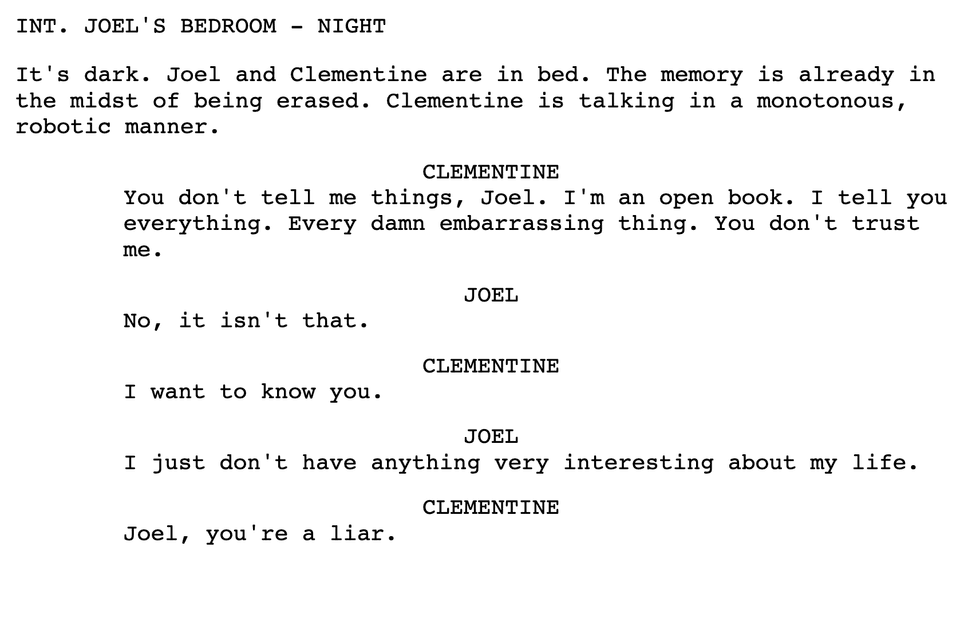
Clementine says, "You don't tell me things, Joel. I'm an open book. I tell you everything... every damn embarrassing thing. You don't trust me."
Joel responds, "Constantly talking isn't necessarily communicating."
Clementine sours immediately. "I don't do that. I want to know you. I don't constantly talk! Jesus! People have to share things, Joel."
Joel can feel this becoming a fight. He murmurs in answer.
"That's what intimacy is. I'm really pissed that you said that to me!" Clementine says.
"I'm sorry... I just, my life isn't that interesting," Joel says.
"I want to read some of those journals you're constantly scribbling in. What do you write in there if you don't have any thoughts or passions or... love?" Clementine says.
Clementine opens the beat with a mild complaint about access. She shares while Joel doesn't, and she wants to know why. His famous line is his answer, and it lands on her as an insult rather than an insight.
She gets it immediately. He calls her openness noise and at the same time dodges what she's really asking for. Her comeback about the journals nails him as a guy who doesn't want to communicate externally, but is more than happy to scribble in notebooks no one else gets to see.
The Line Is a Dodge
Joel isn't wrong in the abstract. Talking a lot and connecting via conversation are two different things.
But look at who's saying it and when. Clementine has just made herself vulnerable, making a bid for connection, and Joel dismisses her with a tidy aphorism that reframes her honesty as a problem.
The line works as a wall. It sounds like he's teaching her something about intimacy while he avoids the intimacy she's trying to get from him.
That doubleness is what makes the moment sting. It feels like something a real person would say without realizing how much it might hurt their partner. Joel gets to be right and evasive at the same time. He names a real problem (empty chatter) and uses it to avoid the specific thing Clementine is asking of him. It lets her react, and her hurt tells us how to read the line.
Watch the small stuff Kaufman gives them to do, even in a scene that only lasts about a minute. Joel's whole contribution to the back half of the fight is "mmm hmm" and "my life isn't that interesting," a man shrinking out of the conversation right in front of us. Clementine's move is the opposite. She points to his journals, the private record he keeps and hides. She isn't asking him to talk more. She's asking to be let in, so she goes looking for the place he's stored himself.
 Credit: Focus Features
Don't Lean Too Hard on Your Dialogue
If you're doing it right, dialogue is the least trustworthy thing about a character. People use words to perform and deflect, just like Joel does. A great line can be a character's shield, and if you write assuming that whatever sounds smartest must be the point, you'll miss what a scene should really be doing.
Kaufman writes the opposite of on-the-nose. Joel's words say one thing, his behavior says another, and the friction between them creates the conflict that tears this couple apart.
Let the audience feel the distance between what someone says and what they're doing while they say it. You can download Kaufman's screenplays and see how often his characters talk around a topic just to keep from feeling something.
When you catch yourself adding a line that spells out the subtext, cut it. The subtext plays stronger when the audience is able to discover it and put the pieces together. A scene where the words and the intent pull against each other is way more interesting.
Notice how much you learn about both of them without a line of exposition. Joel's evasiveness, his low estimate of himself, his retreat into a notebook. That's all character work. Does he fight her at all? Not really. Clementine's need to be known, her frustration, her instinct to go straight for the thing he's hiding is similar.
Kaufman builds character through the shape of the fight, not through anyone describing who these people are. A scene that reveals character while the characters think they're only bickering is doing double work, and that is definitely my goal on every page.
What the Writing Gets Right
What makes the line land dramatically is that it's true and self-serving at the same time. Kaufman builds a lot of his best scenes on that kind of contradiction. Joel means what he says. He's also using it against her.
Write your arguments that way. Know what they want in a scene, and put them at odds. Give your character a real point, then hand them a selfish reason to make it. Make each conversation matter to the characters—maybe it hurts in some way. Maybe it teaches them something. It shouldn't just be about moving the story forward.
It's not easy, but try giving them the good line and the bad motive in the same breath. It's way more exciting to watch than a monologue.
- 9 Best Hollywood Sci-Fi Romances of All Time, Ranked ›
- Charlie Kaufman Breaks Down Hollywood's Biggest Problem Today ›
- Why Everything in ‘Eternal Sunshine of the Spotless Mind’ Is So Blue — And What It Really Means ›
- How 'Eternal Sunshine' Completely Obliterates Your Expectations of Rom-Coms ›
- Hud Quote ›