7 Films That End Where They Began
These films are proof that the audience cares as much about the journey as they do about the destination.
Gandhi (1982)
Bring on all the open-ended narratives you have, but I will always choose a story with a cinematic bookend.
That’s primarily because nothing can beat the satisfaction of a thoughtfully rendered, closed ending. Maybe it’s the control freak in me that rejoices at the win.
I especially love it when filmmakers end their narratives exactly where they began. It’s not giving away the ending, but rather an essential style of non-linear storytelling where you take the viewers on a journey and bring them back to where we started—like a joyride in an amusement park.
Additionally, such a non-linear structure suits most types of narratives across genres. The key here is clarity of themes and resolution.
Ending a film where it began can also be part of your visual spectacle, a plot twist, or a way to throw viewers into a whirlwind, hooking them right from the start. It is also an excellent way to reach an anti-climax.
In this article, let’s look at some films that ended exactly where they began to understand them better.
7 Films That End Exactly Where They Began
1. Fight Club (1999)
The opening scene of David Fincher’s Fight Club is one of the best examples in this category. The movie opens with the narrator (Edward Norton) with a gun jammed into his mouth. We see another man lurking in the shadows, casually conversing with him as he holds him at gunpoint.
The narrator’s voiceover begins with, “People are always asking me if I know Tyler Durden.”
In one minute, the opening sequence, backed by the voiceover, introduces us to three critical elements of the plot—Tyler Durden, Marla Singer, and the mass destruction project, Project Mayhem, which is about to unleash chaos in the form of an explosion in less than three minutes. At least “a few square blocks will be reduced to smoldering rubble” under its impact.
We also go on alert when the narrator says, “I know this because Tyler knows this,” but before we can think too much of it, a smash cut hurls us back to the past in a snap.
The movie ends in the same location, with an iconic long shot, in which the narrator and Marla witness the destruction from their front-row seats.
2. Pulp Fiction (1994)
Quentin Tarantino set the standard for non-linear storytelling with Pulp Fiction. The movie also begins with the end; however, Tarantino does it with novelty.
The film opens with a diner scene where we hear a couple scheming about their next robbery, and they spontaneously decide that they’d rob the very diner they’re sitting in, in the same moment. Within seconds, their guns are out.
Tarantino opens with an omniscient POV, beginning his seven-part narrative from the perspective of two of his four protagonists, who are currently in the diner. From there, Tarantino takes us through parallel storylines that are somehow interconnected.
Finally, he brings us back where we started: the diner, and reveals that even the opening, the only section that felt seemingly unrelated all this while, is tightly wound into the narrative’s climax.
The resolution unfolds in the diner, continuing from where we left off: the robbery, a couple with guns, and a restaurant full of patrons. Only this time, the events unfold through the perspective of a new set of protagonists—the hitmen, Jules and Vincent, who are also there, facing down the couple as they try to rob the establishment.
3. The Usual Suspects (1995)
The movie begins with a hardened criminal who seems to be the only survivor after a shootout on a boat as he sits around a pile of dead bodies. A mysterious man comes to greet him, whom the criminal refers to as Keyser Soze. Soze kills the man and burns down the location.
From there, the narrative proceeds around Soze as the usual suspects are rigorously interrogated about the pier shoutout. In the end, when Verbal Kint stops limping and flexes his disabled hand as he walks out of the police station, we’re brought back to the mystery man from the very first scene of the movie. Everything starts, continues, and ends with Soze.
4. Saving Private Ryan (1998)
Steven Spielberg’s war saga, Saving Private Ryan, begins and ends at the same location: the Normandy American Cemetery and Memorial overlooking Omaha Beach in Normandy, France.
The film opens with an elderly man visiting a particular grave, accompanied by his entire family. He walks down rows of gravestones until he reaches a specific one. The next moment, we see him fall to his knees as he breaks down in tears.
The scene ends with a jump cut as we’re taken to the past: June 6, 1944, Omaha Beach—where it all started. In the end, we’re back at the cemetery where we now know the identity of the elderly man and all about the sacrifices that he’s witnessed in his military service.
5. Romeo + Juliet (1996)
Baz Luhrmann’s adaptation of the Shakespearean love story is set in the modern world. By beginning the movie with a news clip in which the anchor reports on the deaths of two lovers on television, the film reveals the outcome of the love story.
Since we all know the tragic ending of Romeo and Juliet, Luhrmann ditches the traditional presentation of this age-old love story, which used a chorus in the play. He maintains the Shakespearean structure but modernizes the delivery method through media and television.
Luhrmann doesn’t create anticipation about the universally known fate of Romeo and Juliet’s romance, but instead focuses on turning their tragedy into a spectacle. In the end, when the lovers die, it somehow takes us back to the opening scene, which foreshadowed their deaths from the outset.
6. Slumdog Millionaire (2008)
Danny Boyle’s Slumdog Millionaire also begins and ends at the same location, much like Saving Private Ryan. The movie opens with Jamal sitting on the hot seat of Kaun Banega Crorepati or Who Wants to Be a Millionaire. This Indian reality quiz show features an impressive cash prize.
He is only one question away from winning a cash prize of 2 crore ($420,000). The opening deliberately gives away that he is going to get the last question right and win the game in the subtext; however, it doesn’t diminish the curiosity.
In fact, the scene sets the tone of the narrative, exposing important details about the characters, before we’re taken into the past to see exactly how Jamal has achieved this iconic feat.
7. Gandhi (1982)
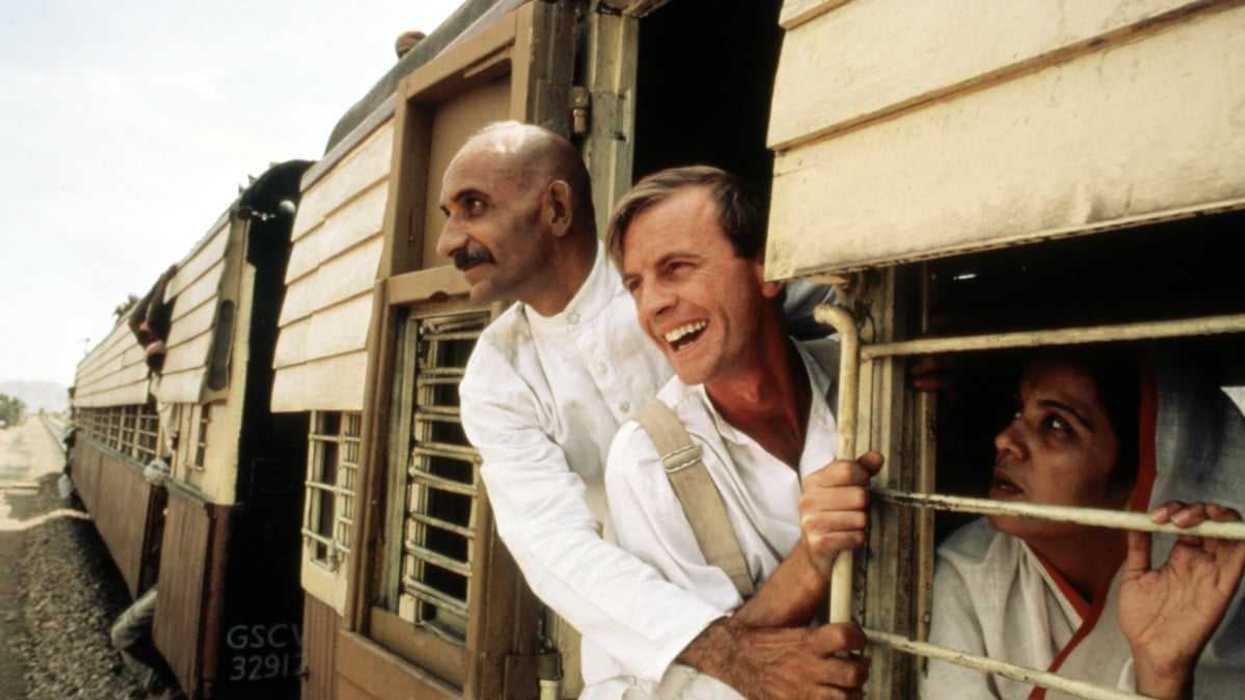
A docu-drama on the life of Mahatma Gandhi, Richard Attenborough's Gandhi opens with Gandhi’s death, as Nathuram Godse shoots him point-blank in broad daylight. We swiftly cut to the last rites procession of Gandhi, showing an entire nation mourning the assassination of their leader.
In a single restrained montage right at the beginning, backed by a voiceover that comes in the form of the procession announcement, Attenborough establishes the stature of the man we’re about to know.
In the end, when we circle back to his demise, the loss suddenly feels personal.
Did we miss any? Let us know in the comments which of these you have watched.