9 Foreign Films That Influenced Popular American Movies
These popular American movies have their foreign counterparts.
'Lady Snowblood' (1973)
Art has always been a global affair, especially filmmaking. While we aspiring filmmakers kill ourselves over originality, we forget that art has always been about inspiration and collaboration. Or, as I like to call it, “smuggling ideas.”
From samurai films influencing classic Westerns to Korean thrillers turning up Hollywood’s appetite for moral ambiguity to Iranian and European auteurs teaching the world restraint in an era of excess, art cannot exist without intentionally smuggling ideas.
So while some of us may be heavily exposed to a single film industry, global cinema collectively shapes what we casually call “popular.”
Don’t believe me?
Here’s a reality check—a list of your favorite American films that were heavily influenced by foreign films.
9 Global Gems That Shaped Hollywood Hits
1. Ghost in the Shell (1995) and The Matrix (1999)
The Wachowskis have never shied away from acknowledging that they’re big fans of anime, and Mamoru Oshii’s film adaptation has been a major inspiration for 1999's The Matrix. Ghost in the Shell has influenced not only The Matrix but also the entire cyberpunk genre.
The Matrix does not share plot similarities with Ghost in the Shell, but its influence on The Matrix’s world-building and action sequences is clear as day for anyone who’s watched both movies.
2. Solaris (1972) and Interstellar (2014)
- YouTube
While we hail Nolan’s Interstellar, Andrei Tarkovsky’s Solaris quietly smiles from backstage.
While there is no formal acknowledgment from Nolan, the similarities in the premises of Solaris and Interstellar make the influence evident, especially since Nolan has always considered Tarkovsky one of his idols.
Both films follow a widowed astronaut who’s sent away to a remote planet for a high-stakes mission. In Solaris, renowned psychologist Kris Kelvin is sent to a space station orbiting a distant planet to uncover a psychological mystery. In Interstellar, Nolan sends a widowed former NASA pilot to outer space in search of a new planet suitable for human habitation.
3. In the Mood for Love (2000) and Lost in Translation (2003)
Sofia Coppola’s Lost in Translation can easily be called an American take on Wong Kar Wai’s In the Mood for Love.
Much like Su and Chow in In the Mood for Love, the protagonists of Lost in Translation, Bob, a fading movie star, and Charlotte, a lonely woman, find themselves in each other's company.
Both movies feature love in its most platonic forms, where the connection is less about physical intimacy and more about emotional synergy.
4. The Inglorious Bastards (1978) and Inglourious Basterds (2009)
The 1978 Italian film and Quentin Tarantino’s film share more similarities than just their titles.
The Italian film follows a group of American military prisoners who’ve managed to escape the Nazis, and they get roped into a quest to steal a German V2 rocket warhead for the Allies. Tarantino’s Inglourious Basterds is more about the mortal revenge of a Jewish woman who witnessed the slaughter of her entire family before narrowly escaping with her life.
Tarantino’s Inglourious Basterds is definitely not a full remake or reimagination of Enzo G. Castellari’s movie, but they’re spiritually related.
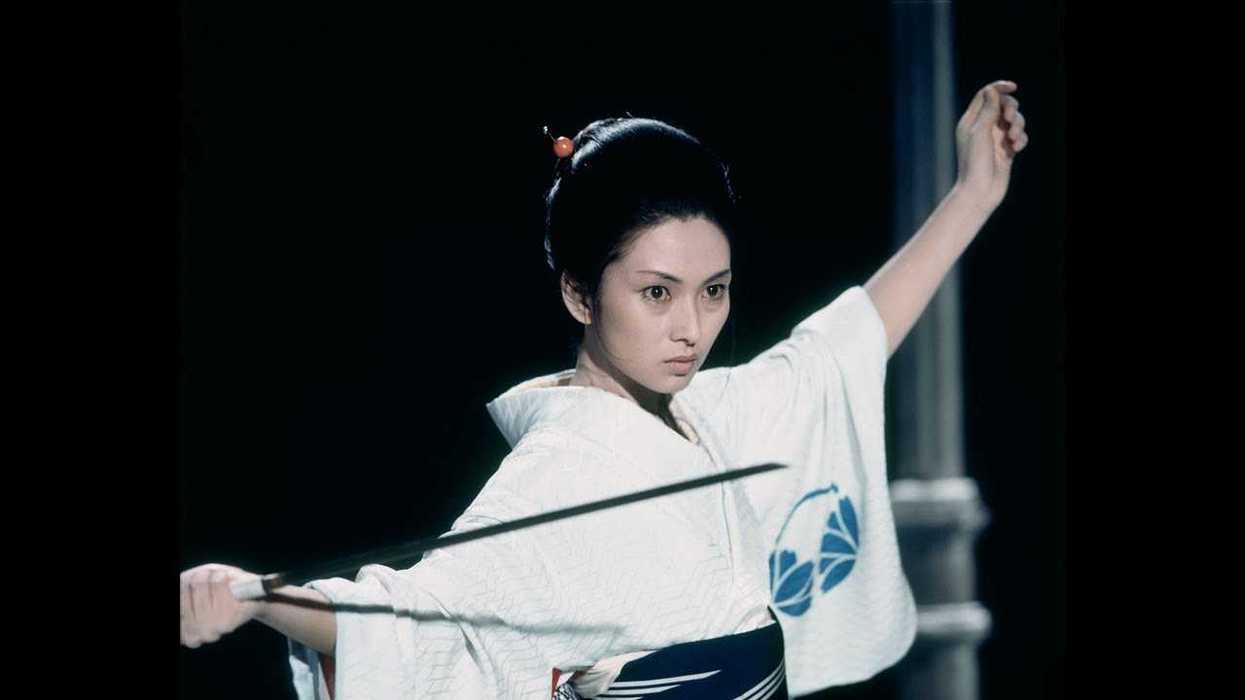
5. Lady Snowblood (1973) and Kill Bill (2003)
Our beloved female assassin, The Bride, is based on Yuki Kashima, the 19th-century female warrior in Toshiya Fujita’s Lady Snowblood. Reportedly, the cast and crew were shown Fujita’s film as a direct creative reference.
Lady Snowblood follows a young woman on her quest for revenge on the people who assaulted her mother and killed her father and brother. Tarantino leaves behind some of the political elements of the Japanese movie, giving us a more Americanized and straightforward story of a female killer seeking revenge.
Some of the most striking similarities between the two films are their non-linear storytelling, sword-wielding heroines, and stylized violence that doesn’t skimp on gore!
6. Paprika (2007) and Inception (2010)
It might come as a shock to you, but one of the greatest films in the 2010s borrowed its premise from a Japanese anime.
Paprika, directed by Satoshi Kon, one of the most prolific anime directors, centers on a specialized device that allows psychiatrists to step into their patients’ dreams and subconscious minds to help them overcome deep-seated traumas. However, this very device can lead to complete social chaos if it falls into the wrong hands, which is exactly what happens in Paprika.
In Christopher Nolan’s Inception, Dom Cobb is a thief who steals or implants ideas by intruding on dreams and the subconscious.
Along with its central premise, a few of Inception’s dream concepts are also borrowed from Paprika, including the aspect in which real consciousness starts leaking in.
7. Infernal Affairs (2002) and The Departed (2006)
Interestingly, Martin Scorsese took home his first Oscar for Best Picture and Best Director by reimagining a Hong Kong action thriller. Andrew Lau and Alan Mak’s Infernal Affairs follows two individuals, a police officer and a local mafia member, as they infiltrate each other’s organizations to gather intel.
Scorsese’s movie is an ideal American reimagination, with Boston serving as the backdrop instead of Hong Kong streets, with a side of extra characters, such as Mark Wahlberg.
8. Perfect Blue (1997) and Black Swan (2010)
- YouTube www.youtube.com
Don’t be surprised if Darren Aronofsky’s Black Swan feels strangely familiar, like a movie you’ve seen before. If you’re a true anime fan, chances are you’ve seen Satoshi Kon’s Perfect Blue—the film that served as the core reference for this Aronofsky movie.
Reportedly, Aronofsky had purchased the rights to Perfect Blue, but the project never took off. However, a couple of years later, the filmmaker was seen paying homage to the film by recreating its iconic bathtub shot in Requiem for a Dream.
Perfect Blue serves as a structural blueprint. Both films follow a young female character, emotionally troubled and burdened, struggling with dual-identity disorder as she tries to attain professional success.
That being said, while the similarities between the two films are evident, when asked if Kon’s anime was an inspiration, Aronofsky denied any direct influence in a 2010 interview at the Philadelphia Film Festival, stating, “Not really, there are similarities between the films, but it wasn’t influenced by it.”
9. The Hidden Fortress (1958) and Star Wars (1977)
Not many know that George Lucas was heavily inspired by the works of Japanese filmmaker Akira Kurosawa, and that the legendary Star Wars followed in the footsteps of one of Kurosawa’s iconic creations, The Hidden Fortress.
The Hidden Fortress follows two goofy peasants and a veteran samurai as they smuggle a princess in disguise right through the enemy territory. The Star Wars parallel? Princess Leia is the princess who needs to be saved from Darth Vader, and Obi-Wan is the veteran samurai.
Much like The Hidden Fortress, Star Wars: Episode IV—A New Hope presents much of the beginning of the story from the perspective of the two goofy characters, C-3PO and R2-D2.
As a filmmaker, I like to think that it is Lucas’ expression of love for his favorite Kurosawa movies.
Which of these foreign films have you watched?