"I believe in America."
These words are spoken over black by a grieving undertaker in a dark room, and it makes one of the most recognized openings in movie history.
The Godfather went on to sit at number two on the American Film Institute's list of the greatest American films. But those words almost never opened the epic mafia story. Francis Ford Coppola first wrote the beginning as a wedding, and the character's plea arrived later, during a rewrite, after a friend stopped by and told him his opening pages needed a stronger way in.
Let's join the family.
- YouTubewww.youtube.com
The Scene
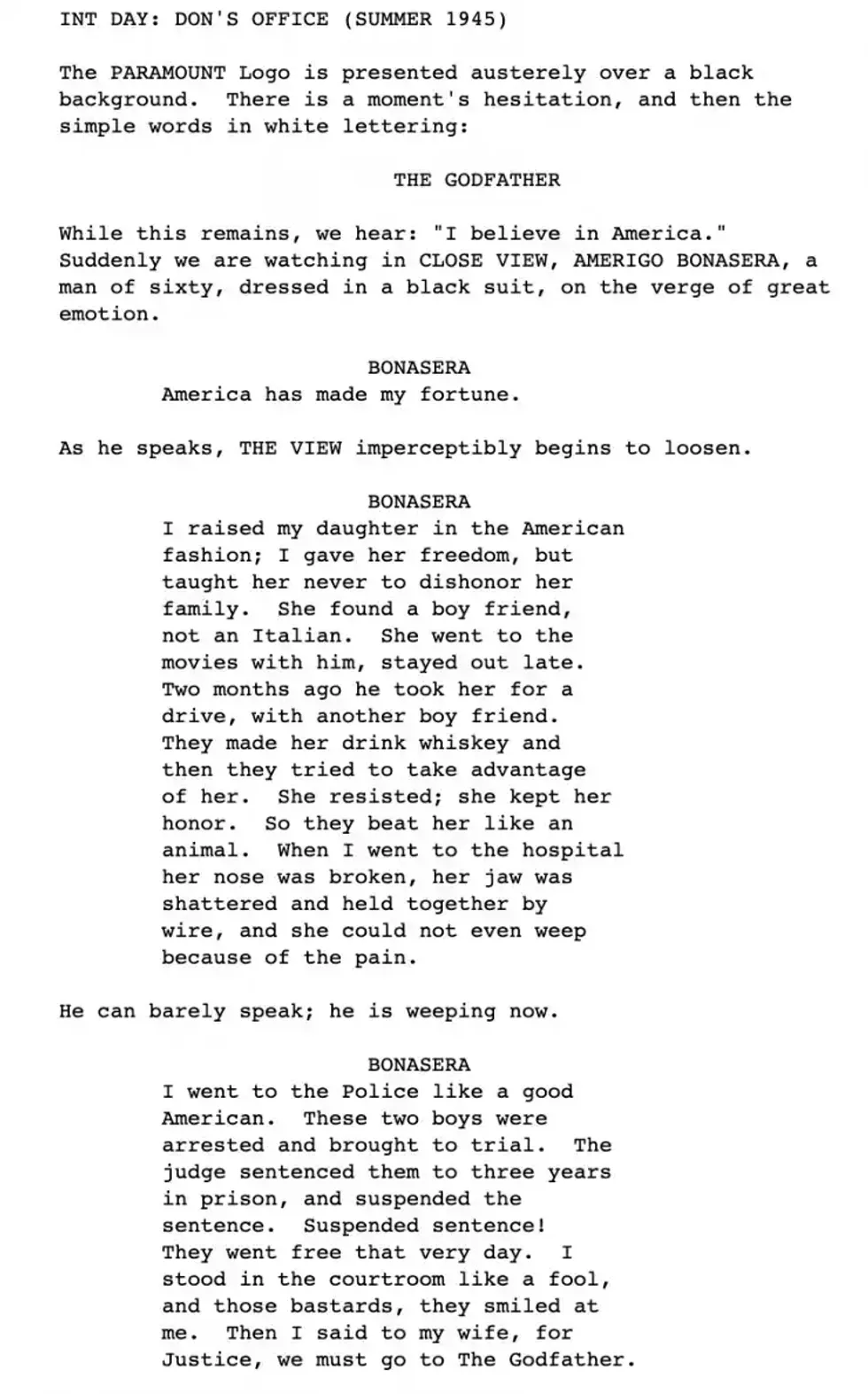
Over black, you hear the words, "I believe in America." We meet Amerigo Bonasera, an Italian undertaker. For over a minute and a half, he speaks about how he manages his family and a tragedy that has befallen them.
"I believe in America. America has made my fortune. And I raised my daughter in the American fashion. I gave her freedom, but I taught her never to dishonor her family. She found a boyfriend; not an Italian. She went to the movies with him; she stayed out late. I didn't protest. Two months ago, he took her for a drive, with another boyfriend. They made her drink whiskey. And then they tried to take advantage of her. She resisted. She kept her honor. So they beat her, like an animal. When I went to the hospital, her nose was broken. Her jaw was shattered, held together by wire. She couldn't even weep because of the pain. But I wept. Why did I weep? She was the light of my life—beautiful girl. Now she will never be beautiful again."
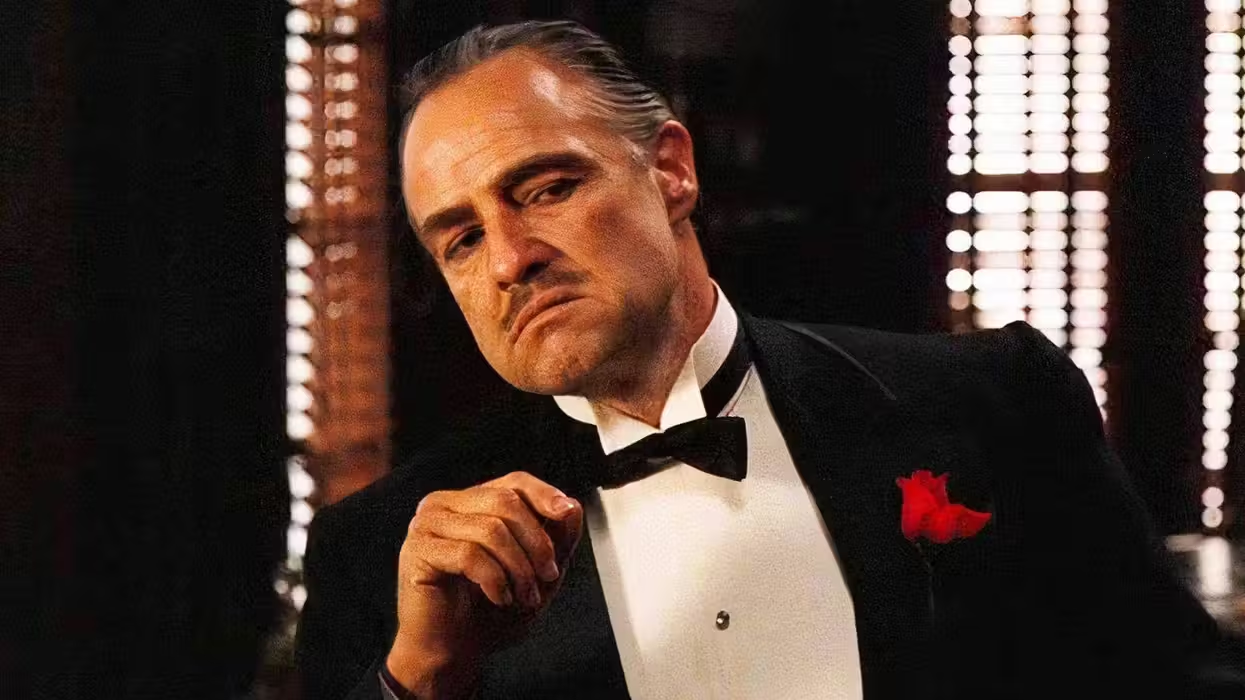
When he breaks down, Marlon Brando's Vito Corleone directs his people to comfort the man.
Bonasera says they went to the police, but no justice was delivered. He now comes to the Godfather for the justice he seeks.
Why These Words Could Carry the Whole Film (or Trilogy)
It's all contradiction. The undertaker is named Amerigo (America itself). He says he believes in America, then turns to a crime boss for justice the courts won't give. Belief and disappointment, all in the same breath. Bonasera uses this love and desire to be a "good American" to justify why he went to the police first, and not the mafia. He still loves America, but in this case he feels it's failed him.
We put this scene in our ranking of the greatest movie opening lines, wondering why Coppola led with Bonasera rather than Corleone. But it's because the undertaker introduces the Don, the theme, and the bargain all at once, and drops the audience straight into the rules of this world with no setup at all. This is a movie about the American dream, but it's got a dark and violent underbelly. When institutions don't support your pursuit of happiness, the mafia will take it into its own hands.
The Godfather Part II opens on another ceremony and another man asking a favor of power, a mirror we pointed out in which Michael offers a senator nothing. This first scene provides a template that the rest of the saga keeps referring to.
 Credit: Paramount Pictures
The Image to Match the Words
The line also lands because of how beautifully it's photographed. Cinematographer Gordon Willis, nicknamed the prince of darkness for his love of shadow, lit the Don's office so low that the studio worried the scene was too dark to read (one of several fights behind that opening). They set that black room against the bright, crowded wedding and pulled the camera slowly back off Bonasera's face. The words reach us before we know who is listening.
The contrast does half the storytelling.
The Line Was Buried in Mario Puzo's Novel
Bonasera's speech didn't start Mario Puzo's book, either, although it does begin with Bonasera's character. According to author Mark Seal's history Leave the Gun, Take the Cannoli (excerpted at Air Mail), the novel opens with the undertaker sitting in a New York courtroom, waiting on a verdict, and the phrase "I believe in America" sits mid-paragraph on page 29.
Coppola went looking through the source material and found it there. In Seal's telling, Coppola recognized what the line could carry. For him, it captured the real pull of the story, "that you could go to someone if you weren't being treated fairly, and the Godfather would make it right."
That promise is the engine of everything that follows, from the wedding-day favors to the war between the five families.
 'The Godfather' Credit: Paramount Pictures
Coppola Added the Opening as a Late Rewrite
The choice to open on the undertaker's face came from a house call, not a plan. On NPR's Fresh Air, Coppola said he'd been writing in a one-room cottage in Mill Valley, building the film's start around the wedding, with about 15 pages done, when a screenwriter friend named Bill Cannon stopped by to read them.
Cannon pointed to the striking opening Coppola had written for Patton and asked whether he could find something more unusual to pull the audience in. The idea landed after Cannon departed.
"So after he left, I had the idea to begin in this way, with the very, very close shot of the supplicant undertaker, Bonasera, and then slowly reveal out of the darkness of this—the Don's studio as opposed to the brightly lit wedding scene—the various characters, you know, the—Brando himself, his son Sonny, and what have you. And I rewrote the opening and added it to the screenplay," Coppola said.
What the Rewrite Teaches Us
The lesson for your own pages is a hopeful one. Your strongest opening may already be in your draft, just somewhere you haven't thought to look.
And what a banger of an opening it is. Coppola didn't invent those words but found the line hiding in someone else's paragraph and saw that it stated his whole theme. A man swears by a country's promise, then turns to a crime boss because that promise failed him.
Read your own draft for the sentence that says what your story is about. If your opening is falling flat, see if you can find the one image or line that says what you're trying to say.
You can study the full script for how that instinct plays out in The Godfather.