'The Godfather' Has a Secret Third Lead (And It’s Not Who You Think)
The 1972 classic is not only about Vito and Michael, and the title quietly proves it.
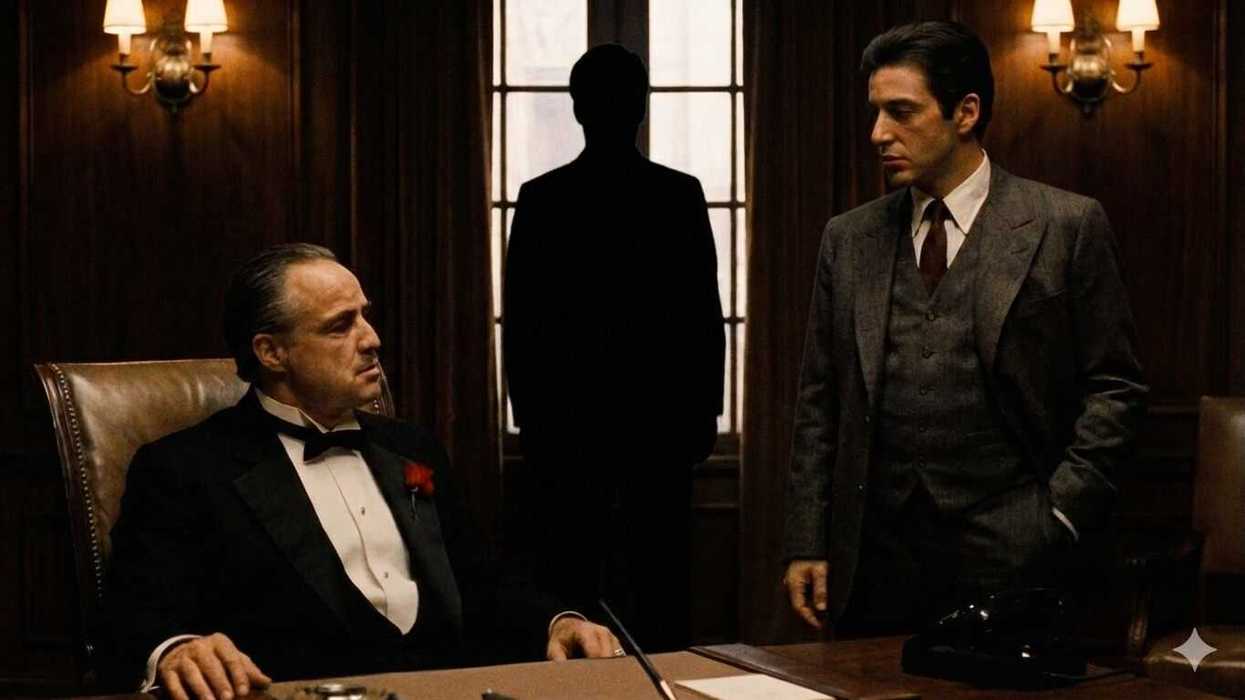
The Godfather (1972)
Everyone talks about The Godfather (1972) as if it begins and ends with the big Corleones, Vito and Michael. The posters, trailers, images, anecdotes, and everything else circle back to this duo. But is that really so?
The movie has now been around for over 50 years. We know these characters in and out. So, if someone asks, “who the movie title refers to,” it’s a no-brainer: Vito comes bearing it first, and then Michael inherits (earns) it.
The answer is right. But is it complete? Is there a chance the title could be hinting at a triumvirate? Are we ignoring the third angle?
Perhaps we are. And quite understandably so. Because the third angle is not as bold or as apparently manifested as Vito and Michael, he doesn’t appear very often, and even when he does, he stays out of the spotlight. Instead, he chooses to work in the shadows, in the margins.
And yet, he changes the context of this crime saga. If you can stop treating “godfather” as a throne and see it as a function, you might be able to see who that third person is.
Why the Title Seems Straightforward (But Isn’t)
The Heavyweights We Know and Love
Vito Corleone (Marlon Brando) opens The Godfather arc as the reigning patriarch. For the first hour, he is the story’s engine. Even Brando’s portrayal is a convincing mix of warmth and authority that establishes the rules of the genre. He is the symbol of respect, authority, and favors. When the law fails you, Vito solves your problems. He maintains family values, pet cats, and makes offers people can’t refuse. In the first half, the title 100% belongs to him.
As the story progresses, Michael Corleone (Al Pacino) lets go of his moral reservations and becomes an integral part of the Corleone business. The second half is all about his slow, agonizing descent from a war hero to the ruthless and cold head of the family. By the final act, he fully embraces his new role and the title transfers to him. This transfer is clean. Father to son. Old world to new. It feels neat, deliberate, and complete.
How the Film Encourages This Assumption
This duopoly of Vito and Michael is the result of marketing, pop culture, the charisma of both stars, and decades of repetition. Across all the promotional media, it’s the images of Brando and Pacino that dominate. The film forums are full of discussions of quotes delivered by these two. Even if you are just a casual viewer, the narrative and the movie’s legacy tweak your mind to frame the story as a two-man relay. The film lets the assumption settle because it wants you to focus on the power struggle, not the machinery underneath.
The Forgotten Candidate Hidden in Plain Sight
Tom Hagen’s Literal and Narrative Role
Tom Hagen (Robert Duvall) is introduced as a consigliere, a legal advisor to the godfather. But in reality, his usefulness goes way beyond that. He negotiates with rivals, manages political fallout, and absorbs pressure so the dons don’t have to.
Vito considers him his son, but, unlike Sonny (James Caan) and Michael, Tom operates without any blood relation. That may seem like a disadvantage, but it gives him distance and clarity. It enables him to understand the Corleone family as a system, instead of as destiny.
Why Tom Fits the Title’s Broader Meaning
Though he is outside of the bloodline, he is perhaps the only one (besides Vito) to understand the real weight of this title. “Lawyer” is just a title for him; he is the architect of the family’s legitimacy. And in this regard, he acts as the godfather of the family’s legal and strategic interests.
His responsibilities and roles are something neither Vito nor Michael (let alone Sonny or Fredo) could manage alone.
Non-Biological Factor
Tom qualifies to be termed the “Godfather” in his capacity to protect the family’s future. He neither seeks nor claims the throne, and yet he wields the power that the throne, the title suggests. He is the godfather by proxy—kind of the “acting” godfather, for life.
His loyalty serves as one of the film’s moral anchors. He also represents the most stable form of devotion. His role, or duty, is not to sit on the throne, but to make sure it always stays standing.
Why the Triumvirate Matters
Three Faces of Power
The title covers three essential pillars of the Corleone empire: Vito, the tradition; Michael, the evolution; and Tom, the infrastructure. Try removing Tom from this equation and see what you get. Without him, Vito and Michael lose their cover of legitimacy and remain only as the thugs in expensive suits.
Being true to his role as the advisor, Tom provides “godly” guidance of wisdom and restraint. That’s pretty much what the title implies. Doesn’t it? And he plays his part with dogged determination and calm, even when the biological Corleones behave impulsively.
How the Reading Changes the Film
Including Tom in the title’s meaning highlights the film’s theme of “belonging.” Tom is an Irishman operating in a world defined by Sicilian blood. And yet, after Vito, he is essentially the most dedicated godfather. Michael’s claim on the throne is because of his birthright; his loyalty is because of his blood. But Tom? Everything he does, everything he is, and everything he offers (including loyalty) is because of his choice.
Do this as an exercise. Watch the film again, but this time, be aware of Tom as the essential third pillar. Look out for his actions and reactions. You will realise, every time he is calm, it’s a warning. Every time he is excluded, it’s a red flag. And ultimately, you will see how the narrative shifts from its simple rise-and-fall structure to a study of what happens when power dismisses its own stabilizers.
For us, Michael becoming the godfather is a tragedy. But within the story’s world, the tragedy is that he no longer needs one.
Conclusion
If you expand your view of the title, you will be able to see how it's a tug-of-war for the soul of a crime empire. Vito started the fire, and Michael let it consume him. It was only Tom who tried to control the heat.
Ignoring Tom makes the story smaller than it is. Including him makes it sharper, colder, and more honest about how power sustains itself.
- How Closing a Door Rewrote Michael’s Fate in ‘The Godfather’ ›
- Friends Close, Enemies Closer: The Most Famous Lesson From 'The Godfather' ›
- The Godfather: Michael vs. Vincent — Two Paths to Power ›
- Michael Corleone’s Wardrobe Was the First Red Flag ›
- The Godfather Line That Changed Movie Dialogue Forever ›
- Vito and Michael Corleone’s 3 Defining Scenes in The Godfather ›
- The Don Corleone Line That Still Resonates More Than 50 Years Later ›
- The Four Words That Opened The Godfather and Changed Cinema ›
- Movie Myth Monday: Did the Mafia Really Try to Stop 'The Godfather' From Being Made? ›