7 Iconic Gene Hackman Quotes from the ‘70s
These seven lines capture the grit, authority, and edge that defined Gene Hackman’s toughest decade on screen.
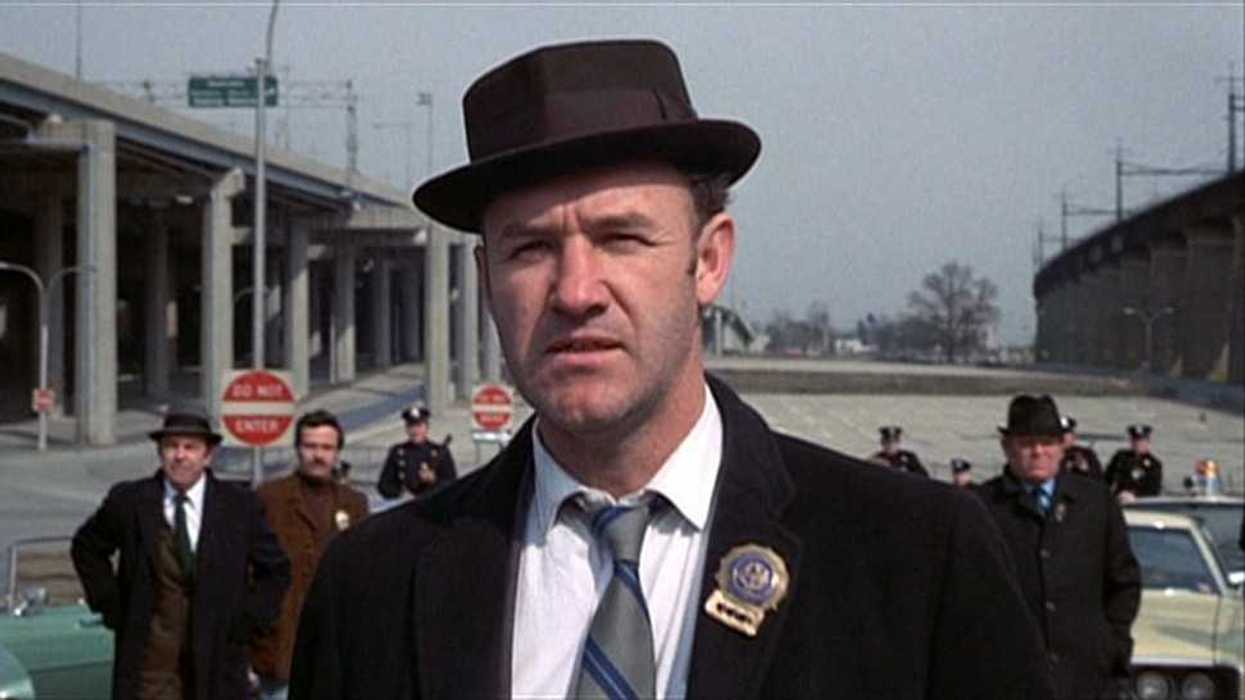
‘The French Connection’ (1971)
Defined by grit, authenticity, and high-intensity performances, Gene Hackman’s brand often embodied the “everyman” and a complex, tough-talking antihero. His tough-guy persona particularly blossomed during his heyday, the ‘70s. During this time, he bridged character acting with leading-man charisma. But beneath the armor of his roughneck exterior, he nurtured a sensitive approach that gave his characters vulnerability.
He famously said, “I was trained to be an actor, not a star.” And that’s not just some Hollywood talk. He was indeed an “actor’s actor.” He was known for his commitment and versatility, rather than movie-star vanity. Talking of versatility, just compare the way his hard-nosed Popeye roughs up a criminal in The French Connection (1971) to his Senator Keeley in drag, scared to be the only non-dancing girl in the club in The Birdcage (1996). The man’s range was krrrazy!
This list includes 7 of those Hackman quotes, delivered as a cop, a criminal, a priest, and a drifter, but always with a voice that carries unique weight. It’s a tribute to a man who made being tough look like an art form.
Legendary Quotes from Gene Hackman’s ‘70s Characters
1. "Alright, Popeye's here!" (The French Connection, 1971)
Written by: Ernest Tidyman | Directed by: William Friedkin
This quote is memorable because: a) It’s minimal and no-nonsense, and b) It still manages to slip in some loaded swagger. Popeye, the rough-n-tough police detective, is simply declaring that he is there; that’s all the criminals need to know. It’s completely devoid of any fluff or heroic chest-thumping. He is not a police officer playing the hero in his own story. And yet, he doesn’t say, “Police are here,” or “I’m here.” He refers to himself in the third person. That choice shows that he is full of himself. That’s Popeye—loud, abrasive, but very effective just where he needs to be.
2. "I’m gonna nail you for picking your feet in Poughkeepsie." (The French Connection, 1971)
Written by: Ernest Tidyman | Directed by: William Friedkin
You might think there must be something in the story about “Poughkeepsie.” Guess again. It’s a total hogwash. In this scene, Buddy Russo (Roy Scheider) is playing the “good cop,” and Popeye is the “bad cop.” Popeye uses this nonsensical, disorienting “Poughkeepsie” BS to confuse the suspect, which makes it easier for Russo to follow up with the actual questions. Eddie Egan, the real-life cop who inspired Popeye’s character, used this absurd question to rattle suspects during interrogations.
3. “God loves tryers.” (The Poseidon Adventure, 1972)
Written by: Stirling Silliphant and Wendell Mayes | Directed by: Ronald Neame
The movie follows the last (and disastrous) voyage of a passenger ship that’s slated to be scrapped later. Hackman plays Reverend Scott, who’s being transferred to an African parish as a punishment for having unorthodox views. In short, he is the kind of priest who is practical and realistic and thinks of the “man in the sky” as an inspiration rather than an actual savior. He gives an impromptu and non-traditional New Year’s Eve sermon. He says, “Don’t pray to your God to solve your problems. Pray to that part of God within you. Have the guts to fight for yourself. God wants brave souls. He wants winners, not quitters. If you can’t win, at least try to win. God loves tryers.” Later, when the ship starts sinking and the passengers try to find comfort in prayers, he gives them a stern-worded rebuke and orders them to move their asses to save themselves. That’s one badass priest!
4. “How many more sacrifices? How much more blood?” (The Poseidon Adventure, 1972)
Written by: Stirling Silliphant and Wendell Mayes | Directed by: Ronald Neame
While the last quote shows us Reverend Scott, who urges people to keep faith but also to keep trying, here we see a different Scott. Here, the ship is a total goner, and he is literally hanging off a burning-hot valve wheel over a pool of flaming oil. People have died, including kids. In this moment, Scott is angrily slamming his boss (the one in the clouds). He says, “What more do you want of us? We've come all this way, no thanks to you. We did it on our own, no help from you. We did ask you to fight for us, but damn it, don't fight against us! Leave us alone! How many more sacrifices? How much more blood? Belle wasn't enough. Acres wasn't. Now this girl! You want another life? Then take me!" He opens the valve, saves others, and falls into the boiling oil. That’s a man of action, not a priest of words.
5. “He was kind of a nice guy, too. It's a shame.” (Scarecrow, 1973)
Written by: Garry Michael White | Directed by: Jerry Schatzberg
This is a road movie about two vagrants, an ex-con, Max (Hackman), and an ex-sailor, Lion (Al Pacino), who travel across America and learn about life, companionship, and tough fate. While Lion is a child at heart, Max is a hot-headed tough guy. Right before this quote, Max is describing how he got into a fight with a man after he caught Max sleeping with his wife. Max proudly says that he “nailed him” pretty good. And then this: “He was kind of a nice guy, too. It’s a shame.” It gives us a glimpse into his softer, empathetic heart beating inside that hot iron surface.
6. “The War and Peace and Chewing Gum” (Superman, 1978)
Written by: Mario Puzo, David Newman, Leslie Newman, and Robert Benton | Directed by: Richard Donner
The full quote goes like this: “Some people can read ‘War and Peace’ and come away thinking it's a simple adventure story. Others can read the ingredients on a chewing gum wrapper and unlock the secrets of the universe." That’s Lex Luthor for you—the egoistic supervillain who thinks he is the smartest person in the room, or anywhere. A perfect psychopathic narcissist who ridicules and belittles everyone else’s intelligence while praising his own. Hackman delivers this line with the class and sophistication of a revered professor, while exuding arrogance and vanity.
7. “The number 200—your weight and my IQ” (Superman, 1978)
Written by: Mario Puzo, David Newman, Leslie Newman, and Robert Benton | Directed by: Richard Donner
This quote is from the same scene as the previous quote; it follows soon after, and Luther extends the same egoistic and arrogant streak even further. This time, instead of generalizing, he focuses the idea of “stupidity” on his less-than-brilliant henchman. “Do you know why the number 200 is so vitally descriptive to both you and me? It’s your weight and my IQ.” Again, Hackman’s delivery proves that Luther may be a big, bad, and bald (he becomes bald later) supervillain, but he has high standards and low patience for mediocrity.
- Story of the Rise, Fall & Wild Comeback of the Western Genre ›
- This Brutal Line From ‘Unforgiven’ Is One of the Most Honest Moments in Cinema History | No Film School ›
- Why This One Line in ‘Unforgiven’ Shattered the Western Myth Forever ›
- Why Clint Eastwood Cut the Original Final Scene of ‘Unforgiven’ ›
- What Are The Best Gene Hackman Movies of All Time? | No Film School ›