This Brutal Line From ‘Unforgiven’ Is One of the Most Honest Moments in Cinema History
This line redefined the idea of justice.
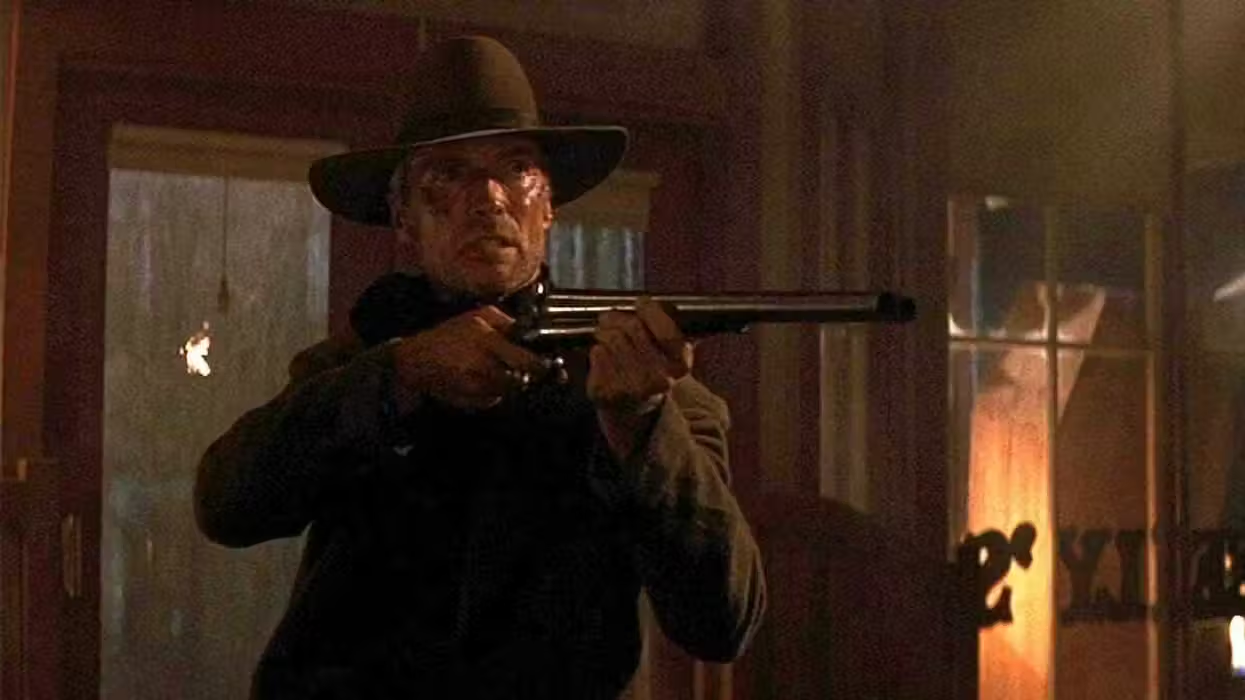
'Unforgiven' (1992)
Some of the most chilling lines in film history are uttered quietly but land with power and precision. Clint Eastwood’s “Deserve’s got nothing to do with it” is one such line, from Unforgiven (1992), a dynamic, modern-day Western.
Said by Eastwood’s William Munny, an aging reformed killer pulled back into the dark world of violence, this line shatters our illusions of justice and questions the relevance of what’s fair. It puts raw power, masterful timing, and the inescapable nature of consequences at the forefront. This single line reminds us how violence is unfazed by what anyone deserves.
What makes this line so powerful? What can we learn from it?
The Movie And The Scene
“Deserve’s got nothing to do with it” is a line said by Clint Eastwood’s William Munny in Unforgiven (1992), a western directed by Clint Eastwood himself. Before we get into the specifics of the line itself, let’s remind ourselves about the story.
William Munny, once a notorious murderer, was living a solitary life as a farmer when the promise of a bounty drew him back into violence. Munny enters the town of Big Whiskey and, along with an old partner, Ned Logan (Morgan Freeman), begins to hunt for the men he is paid to find. After a tragic death that serves as a personal loss for Munny, he reverts to his killer past.
By the time Munny returns to Big Whiskey, it becomes clear to us that this isn’t merely a story about redemption through violence. The idea of righteous gunmen killing men who “deserve to die” is only a small part of the film. These stories often overlook characters who serve as “enablers,” but that isn’t the case with Unforgiven. Sheriff Little Bill Daggett is not the man Munny originally set out to kill, but a man who must be eliminated because his idea of law and order accepts and conforms to terrifying acts of inhumanity.
After a thunderous nighttime shootout, Munny faces Little Bill, who, while lying on the floor, says, “I don’t deserve this…to die like this. I was building a house.” Munny coldly aims the shotgun at him, replies with, “Deserve’s got nothing to do with it,” and fires a fatal shot.
What Makes This Line Powerful
“Deserve’s got nothing to do with it” is one of the hardest-hitting moments from Unforgiven, a film that delivers many such moments with ease and finesse. It works well for several reasons. Let’s begin with the line that triggers Munny to say these words. Bill says, “I don’t deserve this…to die like this. I was building a house.”
Here, Bill isn’t just asking Munny to spare his life. He provides a reasoning, which he thinks is enough to make his case. From Bill’s point of view, some deaths are earned while others are not. He believes that his death would not be justified, because he did not “deserve” to die.
Munny’s response, “Deserve’s got nothing to do with it,” coldly cuts through Bill’s reasoning and offers a holistic perspective on the very existence of violence. Bill remains under the illusion that his position as an enforcer of law and order grants him immunity from consequences. Munny refuses to engage in a baseless negotiation by simply rejecting the concept of “deserve”. According to him, enablers of violence cannot suddenly defend themselves with a code of ethics that they themselves wrote.
The bluntness of Munny’s line and the brilliance of Clint Eastwood’s delivery remind us about the unsentimental nature of brutality. But it doesn’t stop at that. Eastwood’s act of killing isn’t immediate. He takes a moment. A cathartic lingering that almost serves as a reminder to Bill and the audience that actions have consequences.
Clint Eastwood (as director) drains the sounds out of the scene and brings a sharp focus to the dialogue. Munny’s line carries a lot of weight, and the director allows it to come through effectively. His anger is internalized and does not overburden his line delivery. The moment is triumphant, but Eastwood keeps it calm and focused on what’s being said, as opposed to making the scene feel over-the-top.
Lessons For Writers
Here are a few important takeaways from the Unforgiven line, “Deserve’s got nothing to do with it”:
Subvert Expectations
Over the years, audiences have developed their own expectations of movie justice because of what they’ve watched on screen. Westerns in particular often focused on one-dimensional enemies whose deaths were largely “deserved”. This line in Unforgiven subverted that notion. It redefined justice and fairness while holding enablers accountable for their actions. It created a sense of unease through its layered approach to violence.
Go Deeper Than Right And Wrong
For as far back as we can remember, the majority of films have been about good vs evil, and even though there are countless approaches to such storytelling, Unforgiven is an example of a movie that looked deeper. This line took the idea of “deserved” and turned it on its head. It found layers of darkness that are typically ignored in movies in favor of simplistic villains. What is fair and what is unfair? It depends on who is asking and who is answering this question. Few films posed this question better than Unforgiven.
Give Your Antagonists Strong Reasoning
Antagonists must believe in themselves and their actions to set them apart from the protagonists. Very often, this is not the case. People are just presumed to be bad because the writing needs a bad character. Great antagonists justify their actions and stand by them, even when they are moments away from their death. In Unforgiven, Bill defends his stance, and even though his hatred for Munny is clear in his final moments, he believes that he deserves a chance to live.
Summing It Up
“Deserve’s got nothing to do with it” remains one of the most iconic moments from a modern-day Western because it redefines the idea of justice and poses strong questions about what is fair and what isn’t. Drenched in a violent scene, the line feels honest and human.
What is your favorite moment from Unforgiven? Tell us in the comments below.
- The Line That Made Clint Eastwood a Legend ›
- 'Unforgiven' 25 Years Later: 5 Ways Eastwood Masterfully ... ›
- 12 Lines That Made Clint Eastwood a Legend ›
- Watch: Go BTS with Clint Eastwood in 'The Mule' | No Film School ›
- What is Poetic Justice? When Storytelling Lets Fate Write the Ending ›
- How Tarantino Imagined a World with Justice in 'Once Upon a Time ... ›
- Why Clint Eastwood Cut the Original Final Scene of ‘Unforgiven’ ›
- 8 Quotes That Prove ‘Unforgiven’ Is the Ultimate Deconstructed Western ›
- Why This One Line in ‘Unforgiven’ Shattered the Western Myth Forever ›
- The Quiet Truth Hidden In An Iconic ‘Unforgiven’ Line ›
- 7 Iconic Gene Hackman Quotes from the ‘70s ›
- The Brutal ‘Unforgiven’ Scene That Completely Destroys English Bob ›