Bet You Didn’t Notice 'The Godfather' Uses Oranges as a Death Signal
How Coppola turned a simple fruit into a chilling omen of death.
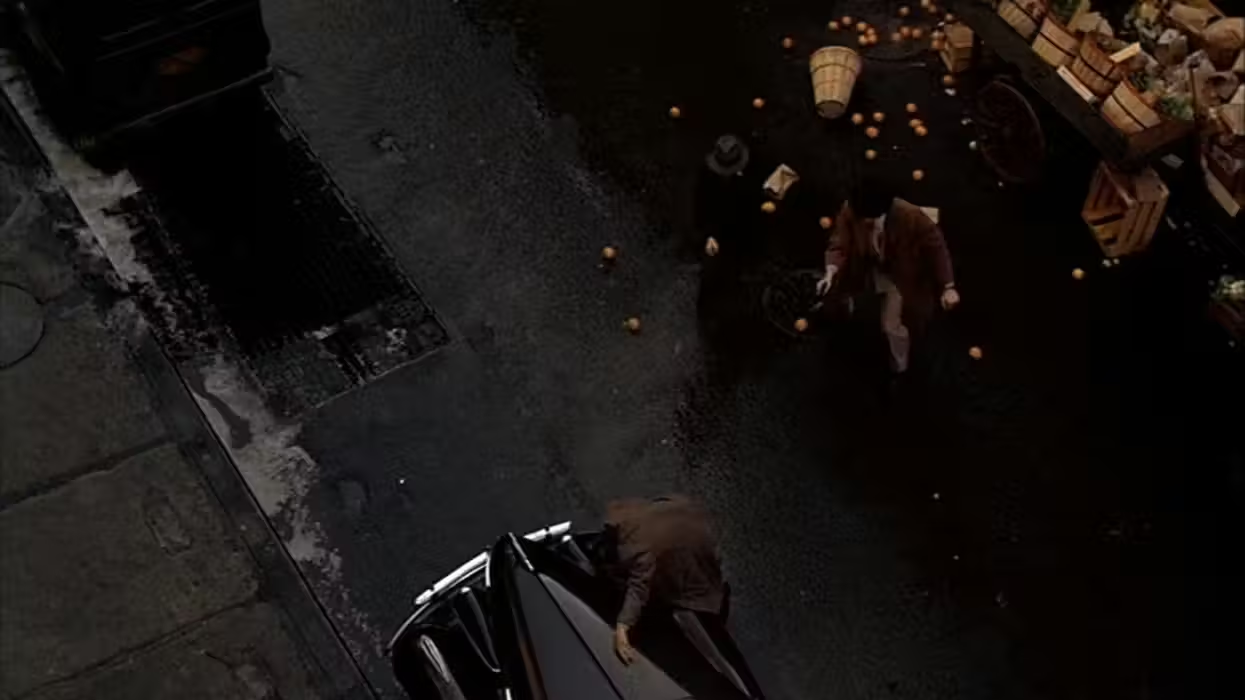
Halfway through The Godfather (1972), Vito Corleone (Marlon Brando) strolls out of a market, hands full of groceries and a bag of oranges. It’s a calm, sunlit moment—until bullets rip through the air, sending the Don to the pavement and those bright orange spheres rolling into the gutter.
On the surface, it’s just good blocking and choreography. But to sharp-eyed viewers, this scene is the tip of a very juicy iceberg.
Throughout Francis Ford Coppola’s mafia masterpiece, oranges quietly stalk the frame like silent hitmen. They pop up in scenes right before a character’s death or near-death encounter—so consistently that it stops feeling accidental.
What was once a background detail becomes a slow-building premonition. This goes beyond mere production design and becomes a coded message in plain sight.
Coppola may have adapted Mario Puzo’s story with all the operatic weight of a Shakespearean tragedy, but here, he weaponized something utterly ordinary.
In The Godfather, a simple fruit became cinema’s most ominous produce aisle.
The Godfather’s Orange Scenes: A Death Log
Key Orange-Death Moments
- Vito’s orange-peeling before the shooting: Just minutes before the assassination attempt, Vito pauses to buy and peel an orange. Seconds later, he’s bleeding out on the street.
- Tom Hagen’s meeting with Jack Woltz: Tom Hagen meets the studio president, Waltz, at his mansion to convince him to give an important movie role to Johnny Fontane. At their dining table, we can see a basket full of oranges. Waltz crudely refuses to comply—and in the next scene, wakes up with the severed head of his prized racehorse.
- Don Corleone’s fatal heart attack: Vito collapses in the garden while playing with his grandson, an orange peel wedged in his mouth for fun. The fruit rolls from the grocery bag moments earlier.
- Michael’s Sicilian exile: During Michael’s courtship of Apollonia, oranges are notably present—foreshadowing her shocking car explosion.
The Symbolism: Why Oranges?
Historical & Cultural Context
In Italian culture, oranges traditionally signal prosperity and abundance—but there’s also a folkloric layer where they can mark the fragility of life. Coppola, steeped in Italian-American heritage, may have tapped into this duality: a fruit that carries both celebration and mortality in its skin. The Baroque-inspired visual language of The Godfather aligns with Renaissance paintings, where fruit often symbolizes cycles of life and death.
Cinematic Language
On screen, the orange is a perfect color cue. Against the film’s muted browns, blacks, and shadows, it blazes like a warning flare. In color theory, orange can signal danger and urgency—think hazard signs, traffic cones, or hunting vests. The Godfather’s oranges are lush, almost over-saturated, turning them into a kind of edible exclamation mark that alerts the subconscious: something bad is coming.
Coppola’s Hidden Strategy
Intentional or Coincidental?
When asked about the so-called “orange theory,” production designer Dean Tavoularis was coy but suggested the fruit was simply there to brighten dark scenes.
Whether this is deflection or truth is up for debate. Even if it started as an accident, the pattern’s repetition—across three films—suggests at least some deliberate reinforcement. For instance, in The Godfather Part II (1974), Don Fanucci holds an orange as he takes a stroll across the market, right before being killed by younger Vito (Robert De Niro).
Other filmmakers have used food this way, too, from the poisoned wine in Game of Thrones to the pink teddy bear in Breaking Bad.
Audience Psychology
Once you’ve noticed it, you can’t unsee it. That’s the brilliance: the orange becomes a cinematic Chekhov’s gun for the subconscious. It works even if you don’t consciously clock it—the brain registers an unusual, vibrant shape and quietly files it under “uneasy.” By the time the blood spills, the groundwork for dread has already been laid.
Legacy & Pop Culture Impact
Today, the “Godfather orange theory” is a full-blown fan obsession. Reddit threads track every single appearance, TikTok clips highlight them with ominous music, and film students treat them as case studies in visual foreshadowing. The reason it sticks? Simplicity. It’s an object you’d never suspect, turned into a harbinger of doom without fanfare or exposition. Coppola, instead of telling us, just showed us—again and again.
A Fruitful Obsession
Strip away the operatic violence, the quotable lines, and the powerhouse performances, and you’ll find a tiny, unassuming fruit quietly weaving itself into the fabric of The Godfather. Whether born of intention or happy accident, the oranges became an unspoken language between Coppola and his audience—a silent countdown to tragedy.
So next time you revisit The Godfather, watch for them. Those bright pops of citrus are more than set dressing—they’re warnings.
And in this world, when life hands you oranges, it’s perhaps too late.
- Why Luca Brasi's Origin Story Was Too Violent for 'The Godfather' ›
- Why Are These People Criticizing 'The Godfather' on Twitter Today? ›
- The Sweet Story Behind One of 'The Godfather's' Most Famous Lines ›
- Michael Corleone's Arc in 'The Godfather' Films Proves He's the Best Character of All Time ›
- The Godfather Line That Changed Movie Dialogue Forever ›
- Breaking Down Michael’s Kiss of Death in The Godfather Part II ›
- The Power Shift: Analyzing the Michael Corleone vs. Moe Greene Showdown in ‘The Godfather’ ›