Film Quote of the Day: This Clint Eastwood Line in 'Gran Torino' Reveals More Than He Ever Says Out Loud
“The thing that haunts a man the most is what he isn't ordered to do.” - Walt Kowalski.
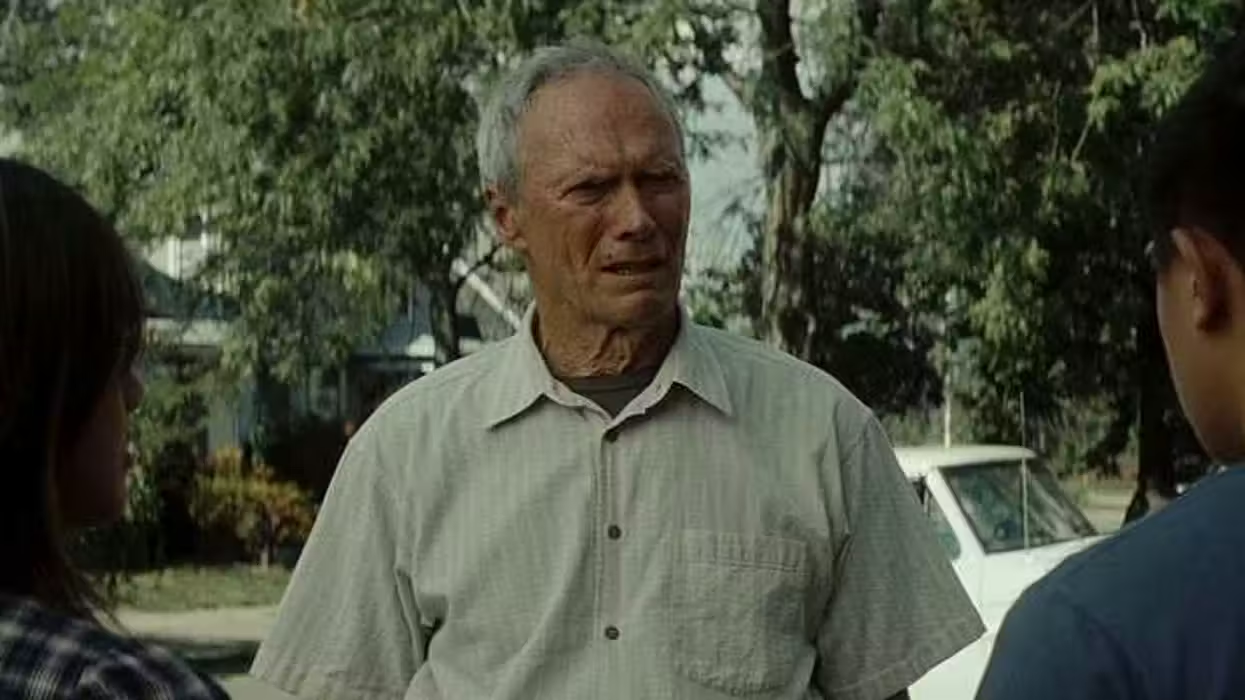
'Gran Torino'
I feel like every few years, Clint Eastwood's late-career masterpiece, Gran Torino (2008), reenters the cultural consciousness, and we have to relitigate a movie that's not a documentary, but a stunning portrait of the way this director sees the world.
It's a movie about an old, bitter racist named Walt Kowalski, who has enough time left on this earth to both ask for forgiveness and to do something about his past.
The movie is famous for the "Get off my lawn" posturing, but beneath the gruff exterior is a deeply fractured man carrying weight he can’t ever truly put down.
Anyway, this is a movie that was famous in the early 2000s for all the one-liners and zingers that Clint delivers. But there's one little speech that hits the emotional core of the film, and you know I love unpacking those.
Let's dive in.
- YouTubewww.youtube.com
The Scene in Question
Okay, so the movie is pretty straightforward. Walt's wife dies, and he's suddenly on his own in a neighborhood full of Hmong immigrants that he hates, because he's an old racist.
They have gangs, and Walt saves some kids from them one night, but his heart of stone does not allow him to let these people in.
Now, midway through the film, Walt begins forming an unexpected bond with his young Hmong neighbor, Thao (Bee Vang). As Thao gets pulled toward the local gang, Walt takes it upon himself to steer the kid straight.
And in return, Thao and his family welcome Walt into their community and help him heal.
This whole time, Walt has been looking to religion to heal, refusing to have his confession heard by the priest he sees every Sunday.
Eventually, both Walt's worlds collide when the priest comes over to tell Walt that the Hmong gangs have it in for him. He begs to hear his confessions because he knows Walt is a ticking time bomb of violence, and he wants him to let that violence go and to find peace.
But Walt pierces through the heroic Hollywood myth of military service to deliver a stark truth about guilt and what he has inside him.
So he delivers this cold line to the priest:
“The thing that haunts a man the most is what he isn't ordered to do.”
- YouTubewww.youtube.com
What The Quote Means
On a thematic level, this single line shifts Gran Torino from a simple vigilante story into a heavy meditation on one's soul and how one's actions may haunt one for the rest of one's life.
That's the core of this story, making amends for the things that weigh on your soul.
The funny thing is, when Walt finally does go to confession, his sins are mostly innocuous. He doesn't talk about war or what he saw; he talks about the things that really weigh on him, like family relationships and missing his wife.
That's because Walt has a plan of action, a way to receive his own absolution.
For screenwriters and filmmakers, this scene is a textbook example of using subtext to reveal character and to add foreboding to a script.
We hear Walt say this to a priest, and we can feel an inevitable conclusion coming toward us. We sense the violence creeping up on us.
It's also a brilliant misdirection.
The audience expects a grizzled war vet to be traumatized by the horrors of official combat, but what haunts Walt winds up being what happened to him and his family later.
The other stuff he files away in war. And later, when he returns to combat, we know he does so without regrets.
The climax of this movie gives us a Walt, free of sin thanks to confession, who makes a conscious choice to break the cycle so that Thao doesn't have to carry the same burden he did.
I think it's a really beautiful movie under all its laughs and grime.
Summing It All Up
Clint Eastwood has spent decades deconstructing the hard-boiled archetype he helped create, and this feltl ike one of the culminations of that.
Great cinema doesn't always rely on grand monologues; sometimes, all it takes is one quiet confession about the choices made when no one was watching.
And then paying that off by the end.
Let me know what you think in the comments.
- The Line That Made Clint Eastwood a Legend ›
- Clint Eastwood’s Top 10 Must-Watch Directorial Hits ›
- Film Quote of the Day: The Line From Clint Eastwood's 1976 Western Classic That Became a Timeless Life Lesson ›
- Why Clint Eastwood Cut the Original Final Scene of ‘Unforgiven’ ›
- 12 Lines That Made Clint Eastwood a Legend ›
- Film Quote of the Day: The 1971 Movie Line That Captures the Bittersweet Reality of Life | No Film School ›