11 Unforgettable Phone Calls in Film History
From tense standoffs to emotional revelations, these calls show how a single phone call can define an entire movie.
Scream (1996)
The sound of the phone ringing carries multiple emotions–thrill, fear, excitement, and happiness. Cinema has always understood and exploited that quality. A simple phone call can immediately reach a character’s most vulnerable core, forcing us to lean in and listen.
Phones are definitely more than props — they can bring about a narrative turning point, expose a character, or heighten the suspense.’
The 11 scenes we have listed here prove that sometimes, the most riveting drama comes out of not just what we see, but also what we hear.
Famous Phone Calls in Film
1. The Wrong Number (Sorry, Wrong Number, 1948)
Written by: Lucille Fletcher | Directed by: Anatole Litvak
Leona Stevenson (Barbara Stanwyck), a bedridden heiress, stumbles upon a cross-connection while making a call and overhears two men plotting murder. Already distressed, she gets even more frantic as she starts piecing together the information she heard and realizes she could be the intended victim.
This is an early example of building suspense entirely through sound. The phone becomes the primary tool of suspense because it might be the source of a psychological nightmare, but it’s also her only link to finding help.
2. “Hello… Hello… Hello…” (Dial M For Murder, 1954)
Written by: Frederick Knott | Directed by: Alfred Hitchcock
Tony Wendice (Ray Milland) calls his wife, Margot (Grace Kelly), from his club. This call is actually a signal for the assassin that he hired to strangle Margot. The planned murder, however, goes wrong when Margot unexpectedly puts up a fight.
Hitchcock stages the scene in a way that offsets the humdrum nature of a simple act of answering a phone call by the unseen threat that lurks around it. And, in doing so, the phone becomes a trigger for an unbearable sense of dread.
3. Calling the Soviet Premier (Dr. Strangelove, 1964)
Written by: Stanley Kubrick, Terry Southern, Peter George | Directed by: Stanley Kubrick
The US President Merkin Muffley (Peter Sellers) attempts to calmly inform his Soviet counterpart that a rough US general has launched an unauthorized nuclear strike on the USSR. As this awkward phone call goes on, even the prospect of global annihilation starts to look like a comedy routine.
The brilliance of this scene lies in the contrast between Muffley’s overtly polite, bureaucratic tone and the apocalyptic stakes that he is addressing. Kubrick exploits this ridiculous absurdity in one line by Muffley: “Dimitri, you know how we’ve always talked about the possibility of something going wrong with the bomb…” The line is a masterclass in understatement.
4. The Call is Coming From Inside the House (When a Stranger Calls, 1979)
Written by: Steve Feke | Directed by: Fred Walton
An unknown caller is tormenting babysitter Jill Johnson (Carol Kane) with a series of increasingly menacing phone calls. When she finally reports to the police, they trace the call and inform her of their unsettling discovery: the call is coming from inside the house.
The scene, much like Sorry, Wrong Number and Dial M for Murder, turns the home from a place of safety into a vicious trap. The scene is noted for its exploitation of silence, heavy breathing, and incessant repetition of seemingly ordinary questions to create a sense of helplessness and fear.
5. “I Am Your Boyfriend Now” (A Nightmare on Elm Street, 1984)
Written by: Wes Craven | Directed by: Wes Craven
While talking to her boyfriend on the phone, Nancy Thompson (Heather Langenkamp) suddenly hears Freddy Krueger’s (Robert Englund) chilling voice. Before she has recovered from this shock, a grotesque tongue lolls out of the phone’s receiver and licks her face.
The visual is pretty emblematic of the film’s core horror: a nightmarish fever dream bleeding into reality. Wes Craven quite impressively uses a mundane object to channel Freddy’s dread, making a point that literally nowhere is safe from him.
6. “Having an Old Friend for Dinner” (The Silence of the Lambs, 1991)
Written by: Ted Tally | Directed by: Jonathan Demme
When the film has reached its apparent conclusion, Clarice Starling (Jodie Foster), right in the middle of her graduation celebration, receives a call from Hannibal Lecter (Anthony Hopkins), who proposes a truce: he stops pursuing her if she returns the favor. She declines. Anything but disappointed, Lecter follows up with a cryptic mention of his plan to have an old friend, Dr. Chilton (Anthony Heald), for dinner.
The call, also the final scene of the movie, is a perfect epilogue that confirms Lecter’s freedom as well as his intention to resume his murderous, cannibalistic endeavors. The line is simple, outwardly indicating warm hospitality; in reality, however, that is just a coating on something far more sinister.
7. “Give Me Back My Son” (Ransom, 1996)
Written by: Richard Price, Alexander Ignon | Directed by: Ron Howard
After negotiations for his son’s release fall apart, Tom Mullen (Mel Gibson) not only turns the kidnapper’s ransom demand into a public bounty on the kidnapper’s head, but soon doubles it. When the agitated kidnapper calls again, their desperate argument turns explosive.
Ron Howard frames this call as a turning point in the story. With this call, and with Gibson’s performance, a desperate father transforms into an aggressive hunter, completely flipping the power dynamic.
8. “Show Me the Money” (Jerry Maguire, 1996)
Written by: Cameron Crowe | Directed by: Cameron Crowe
An epiphanous moment of integrity causes sports agent Jerry Maguire (Tom Cruise) to lose his job, prompting both him and his employer to race against time to steal or retain their clients. Jerry speaks to Rod Tidwell (Cuba Gooding Jr.), one of his smallest clients, who is unhappy with his pay. Rod, instead of letting this remain a formal and civil business call, demands that Jerry prove his commitment to making him more money by screaming the now iconic phrase, “show me the money.”
The scene’s comedic significance is in the fact that it strips away the corporate facade–the fake politeness, performative civility, the air of control and authority–and exposes its pure, raw desperation. Gooding Jr. and Cruise’s energetic performances bring out the scene’s cathartic absurdity.
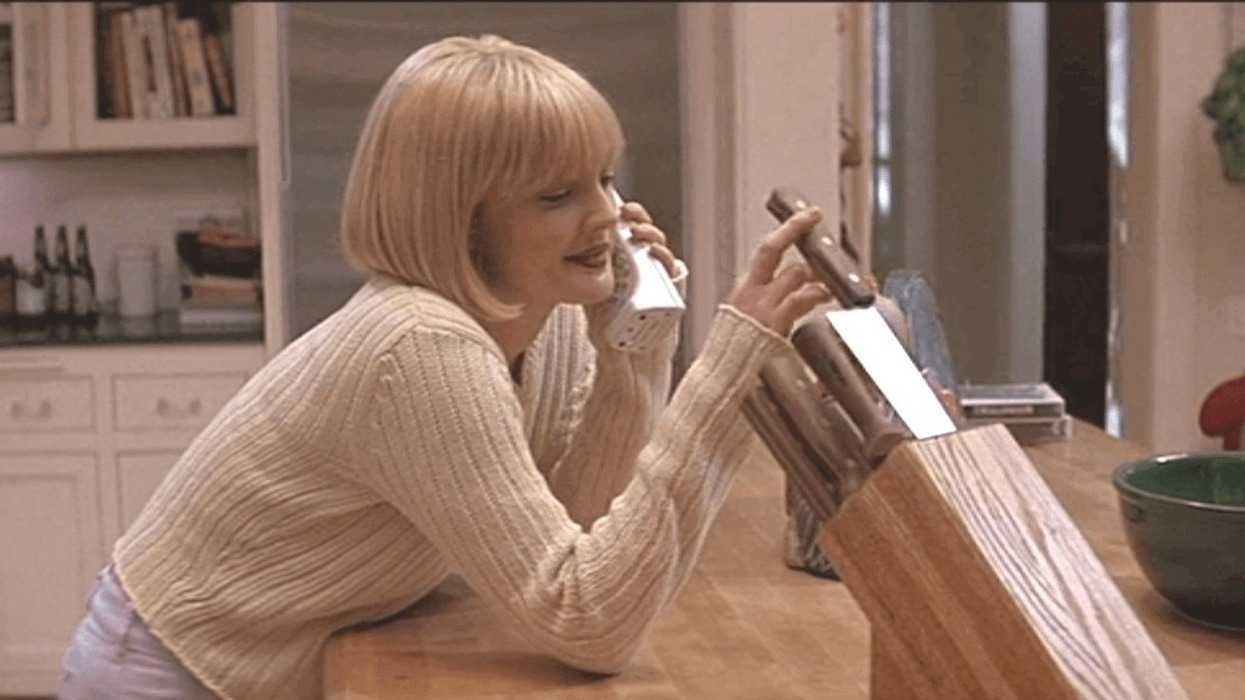
9. Casey Becker (Scream, 1996)
Written by: Kevin Williamson | Directed by: Wes Craven
While home alone, Casey Becker (Drew Barrymore) receives a call from someone unknown. Initially, she playfully entertains the conversation and engages in a flirtatious chit-chat about movie trivia. The caller soon turns malevolent and sadistic, ultimately resulting in Casey getting brutally murdered.
By killing off its biggest star in its opening scene, the movie practically rewrote the most crucial rule of the slasher genre: there are no rules. Craven announced that all bets were off and revitalized the slasher tropes to make the horror more nail-biting for the new generation.
10. The Phone Call (Phone Booth, 2002)
Written by: Larry Cohen | Directed by: Joel Schumacher
The movie is famous for its main setting: the public phone booth. Stuart Shepherd (Colin Farrell), a slick, cocky publicist, finds himself trapped—both physically (in the booth) and psychologically (in the call)—by a sniper (Kiefer Sutherland). What initially seems like a silly ruse quickly turns out ot be a frightening hold-up.
The scene’s impactful tension can be credited to flaking off all the excess and maintaining just the bare essentials: one actor, one location, and one impossible choice. Farrell’s desperation comes across as genuine, while Schumacher’s use of split-screens and close-ups makes the audience feel as if they are trapped with Stuart. The film also proves that explosiveness and blood-racing sequences don’t always need larger-than-life settings or overtly illustrative writing; tighter spaces and tight writing do just fine if you know how to milk them.
11. “I Will Find You, and I Will Kill You” (Taken, 2008)
Written by: Luc Besson, Robert Mark Kamen | Directed by: Pierre Morel
Retired CIA operative Bryan Mills (Liam Neeson) witnesses his daughter Kim’s (Maggie Grace) kidnapping in real time while talking to her on the phone. Stunned and helpless, he instructs Kim to remain calm, and then he speaks to the kidnapper. While remaining utterly objective, he tells the kidnapper, in the calmest possible yet chilling tone: “I will look for you, I will find you, and I will kill you.”
The delivery, loaded with composed menace, raises the film’s excitement quotient to another level. The business-like coherence and composure with which Bryan explains his plan of action immediately validates Bryan’s formidable character. The movie, especially this scene, is notable for causing the resurrection of Neeson’s career.