7 Incredible Plot Conveniences In Movies
Films that made you say “Yeah, right!” out loud.
Transformers (2007)
Every story hits its speed bumps. But some speed bumps just magically disappear.
We all recall a moment in a film, probably one we love, when the story suddenly tilts in a character’s favor. Something about the timing or the manner in which it happens feels suspicious or too perfectly timed. This is what’s known as a plot convenience.
Plot conveniences are unsurprisingly popular in storytelling. However, some are so unmissable and significant that they cannot be ignored.
Let's take a look at seven such films that had unmissable plot conveniences.
What Exactly Is A Plot Convenience?
Simply put, a plot convenience is when realistic obstacles are removed from a story, typically from a character’s path, only so that the story can move forward evenly. It is introduced into a story in a manner that ignores realistic possibilities, to some extent, and hence it is labelled as a plot “convenience.”
Another common purpose of a plot convenience is to push the story towards an important point quicker than it would otherwise, if it dealt with certain practicalities. If this is minor and does not feel like an unavoidable, realistic detail was overlooked, it wouldn’t count as a plot convenience.
To a large extent, plot conveniences are personal. Some may find certain plot conveniences to be normal or acceptable in a cinematic setting. Others may find it to be a practical hindrance.
In this list, I have tried to choose moments from films that feel a little bit too … convenient.
7 Incredible Plot Conveniences In Movies
Here are seven films that simply had to make it to a list of unforgettable plot conveniences in cinema.
(Let me make one thing clear, these are all fun, likeable movies. Many of them are compulsively rewatchable. The purpose of this list is to point out the plot conveniences in these movies and nothing else.)
1. Jurassic Park (Steven Spielberg, 1993)
Plot: A billionaire’s dinosaur theme park goes catastrophically offline during a storm, putting its visitors in direct contact with real dinosaurs.
Plot convenience: How is this massive, obviously dangerous theme park being run by a single computer system? Let’s also assume that this isn’t the first storm humanity has witnessed. One click puts murderous dinosaurs in contact with humans. One click restores the system. Come on!
2. Independence Day (Roland Emmerich, 1996)
Plot: Massive alien invasion destroys Earth’s cities, and all of humanity has one day to fight back.
Plot Convenience: David Levinson’s (Jeff Goldblum) 1996 PowerBook wirelessly connects to an alien spaceship that has never come in contact with human technology. Not only that, it uploads a virus written in one afternoon and disables the alien fleet altogether. I mean, it's an alien invasion that gives us all a day to make a case for our survival; maybe the required response should have been just a little more challenging?
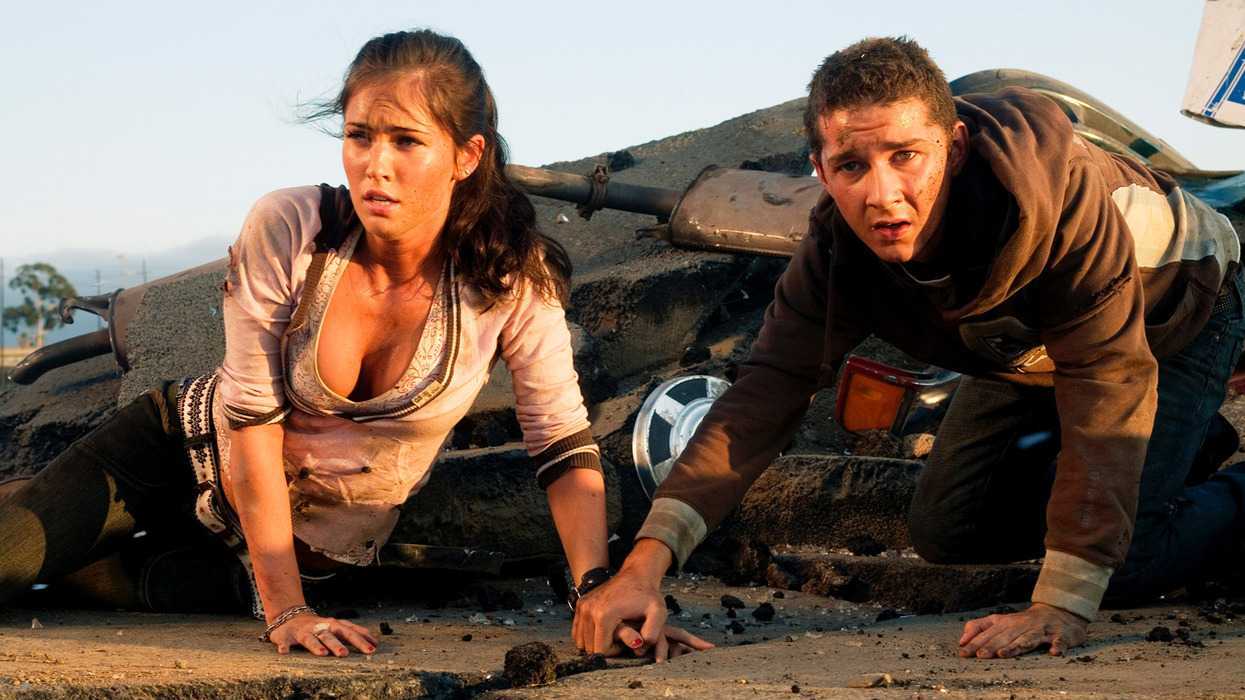
3. Transformers (Michael Bay, 2007)
Plot: Teenager Sam Witwicky’s (Shia LaBeouf) first car turns out to be a robot that drags him into an ancient war between other such robots.
Plot Convenience: Sam’s great-great-grandfather accidentally (wink) discovered Megatron a century ago, and the only map to the All Spark is engraved on a pair of glasses, which Sam is trying to sell on eBay. If that wasn’t enough for a plot convenience, Sam tries to sell the glasses the exact week the Decepticons arrive. There is perfect timing, then there’s this!
4. Harry Potter and the Philosopher’s Stone (Chris Columbus, 2001)
Plot: 3 eleven-year-olds, Harry Potter (Daniel Radcliffe), Ron Weasley (Rupert Grint), and Hermione Granger (Emma Watson), discover that someone is after the Philosopher’s Stone at Hogwarts, in J.K. Rowling’s magical world.
Plot Convenience: The stone is mystically protected by the exact skillset that each of these three kids possesses. Flying keys for Harry, the star Seeker, giant chess for Ron, the strategy genius, a tricky logic-potion riddle that only Hermione can solve, and the Mirror of Erised, which only gives the stone to someone of pure heart. Obviously, as the series of films moves further, the plot conveniences disappear, which I think is part of the Harry Potter series’ charm.
5. Speed (Jan de Bont, 1994)
Plot: On a routine day, a city bus will explode if it drops below 50 mph. Jack Traven (Keanu Reeves) and Annie Porter (Sandra Bullock) have to keep it moving through LA traffic.
Plot Convenience: Howard Payne, the bomber, played by Dennis Hopper, installs a pressure sensor that never once glitches despite bumps and crashes. Payne’s video feed to the police is crystal clear; that would be a lot more believable today than it was in 1994. The most convenient aspect of Speed is how Payne almost hands Jack and Annie every piece of information they need to stay ahead, ensuring the bomb doesn’t go off. However, the brilliance of the film lies in how none of these things matter because that bus ride is thrilling and breathtaking.
6. Titanic (James Cameron, 1997)
Plot: Artist Jack Dawson (Leonardo DiCaprio), of limited means, and wealthy Rose DeWitt Bukater (Kate Winslet) fall in love on the doomed Titanic.
Plot Convenience: I think you know where I am going with this. At the end of the film, Rose drifts to one door panel that’s exactly the right size to keep an adult afloat. It holds her perfectly, never tips or threatens to drown her. So, wait, there was room for two, right?
This debate sent the internet into a spiral and continues to be a polarising one. Well, if the idea was to make a tragic love story, let’s presume that Jack had to die (sorry, Jack), and hence, the greatest convenience in the film is that itself. Jack’s death is essential to the tragedy, even if there was room for two.
7. The Day After Tomorrow (Roland Emmerich, 2004)
Plot: A sudden climatic shift freezes half the planet. Sam Hall (Jake Gyllenhaal) and his friends take shelter in a New York Public Library while his father, Jack Hall (Dennis Quaid), treks north to save him.
Plot Convenience: One fireplace plus an endless supply of books and wooden shelves keeps Sam and his friends perfectly warm in extreme cold. It gets better. They don’t face any smoke or oxygen problems. Just like another chilly winter evening, they weather the storm, which is quite certainly convenient. I guess that is why they say, books are our greatest companions.
Final Thoughts
Even though we can go on and on about plot conveniences being a bother, more often than not, they are what make movies magic. In their own sweet manner, they take away everyday obstacles and help us believe in a world that clearly isn’t real. Multiple love stories, for example, take enormous liberties, especially in their third acts. But I did not include them in this list because I feel like those liberties are part of their charm.
What are some of the plot conveniences you spotted in a movie? Tell us in the comments below!