Why 'Independence Day' Still Works 30 Years Later
Some movies live on in popular culture and inform our lives long after we're done with them in theaters.
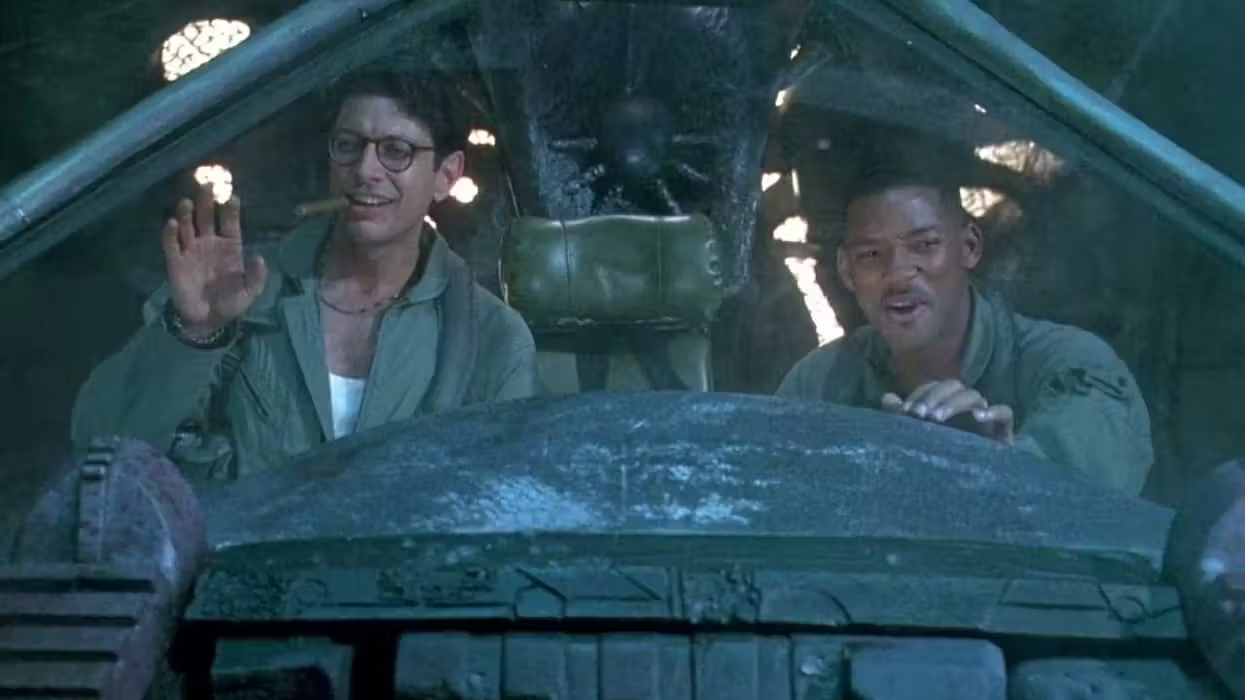
'Independence Day'
I was down the shore when this movie came out in 1996, and I remember walking the beach and hearing people talking about it in passing.
It was an action blockbuster that took the world by storm and just became a movie people love to revisit, with iconic scenes and lines they love to recall and quote.
It's hard to believe it's been 30 years since director Roland Emmerich unleashed Independence Day onto the world, but it's kind of that ultimate summer blockbuster everyone has been trying to capture since.
And its story still holds up today.
Today, I want to look at the screenwriting, practical effects, and pacing choices that keep this alien invasion classic completely timeless.
Let's dive in.
- YouTubewww.youtube.com
1. The Power of Perfect Pacing
This is not a short movie, but it never feels slow. Independence Day opens with aliens arriving on Earth and keeps its foot on the gas pedal from then onward.
But that doesn't mean that the ehowl thing is an action set piece. Actually, the whole first act makes you wait and wonder. You're on the edge of your seat, wondering what the aliens will do after their arrival and watching people on Earth scramble to decode a message.
The film operates on an incredibly deliberate rhythm and pace. The giant city-destroyers enter Earth's atmosphere, position themselves over major global cities, and then... as we break into act two...
They attack!
2. A Masterclass in the Three-Act Structure
Pacing matters, but the script for this movie is really dialed in when it comes to structure. The film is widely taught as a prime example of a highly functional three-act screenplay structure, which we went into briefly above.
- Act I (The Threat): The status quo of all of Earth is disrupted. We meet a massive ensemble cast scattered across the country, each facing personal stakes before the ships arrive.
- Act II (The Midpoint & Low Point): The initial counterattacks fail miserably. The characters are brought to their lowest point, forcing them to retreat to Area 51, where it looks like everyone will die.
- Act III (The Climax): The disparate characters unite under a singular, desperate plan to fight back on July 4th, reorganizing an American holiday to become one for the world, where they are standing up to the bad guys pushing them around.
When it comes to the people on screen, each of them has distinct arcs that allow for payoffs all set up from the first time we meet them.
Every main character has a clear arc that pays off.
David Levinson (Jeff Goldblum) overcomes his being passive and failing at life's biggest moments, like his marriage, to save the world; Captain Hiller (Will Smith) earns his way into the space program and becomes a husband/father; and President Whitmore (Bill Pullman) transitions from a politically weak leader into a unifying commander who earns the respect of his countrymen and the world.
3. Practical Effects Keep It Grounded
The mid-1990s were a transitional era for Hollywood visual effects. We are seeing the rise of CGI, but there were still a lot of practical effects and miniatures to capture the destruction.
The iconic shot of the White House exploding wasn't created inside a computer. The crew built a massive 1/12th scale plaster model and rigged it with real pyrotechnics.
The aliens were not CGI blobs, but guys in costumes that could really grip necks and really be punched in the face. There were things to act off and to react to.
The Takeaway for Filmmakers
Independence Day still holds up because it remembers that spectacle only works if you care about the people on the ground. And if the effects look real and timeless.
It's a movie I go back to time and time again for its scope, scale, and characters. And I think Hollywood would love to find something to replicate its success.
Let me know what you think in the comments.