“Where’s the Horizon?!!!” John Ford's Advice to a 15-Year-Old Spielberg
One brief and embarrassing meeting with the legend John Ford pushed the horizons of a young Spielberg.
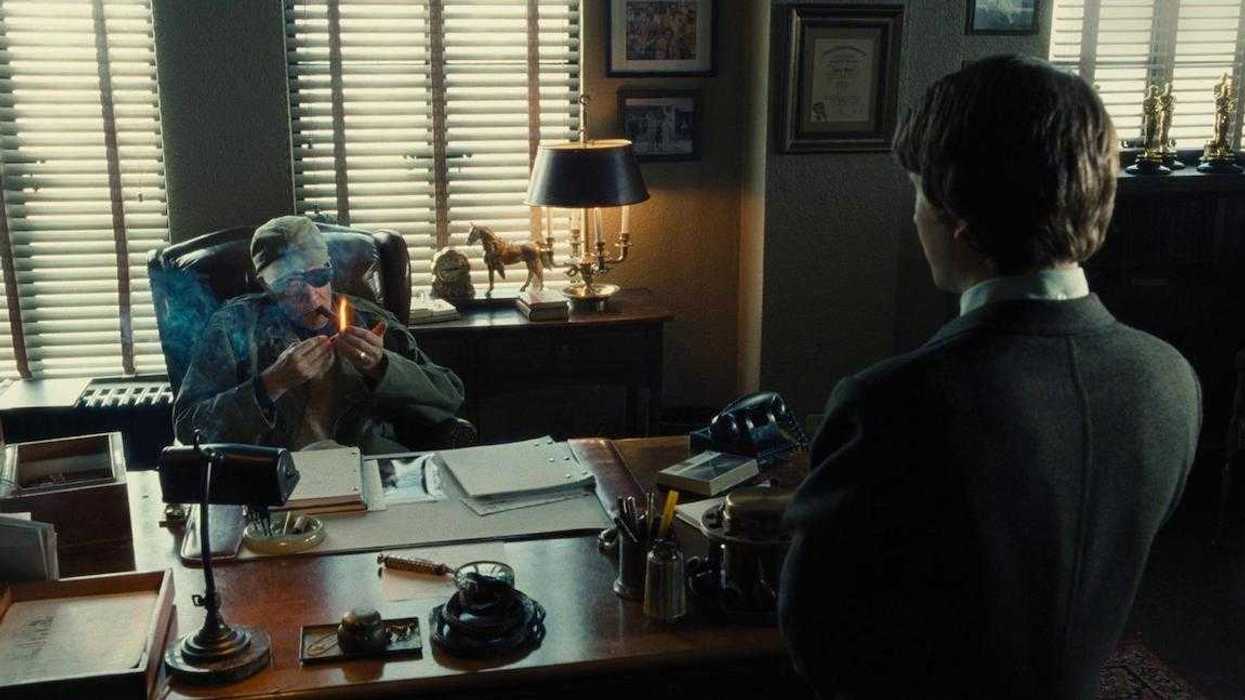
'The Fabelmans' (2022)
Once in a lifetime, life puts you in front of the toughest son of a gun with the most valuable advice. The same happened with a 15-year-old Steven Spielberg when he met his idol, to whom many of the greatest directors of our generation owe their editing and visual styles.
Ford asked, “Where’s the horizon?” The young Spielberg heard this and started trembling and mumbling as he stood face-to-face with his hero. He wanted to convey his appreciation to a genius of a person, but ended up learning a life lesson that would change the way he makes movies.
Let’s understand what Ford meant by his advice to Spielberg in this inspiring yet short meeting.
When Spielberg Met Ford
At the age of fifteen, Spielberg managed to arrange a meeting with his hero, John Ford, in his office at Republic Studios.
Ford’s office was decorated with Western paintings. When Spielberg walked into the office, he saw a pair of cowboy boots sitting on his desk. Wearing a safari jacket, a floppy hat, an eyepatch over his left eye, and smoking a cigar, Ford didn’t deliver a formal filmmaking lecture to the young Spielberg.
The Golden Interaction
His very first question to Spielberg was, “They tell me you wanna be a picture-maker?” To which Spielberg happily obliged. Then he asked, “What do you know about art?” Spielberg stammered hard while constructing his answer, and Ford interrupted, telling Spielberg to move over and keenly observe the paintings hanging on the wall one by one, repeatedly asking, “What do you see in the painting?”
When Spielberg tried to describe them in terms of characters, subjects, and settings, John cut in to ask, “Where’s the horizon?”
Each time, Spielberg would identify it—always either at the bottom or at the top in the paintings. John Ford made him bounce from one composition to another until the subtext of his words solidified.
The Punchline
Ford then delivered his famous instruction: “When you’re able to distinguish the art of the horizon at the bottom of a frame, or at the top of a frame—but not going right through the center of the frame—when you’re able to appreciate why it’s at the top and why it’s at the bottom, you might make a pretty good picture-maker. Now, get out of here.”
The Lesson in Disguise
John Ford didn’t simply mean that you shouldn’t put the horizon at the center. It’s far more profound than that.
When the horizon line is at the top of the frame, it dominates the foreground action, with more focus on the objects, people, and the ground. It lends narrative power to the characters and the action in the frame.
When the horizon is at the bottom, the framing dominates the vastness in the sky in the background. It evokes feelings of wonder, openness, and huge landscapes, often making the characters look small under a vast sky. It’s ideal for when you want the environment to be the main subject of the frame.
After all, putting meaning behind framing is what differentiates a visual storyteller from a competent cinematographer.
Influence on Steven Spielberg
Although this incident proved to be the most embarrassing encounter of Spielberg’s life, it became the foundation of his filmmaking career. As a master of his craft, he used every horizontal and vertical line as part of storytelling—a gate, a pool table, or maybe a huge wall.
It’s safe to say that Spielberg took the technique to a whole new level by applying the same theory to character-object framing. Whether it’s a character hiding in the foreground of a table or a moving shot of a character from point A to point B (complex blocking), cleverly shifting the focus from foreground to background action, he knew where to place the camera. Moreover, the consistent use of reflections, mirrors, and push-in close-ups in Spielberg’s work is heavily inspired by John Ford’s filmmaking style.
This advice laid the foundation for his composition in movies like Jaws, Schindler’s List, Jurassic Park, and countless others. Every frame holds meaning, a contribution to the narrative on screen rather than just being a stunning piece of cinematography.
Ritual Before Shooting
Steven Spielberg has also stated in interviews that before shooting every movie, he watches one or two of John Ford’s movies, simply because Ford’s framing and composition inspire him. Listen to the man himself.