The Doorway to Nowhere: Why the Final Shot of ‘The Searchers’ Still Haunts Us
The closing shot of Ethan Edwards walking away in The Searchers (1956) shows a hero forever locked outside the world he saved.
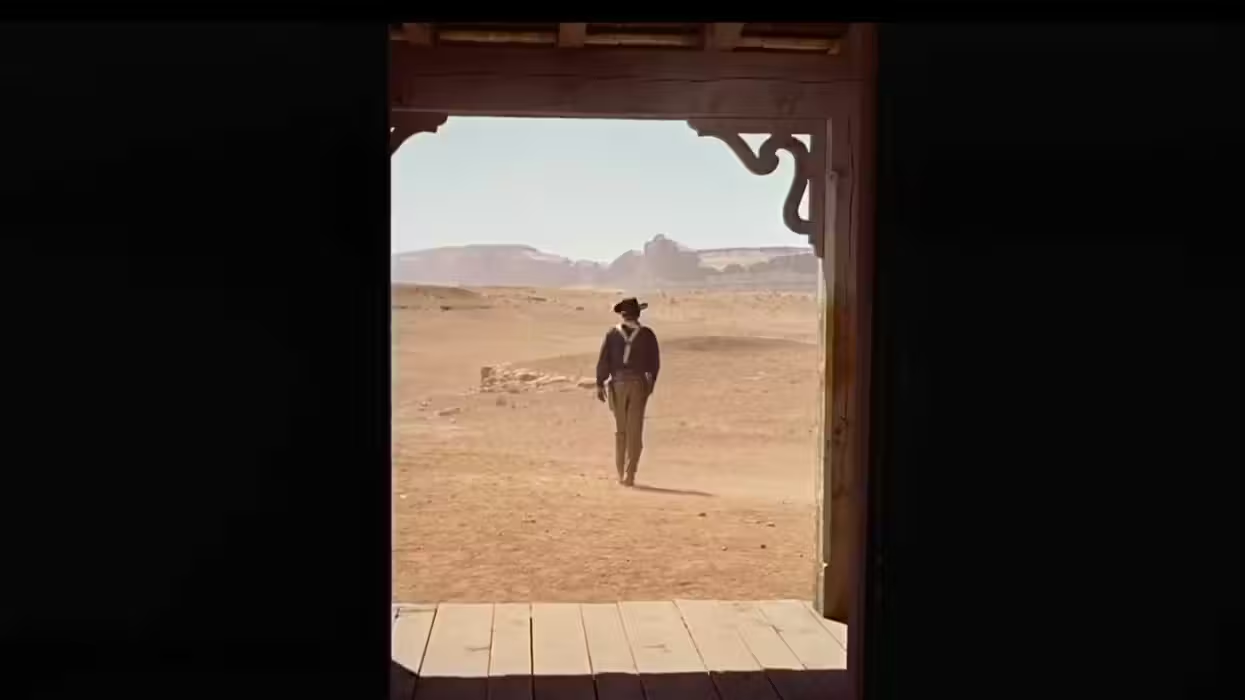
'The Searchers' (1956)
The Wild West often serves as the foundation of American mythology. It’s quite understandable that one expects the Westerns to conclude in the hues of overwhelming Americana.
The Searchers (1956), however, has a surprisingly grounded take on this. Having spent years on a single mission and after having finally achieved his goal, the protagonist returns home only to have a quiet realization that he no longer belongs there.
That’s the note at which the movie ends: a profound sense of isolation. And the image of the protagonist “walking away” has been immortalized as the poignant reminder of that feeling.
It feels wrong, but in the best possible way. The very heart of the Westerns lies (or ideally should be) in rewarding their heroes with a sense of belonging, with a home. But this one refuses. It’s not the “happily ever after” conclusion we would like to leave with—the movie seriously complicates that for us. But this refusal is exactly where the film gains its power.
It gives us a goodbye that acknowledges that some people are built for the journey, not the destination.
Context
Ethan Edwards (John Wayne), an ex-Confederate soldier, returns to his brother’s home after eight years. Shortly after his arrival, the Comanche, a Native American tribe, lures the men away from the house. In their absence, the tribesmen destroy their house, kill Ethan’s brother, sister-in-law, and nephew, and kidnap both his nieces, Lucy (Pippa Scott) and Debbie (Lana Wood).
From here on, Ethan embarks on a rescue mission. Soon after, he goes searching for the girls, and he finds Lucy dead and raped. A few more years pass, but there is no sign of Debbie. Ethan continues the hunt.
Finally, after five years, he finds Debbie (Natalie Wood), now grown up and living as one of the wives of the tribal chief. It’s implied she has been brainwashed and made Comanche. Seeing that she considers herself a Native American, Ethan flies into a rage and tries to shoot her, but his companion, Martin (Jeffrey Hunter), Debbie’s adoptive brother, stops him.
Ethan returns home, but only to arrange a frontal attack on the tribe with more men. This time, the tribal chief is killed, and Ethan forcibly brings Debbie home. After this family reunion, Ethan watches everyone enter the house before he turns and walks away.
The Incompatibility of Peace and Violence
The Door: The Border Between Frontier Life and Family Life
The final shot is taken from inside the house. After everyone enters, the camera doesn’t move but stays focused on Ethan. He is walking away from the house when the visual ends. This directorial choice turns the door into a boundary, both literal and figurative, between the safe, warm interior of family life and Ethan’s reality of the scorching frontier life. It’s a symbolic gap between the civilized world (which Ethan defends) and the violent world (which he lives in). For him, there is no crossing this boundary.
But Why…
Ethan has fought in two wars, the Civil War and the Franco-Mexican War. Fighting and violence are instinctive to him. The film’s timeline starts a few years after these wars have ended, but Ethan has never really put his weapons down. He lives by the code of protection and vengeance.
While characters like Martin represent the future of tolerance, racial integration, and growth, Ethan stands resolute as a relic of the bloody past. He understands that if he is to expect his family to live in peace, he must carry the violence, and he must do so outside the garden gate.
The Choice to Remain an Outsider
The End of the Obsession
Staying true to his “fighter” and “protector” spirit, during the five years of rigorous hunting, Ethan makes “the search” his mission as well as his identity. He obsesses over finding Debbie. Once that mission is over and the threat is neutralized, he has no purpose to stay back: no trade, no land, and no domestic ties. With nothing to fight for, nothing to protect, no conflict to resolve, he becomes a ghost in his own life.
The Weight of the Journey
Throughout the events of the film, you cannot miss a few dark impulses in Ethan’s character. You might think it’s his love for his niece that compels him to go on this obsessive hunt. But when he finds her and sees that she has willingly accepted her new Native American identity, he doesn’t hesitate to pull the trigger on her.
He does ultimately choose to save her, but it’s possible he identifies this darkness inside him. And perhaps that’s why he walks away knowing he cannot fully transition into a peace-loving family man. He has witnessed and partaken in far more brutality to be able to do that. He treats himself like the shadow that must disappear when the light is restored.
The Uncomfortable Legacy
While it remains a poignant picture of a lonely man in the Old West, we must not overlook the window this film provides into the era’s social biases and the controversial nature of John Wayne.
The movie marches into an uncomfortable territory regarding race and morality. It portrays the Comanche (the Native Americans in general) as a vicious, unredeemable tribe. In fact, it straight away uses them as a flat backdrop for Ethan’s personal crusade. No matter how much you try, you cannot ignore the fact that the movie doesn’t so much as flinch while granting Ethan—the guy who fought on the wrong side in the Civil War and to date remains loyal to that ideology—the moral upper hand throughout the story.
Also, when John Wayne, who, in no uncertain terms, pledged his belief in white supremacy, plays the lead, the film adds a layer of historical weight to its one-dimensional depiction of the Old West.
Conclusion
The film’s ending refuses to give us a typical happy wrap-up, and maybe that’s why it works. Ethan comes across as a man who saved his family but lost his own place among them. The end is saddening, but also fitting. His intention, even in “staying outside the family," is to protect the family.
The film ends not with celebration but with a quiet exit that leaves the story’s more troubling biases in the dust. Ultimately, what we take away is the wanderer who is forever framed by a door that will always stay closed for him.
- 10 Best Westerns of the 1970s: Ranked ›
- The Line That Made Clint Eastwood a Legend ›
- 10 Best Movies Starring Clint Eastwood, Ranked | No Film School ›
- Clint Eastwood’s Top 10 Must-Watch Directorial Hits | No Film School ›
- The ‘Dirty Harry’ Line That Made Clint Eastwood Untouchable ›
- 12 Lines That Made Clint Eastwood a Legend ›
- What Are The Best Western Movies of All Time? | No Film School ›
- How Martin Scorsese Was Inspired by 'The Searchers' | No Film School ›
- The John Wayne Quote From a 1976 Western That Still Resonates Today ›
- The 1969 Western That Won John Wayne His Only Oscar ›
- Best John Wayne Quotes ›
- How an Improvised John Wayne Line in ‘The Searchers’ Changed Rock n' Roll History Forever ›
- The John Wayne Quote From a 1968 War Movie Classic That Redefined the War Genre (In a Bad Way) ›
- Kirk Douglas Had One Rule for Working with John Wayne ›