10 Movies That Teach Filmmaking Better Than Film School
By excelling in nearly every filmmaking element, these films reveal how great cinema is constructed from script to final cut.
'Come and See' (1985)
Alfred Hitchcock, Akira Kurosawa, Stanley Kubrick, Steven Spielberg, James Cameron, Quentin Tarantino, Christopher Nolan: What’s common among these people? (You could state the obvious, but you know that’s not what I have in mind.)
The one thing they have in common is that none of them had formal training. Yes, these crème de la crème of auteurs—who not only made classics but defined what qualifies as a classic—never went to film school. And yet, they became film schools.
In one of his interviews, Steven Spielberg claimed that despite not going to a film school, he had several great teachers. And who were they? All the great filmmakers that there are. He taught himself by watching great films made by great filmmakers. Tarantino says, “When people ask me if I went to film school, I tell them, 'No, I went to films.'" Some, like Hitchcock and Kurosawa, got jobs as assistant directors and learned filmmaking on the sets while watching countless films.
So, that brings me to wonder: Film schools are great, but are they essential? I mean, you have the greatest professors in cinema history who left their lessons and lectures on celluloid; do you really need to shell out thousands of dollars to do the same in a classroom? Do you really need a degree to understand how a camera moves or which cut feels right?
If you have a keen eye, great observation skills, and a shrewd insight, I say, just watch how the greats handle a lens or a script, and you will pick up the “grammar” of films.
And you can start here. I have shortlisted 10 essential films that should work as a full curriculum. These movies already have what you need; you just gotta find it out.
10 Essential Films That Can Teach Great Cinema
1. Battleship Potemkin (1925)
Written by: Nina Agadzhanova | Directed by: Sergei Eisenstein
As the First Russian Revolution of 1905 is underway, a naval mutiny erupts on the Imperial Russian Navy’s battleship, “Potemkin,” anchored in the Black Sea. The mutiny becomes violent and quickly spreads beyond the ship’s naval officers. The film follows the rhythmic, terrifying sequence of escalating violence as the civilians face the wrath of the Russian soldiers.
Sergei Eisenstein is credited with the invention of the montage technique, which is called the Soviet Montage Theory. While he experimented with this technique in his previous film, Strike (1925), it was in Battleship Potemkin that he perfected it. Through montages, Eisenstein proves that the way you join two shots creates a specific emotion in the viewer. If you watch the film, focus on the famous “Odessa Steps” sequence, which, on any given day, is a better lesson in pacing and visual impact than any textbook. This sequence tells you that editing and montage are not just about cutting scenes and sticking them together; it’s about building a psychological reaction through the meaningful collage of moments.
2. Citizen Kane (1941)
Written by: Herman J. Mankiewicz, Orson Welles | Directed by: Orson Welles
A newspaper tycoon, Charles Foster Kane (Orson Welles), dies, leaving behind a cryptic final word: “Rosebud.” A reporter decides to uncover who Kane was by trying to find out what “Rosebud” is. He interviews Kane’s former associates and acquaintances to solve the mystery of the man behind the massive media empire.
Citizen Kane is well-known for having extensively used deep focus photography to keep everything in the frame sharp. This is how Welles directed the audience to look where he wanted them to focus. At the time, it was groundbreaking how he used the low angles and ceilinged sets to change how viewers perceived power or dominance on screen. The film is also a masterclass in blocking and its innovative use of light and shadows. If you watch Citizen Kane, you might learn a thing or two about how to use every inch of the frame to tell a story without using words.
3. Bicycle Thieves (1948)
Written by: Cesare Zavattini | Directed by: Vittorio De Sica
In post-war Rome, a desperate father, Antonio (Lamberto Maggiorani), loses his bicycle on the first day of his job. This cycle is extremely vital for the survival of his family. The film follows as he and his young son, Bruno (Enzo Staiola), comb the city in a frantic, heartbreaking, and ultimately futile search to recover it.
If you ever actually get down to making a film and face budgetary issues, I insist that you watch this film. It will boost your morale by showing you that you don’t need millions to create high stakes on screen. It’s a beautiful lesson in how to utilise non-professional actors, as well as how to excel in “on-location” shooting. Being one of the foremost proponents of Neorealism, Zavattini and De Sica maintain a minimalist approach and prove that a simple, linear quest such as this can carry immense emotional weight. All it needs is a focus on the subtle bonds between characters. You can skip flashy gimmicks.
4. Seven Samurai (1954)
Written by: Akira Kurosawa, Shinobu Hashimoto, Hideo Oguni | Directed by: Akira Kurosawa
After getting wind of a bandit gang’s plan to raid their village, the villagers hire seven rōnins, i.e., wandering samurai without masters. The film, a character-driven human drama, is an exploration of the interpersonal dynamic between the men, wherein their leader, Kambei (Takashi Shimura), organizes the defense, while the erratic Kikuchiyo (Toshiro Mifune) tries to prove his worth as a true warrior.
Kurosawa was a master of geometry. He used the “rules of threes” and physical movement to simplify the complex action scenes. This film will teach you how to manage a large ensemble cast. It will also teach how to use weather, like rain, to intensify and heighten drama. I am sure you must have watched a lot of action movies; watch this one to know why it is a blueprint for all those regarding balancing character development with tactical, coherent direction.
5. 2001: A Space Odyssey (1968)
Written by: Stanley Kubrick, Arthur C. Clarke | Directed by: Stanley Kubrick
In prehistoric times, humanity discovered a mysterious monolith, which triggered an evolutionary leap. Millions of years later, Dr. Dave Bowman (Keir Dullea) heads towards Jupiter, but the onboard AI, called HAL 9000 (voiced by Douglas Rain), begins to malfunction, causing deadly consequences.
Kubrick famously said, “The screen is a magic medium,” and this is where he proves how. The most important takeaway from this film is “visual storytelling” by stripping away dialogue. It is simply exceptional how Kubrick managed to bridge thousands of years of history through just sound design and match cuts. “Production design” is yet another vital takeaway for you. If you are curious about how to lift music from simply being background noise and use it as a narrative force, then, once again, watch this film.
6. The Godfather (1972)
Written by: Mario Puzo, Francis Ford Coppola | Directed by: Francis Ford Coppola
Michael Corleone (Al Pacino) is a war hero, but also the youngest son of a powerful mafia boss, Vito Corleone (Marlon Brando). After an attempt on Vito’s life, Michael gets sucked into the family’s crime business. The film follows his character journey from a reluctant outsider to a cold and calculating mob leader.
When a noun becomes an adjective, it’s an indication that it has become a gold standard. The Godfather has become an adjective, and there really is no point in going into how valuable this film is. But to stress some less talked-about angles: Gordon Willis, the cinematographer, used “Rembrandt lighting” to keep the characters in shadows, reflecting their moral ambiguity. The film also teaches you about subtext. The framing is also worth paying attention to, as it shows how the camera can be used to reveal a character’s internal conflict—in this film’s context, characters’ corruption. Screenplay structure? Again, a gold standard. It demonstrates how to weave multiple subplots into a cohesive, operatic tragedy that feels both legendary and intimate.
7. Fanny and Alexander (1982)
Written by: Ingmar Bergman | Directed by: Ingmar Bergman
Young Ekdahl siblings, Fanny (Pernilla Allwin) and Alexander (Bertil Guve), see their lives changing for the worse when their father dies, and their mother marries a cold and austere bishop. The children move from their bustling, vibrant, and (literally) theatrical home into a grey, oppressive world of strict religious discipline.
The film goes “big” on production design, and masterfully uses it to mirror characters’, especially Alexander’s, internal state. The mere contrast in the respective architecture of both the warm and cluttered Ekdahl household and the stark, empty Bishops’ house is enough to tell a story. The film is also noted for its ingenious use of magical realism and for blending it with gritty drama. What’s more, you can learn how to handle a wide range of tones—from joy to terror—within a single, cohesive narrative structure.
8. Ran (1985)
Written by: Akira Kurosawa | Directed by: Akira Kurosawa
Hidetora (Tatsuya Nakadai) is an aging warlord who decides to abdicate his throne and divide his kingdom between his three sons. Sadly, this decision sparks a bloody civil war that is fueled by betrayal, pride, and family madness.
One thing that prominently jumps out from Ran is its vibrant mishmash of colors. The film is essentially a painting; an authoritative lesson in “color theory” and epic scale. It’s worth noting how Kurosawa uses different hues to symbolize different psychological states. Its every frame can teach you that cinematography should be used to emphasise the narrative themes; chaos and man’s inevitable downfall, in this context.
9. Come and See (1985)
Written by: Ales Adamovich, Elem Klimov | Directed by: Elem Klimov
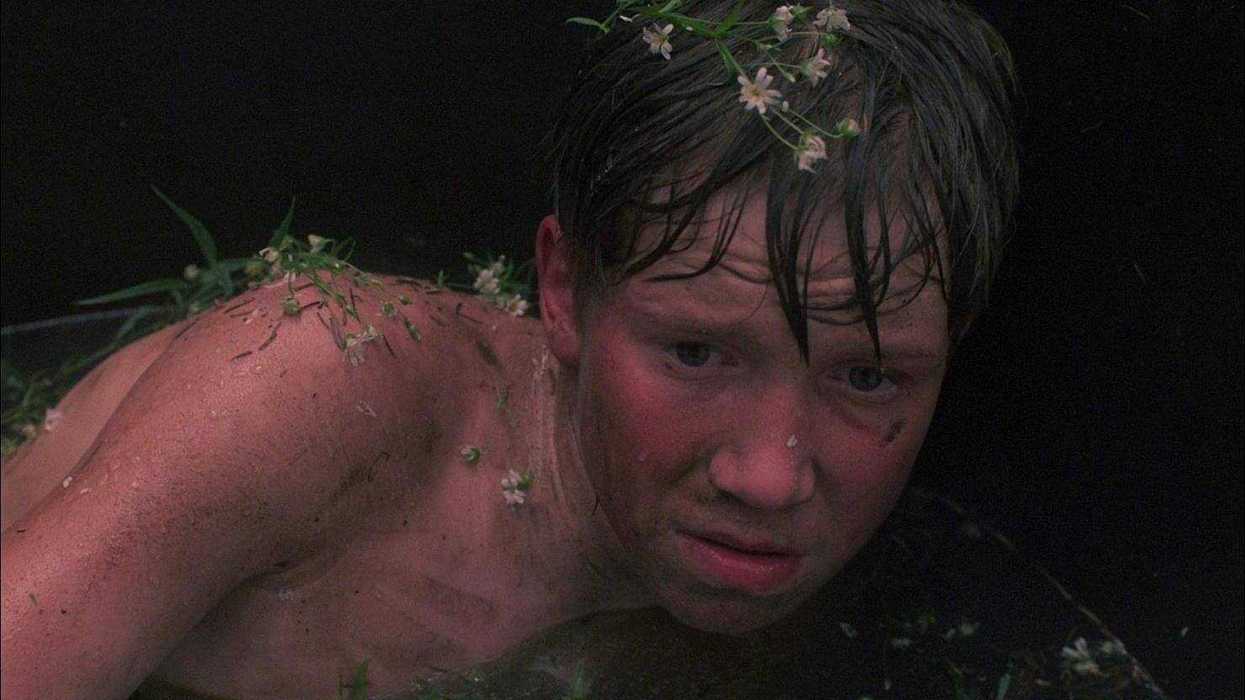
During World War II, in German-occupied Belarus, a young boy, Flyora (Aleksei Kravchenko), joins the Soviet resistance against the warnings of the village elders. What follows is the unimaginable brutality of the Eastern Front, which causes him to physically and mentally age as the horrors of the invasion consume his world.
Lauded as one of the supreme anti-war films, Come and See doesn’t hold back in its depiction of war atrocities, trauma, and loss. Things that are usually skipped in more mainstream war-related movies are not only included here but are intensified through techniques such as “subjective sound design” and Steadicam. Klimov’s use of high-pitched ringing and muffled audio puts us inside Flyora’s shell-shocked perspective. Also, you can learn how, in realistic films, especially war films, the use of visceral, unflinching cinematography can come in handy. The film also uses long takes to create a sense of inescapable reality. If ever “catching human trauma” is on your filmmaking bucket list, give this film a go.
10. The Silence of the Lambs (1991)
Written by: Ted Tally | Directed by: Jonathan Demme
As the FBI hunts for the serial killer Buffalo Bill (Ted Levine), it comes upon a rookie trainee, Clarice Starling (Jodie Foster), to interview an imprisoned—and cannibalistic—serial killer, Dr. Hannibal Lecter (Anthony Hopkins). The idea is to gain his brilliant but twisted insights to apprehend Buffalo Bill.
Just pay attention to the “subjective camera angles,” in which actors look directly into the lens. Demme uses this technique to let the audience peek directly into the characters’ inner psychological world; Clarice’s vulnerability and Lecter’s manipulativeness. That’s like watching emotions in 3D. The movie is also a perfect lesson in editing and shot selection for building suspense. It teaches you how to use close-ups to create an intimate, terrifying connection between the hero and the villain. This approach will help you make the audience feel they are trapped in the same room with you.
- Watch: How to Teach Yourself the Basics of Filmmaking in 30 Days ›
- Skip Film School and Learn the Basics With These Free Resources ›
- 5 Keys to Learning How to Be a Filmmaker ›
- How Stanley Kubrick Recreated New York Without Leaving London ›
- 10 Filmmaking Tips from Stanley Kubrick | No Film School ›
- This Is Why Stanley Kubrick Did 30 or More Takes for Every Scene | No Film School ›
- Who Is Sergei Eisenstein, and What Was Soviet Montage Theory? | No Film School ›
- “A Nice Chianti”: 8 Iconic Anthony Hopkins Quotes That Define His Legacy ›
- 7 Great Hal Ashby Films That Shaped New Hollywood ›
- 10 Best Nicolas Cage Movie Characters, Ranked ›
- This is For the People Who Are Nervous to Make a Movie | No Film School ›