Film Quote of the Day: The 'White Heat' Line That Proved Censorship Can Accidentally Create Masterpieces
"Made it, Ma! Top of the world!" — Cody Jarrett, White Heat (1949).
'White Heat'
If you're like me, you probably have a list of movie endings that completely rewired the way you think about movies. The ones that rocked you in the theater or home on the couch, and challenged your own writing to be better and more impactful.
Whenever I’m talking to students about ending a movie on a high note, or just arguing with friends over the greatest gangster movies ever made, I bring up White Heat. It's one of my favorite classic movies to recommend to people because it feels so contemporary and so manic.
This film has this kinetic energy that sucks you in and shows you a side of criminality that, at the time, Hollywood wasn't sure how they felt about it. There were codes around what you could and could not broach, so this film feels dangerous.
Today, I want to dig into the movie's most famous line and talk about how it echoes not just in our heads and hearts, but across all cinema.
Let's dive in.
- YouTubewww.youtube.com
The Scene in Question
As I said at the top, White Heat is one of my favorite movies to recommend to people who want to try out a classic gangster movie. It was made at a time when the Hays Code was rampant in Hollywood, so you kind of get this epic adventure that has all the violence and thrills you want, but alludes to extreme violence and sex in ways that feel elegant and imposing.
The film stars James Cagney as Cody Jarrett, a ruthless, migraine-plagued gang leader. But this gangster isn't just obsessed with money and power; he's also a Momma's boy who needs her approval for everything he does.
The story follows Cody's hijinks, making money, falling in love, and becoming the most notorious gangster in America, all while the cops chase him.
This is him living up to his mom's expectations; she raised him to be this guy. She was the one who was always there, telling him he could do it, and he even talks about how she wanted to see him on top of the world.
He's been betrayed one by one by the people around him, including an undercover cop they set up to bring him in, whom he thought was his friend.
At the movie's climax, Cody’s world has completely collapsed. His mother is dead, his gang has betrayed him or is dead, and he has been cornered by the police at a massive oil refinery.
That's when we get maybe one of the coolest endings in gangster cinema.
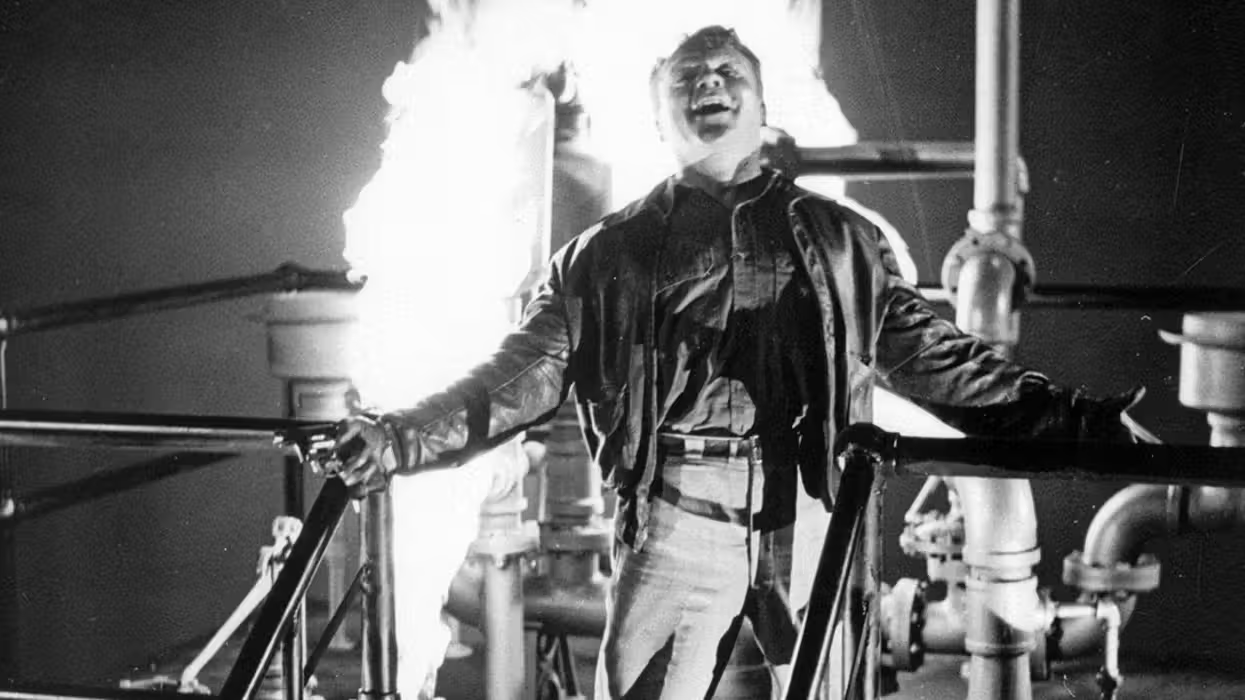
Bleeding and out of time and options, Cody climbs to the top of a chemical storage tank and yells down at the assembled cops below.
They want him to surrender, but he has other ideas.
Cody laughs maniacally, shoots the tank beneath his feet to ignite the gas, and screams his final, legendary tribute to his mother into the night sky right before he blows himself into smithereens.
"Made it, Ma! Top of the world!"
- YouTubewww.youtube.com
How The Hays Code Created a Legend
This movie totally rocks. It has one of the most compelling character arcs in cinema and also feels like it pulls no punches...when it actually is pulling them quite often, thanks to the Hays Code.
During this era, studio screenplays were governed by the Motion Picture Production Code, which was better known as the Hays Code.
These were rules put in place that were effectively censorship. They were non-negotiable, and they had a certain set of guidelines as to how criminals could be shown on screen...
- Crime could never be presented in a way that would evoke sympathy with the criminal.
- The audience must never be encouraged to associate with, or imitate, the wrongdoer.
- Most importantly, evil and sin must always be punished. No criminal could ever get away with it.
But Raoul Walsh and writers Ivan Goff and Ben Roberts didn't want ot make a boring movie with James Cagney; they wanted to make an evocative gangster film that pushed the code as far as it could go.
So he used their rules against them.
They made a movie that followed the rules but suggested a lot subtextually. Think about the line we got, an all-time great line. Just on a pure character level, the line is a distillation of Cody's entire psychology.
In the movie, we see that his mother was his driving force behind his bad deeds, and also, somehow, the only connection he had to being a real person outside of his gangster ways.
At the end, he's up there thinking she may finally be proud of him; he is literally on top of the world, the most wanted man out there, and standing alone at the pinnacle of success. We're getting a wink and a nod at the Hays Code saying you can't show them win, he has, objectively, gotten all his heart's desires.
And he doesn't let the law punish him; he goes out on his own terms.
Cody gets vaporized by his own ambition.
This satisfied the censors' demand for punishment, while still giving the audience a jaw-dropping, mythic finale that made them confront who this guy was and what he believed.
The Takeaway for Screenwriters
As modern filmmakers, we aren't bound by the moral policing of the Hays Code anymore. Movies like the Scarface remake can show and do whatever they want.
But look at how they still harken back to this guy, a complicated antagonist who wants to go out on his own terms in a fiery display instead of whimpering.
We can write antiheroes who ride off into the sunset, and bad guys who get away scot-free. But there is still a massive lesson we can pull from this movie, which is just writing to the theme.
White Heat is not just the title, but his temper and the temperature of how he went out. It was also the way his ambition drove him to madness, and what he felt when he got his migraines.
Writing with all this in mind gave us a memorable movie that was not limited by censors, but took off thanks to suggestions and by bringing the theme into every frame and idea.
Here are the lessons:
- Let the Climax Match the Theme: Cody wanted to rule the world, but his world was built on violence and greed. His final "throne" is a bomb. The setting of your climax should visually mirror your protagonist's internal struggle.
- Write Active Downfalls: Cody isn't taken down by a lucky police sniper. He pulls the trigger himself. When your characters fail or fall, make sure their own choices are what seal their fate. It makes the ending feel incredibly tragic rather than convenient.
Summing It All Up
There is a distinct reason White Heat still feels so dangerous and alive nearly eighty years later. This epic character study holds up because we are still haunted by his ambition to do something and lured in by his charisma and even a secret happiness when we see what he was able to accomplish.
Cody Jarrett was never going to walk away from that refinery. But by screaming that line before disappearing into the fire, he made sure he would live forever, no matter what the Hays Code said.
Let me know your favorite classic gangster movie lines in the comments!