9 Most Misunderstood Movie Characters: Heroes or Villains?
Misunderstood characters—we hate them, we love them, and we misinterpret their intentions.
'500 Days of Summer' (2009)
Let’s be honest, no one likes to be misjudged or misread. It’s the worst feeling ever, but some of cinema’s most iconic characters find themselves in that gray space.
Some characters are hated too quickly, while others are celebrated too easily. The quiet and ambiguous ones are misunderstood, but the loudmouths can be romanticized.
In addition, we humans love labeling—heroes, anti-heroes, or villains. But in reality, people are rarely that simple to explain. If you look closely, you’ll discover their pain, trauma, and fears that made them what they are. On that note, let’s check out the nine most misunderstood characters ever.
9 Highly Misunderstood Characters in Cinema
1. Summer — 500 Days of Summer (2009)
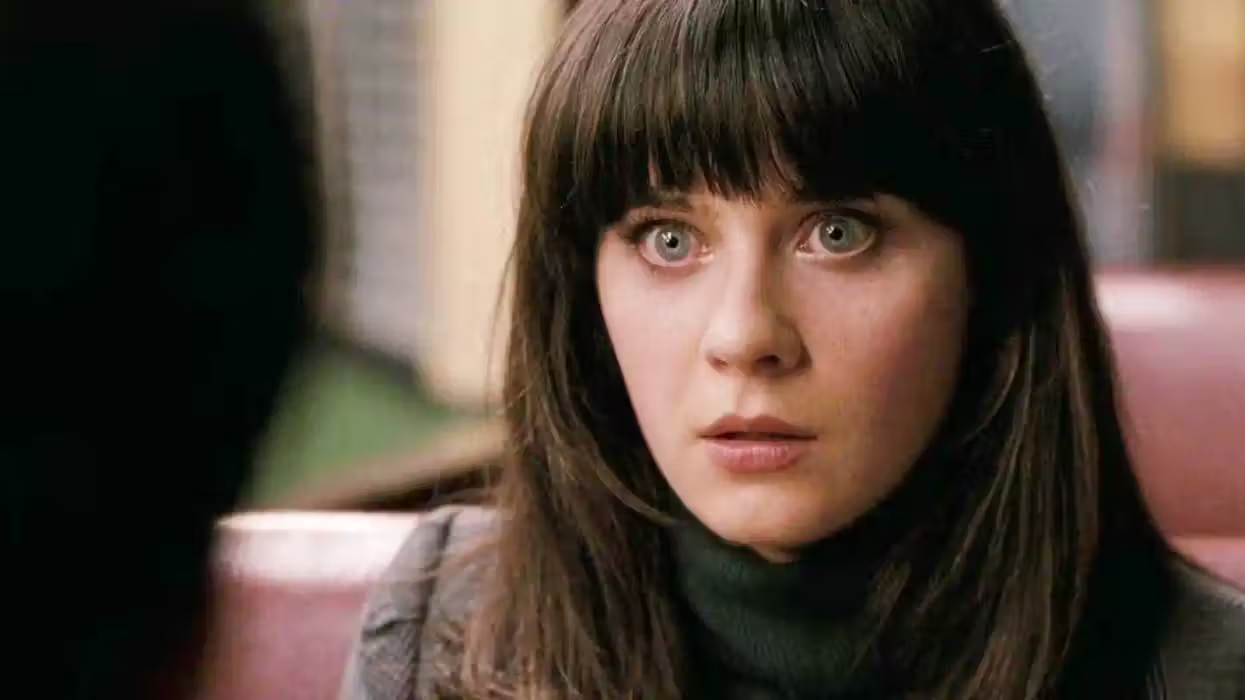
500 Days of Summer is an unconventional rom-com directed by Marc Webb. When Tom (Joseph Gordon-Levitt), a greeting card writer, is suddenly dumped by Summer (Zooey Deschanel), he reflects on his relationship to figure out what went wrong, and in doing so, he rediscovers himself.
Summer Finn’s character is too easy to hate. For most of the audience, she is popularly known as the cold manic pixie dream girl who doesn’t reciprocate Tom's (Joseph Gordon-Levitt) romantic fantasy. However, Tom was borderline delusional. Summer rejects Tom’s idealization of love, which he projects on her. Her leaving Tom is not abandoning him; she is being honest.
2. Severus Snape — Harry Potter Franchise (2001-2011)
“Always.” Severus Snape (Alan Rickman) was considered the cold, sadistic villain, and the audience doubted his motives every time he was on screen with Harry Potter (Daniel Radcliffe). This peaked in the climax of Harry Potter and the Half-Blood Prince, where Snape reveals he is the Half-Blood Prince.
It wasn’t until Harry Potter and the Deathly Hallows: Part 2 that the audience and Harry realized that Snape was a double agent, following the commands of Albus Dumbledore to save the chosen one. Moreover, his unrequited love explained why he always had an eye on Potter throughout the series, making him one of the greatest tragic sacrifices. It reshapes Snape’s character into a daring and good-hearted man who risked his life to bring order to the Wizarding World.
3. Cyclops / Scott Summers — X-Men Franchise
Cyclops is a member of the X-Men team who has also led the superhero team in comics and Marvel movies. But in X-Men movies of the past decade, the portrayal of Cyclops has always gotten flak from fans. He comes out as whiny and annoying, but one thing he is good at, among most superpower-wielders, is his restraint. Cyclops possesses devastating power.
In comics, his ability to control himself and be disciplined is nothing less than heroic—a quality that has proven to be difficult for filmmakers to pull off while adapting the character for the screen.
4. Jenny — Forrest Gump (1994)
A mild-witted Forrest Gump (Tom Hanks), who has difficulty comprehending society’s pre-decided ways, sets out on an adventure and becomes part of historical events while carrying his love for Jenny (Robin Wright).
For the most part, Jenny seems to be a self-centered person who never appreciates or accepts Forrest’s love for her. But if you look at her own personal arc, it’s full of trauma, abuse, and survival. She keeps leaving Forrest not out of selfishness, but out of self-preservation. When it comes down to it, the movie doesn’t dramatize her suffering, making the audience ignore her reasons and mistake her departure for abandonment.
5. Travis Bickle — Taxi Driver (1976)
Martin Scorsese’s Taxi Driver is a cult classic that delves into the isolation and loneliness of a taxi driver, Travis Bickle (Robert De Niro).
Travis Bickle’s character is romanticized as a lone warrior, isolated by society, who eventually becomes a violent vigilante to clean the streets. However, Travis is a deeply disturbed man whose violence emerges from toxic masculinity and deteriorating mental health rather than crime or moral clarity. The film gives us a violent but ambiguous ending—whether Travis’s actions were too pathetic and violent to be justified or were heroic.
6. Tyler Durden — Fight Club (1999)
David Fincher’s Fight Club slowly rose to cult status after a decade of its release. Tyler Durden’s (Brad Pitt) character was at the center of it all with his narrated modern, anti-corporate philosophies, making him a pop culture icon.
However, the film itself portrays Tyler as a dangerous, narcissistic, and shrewd figment of imagination created by the Narrator’s (Edward Norton) emasculation. Moreover, Tyler represents a toxic male delusion who got a few things right about the mindless consumerism, but in the end, he gets rejected and killed by the Narrator himself.
7. Edward Scissorhands — Edward Scissorhands (1990)
In director Tim Burton’s Edward Scissorhands, Edward (Johnny Depp) is a mad scientist’s creation who lives isolated and alone in a rundown mansion. With his freakishly long appendages, people look at him as some kind of monster.
Even after he is accepted by the town, the hostility toward him never really fades and runs just below the surface. But despite his outer appearance, Edward Scissorhands is nothing like a monster—he is kind and gentle. More than Edward’s indifference, the film questions the suburban town’s hypocrisy, which initially accepted him but later turned violent. Edward was just looking for a connection, which he never got from his townspeople.
8. Sadness — Inside Out (2015)
In Inside Out, five emotions—Joy (Amy Poehler), Anger (Lewis Black), Fear (Bill Hader), Disgust (Mindy Kaling), and Sadness (Phyllis Smith)—regulate Riley’s (Kaitlyn Dias) life through her ups and downs.
Well, no one wants to feel sad. In fact, we humans hate it. But isn’t it one of the fundamental parts of being human? This is a concept that other emotions in Riley’s mind, especially Joy, struggle to understand. They think Sadness is useless and damaging in Riley's life as they desperately try to keep Sadness far from Riley’s control system. But it only makes things worse as dealing with negative emotions becomes difficult for Riley.
9. Quasimodo — The Hunchback of Notre Dame (1996)
Based on Victor Hugo’s novel, The Hunchback of Notre Dame follows Quasimodo (Tom Hulce), the titular hunchback, who is an outcast living in Notre Dame. He is perceived as a monster by the people because of his deformed outward appearance.
However, among all the characters in the movie, Quasimodo is the most gentle and understanding. He is so despised that he can only see the lives of regular people from above, and not walk alongside them. The central theme of the movie explores what makes a monster, and the answer is fairly simple—society and its judgment.
Conclusion
We tend to see what we want to see—romanticizing flawed protagonists into heroes while rejecting ambiguous or miscommunicated characters as villains. This is not by chance, but by design. They are portrayed that way, crafting interesting characters that we either hate or idolize, but are definitely misread.
- 10 Unnamed Characters Who Prove Screen Presence Matters More Than Dialogue ›
- 9 Most Quotable Movie Characters of All Time ›
- 8 Iconic Characters Defined by Regret ›
- 7 Movie Characters So Pure They Restored Our Faith in Humanity ›
- 10 Greatest Sci-Fi Movie Characters to Ever Grace the Screen ›
- Scene Stealers: 13 Supporting Characters Who Became Stars of the Film ›