Throwing Shade, Western Style: Why Josey Wales’ Iconic Taunt Still Hits in 2026
How one taunt distills Clint Eastwood’s frontier masculinity and moral code.
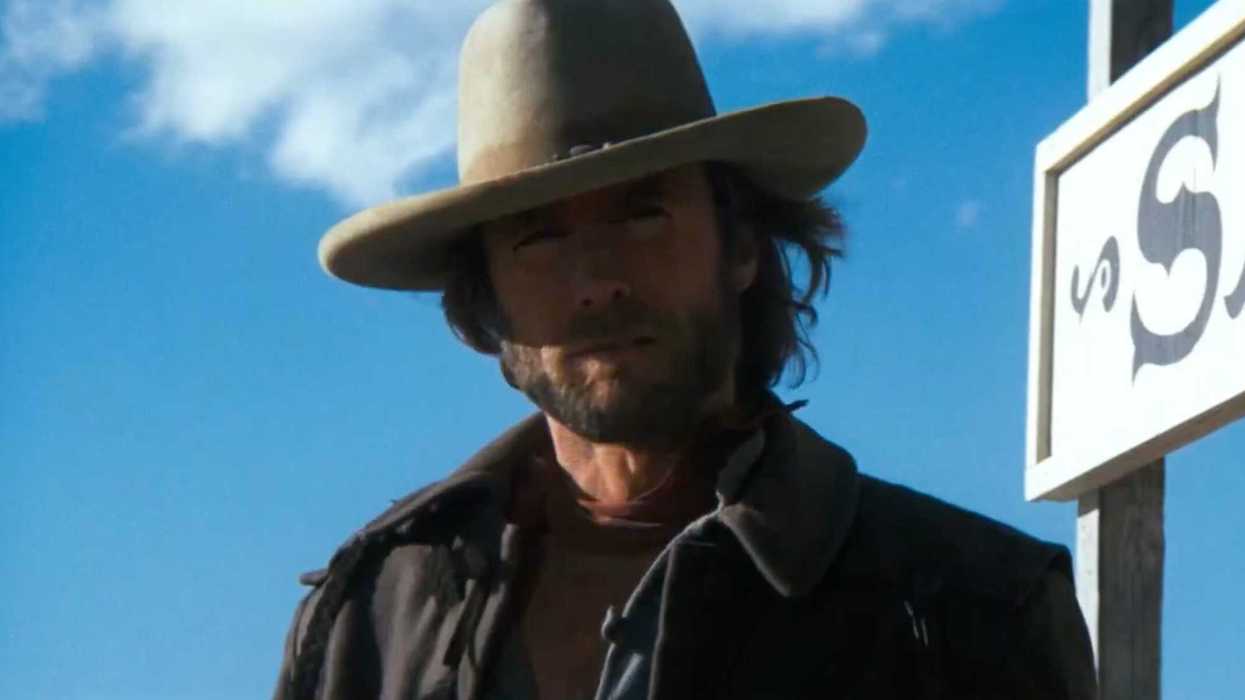
'The Outlaw Josey Wales' (1976)
You think of a Western standoff, and the image that comes to your mind is that of a cowboy, standing in a cloud of dust, sweaty-faced, with a piercing gaze, hand hovering over the holster, and if you like clichés, then a tumbleweed cascading across.
None of that happens in this scene. In The Outlaw Josey Wales (1976), Clint Eastwood replaces the quick draw of his gun with the quick draw of his wit. The result, however, is the same.
And don’t think of this line as just a cool comeback. It’s a loaded ultimatum, full of high-stakes consequences, a choice between life and death. And while doing its job, the line also captures a specific brand of frontier spirit.
This is one of the signature Eastwood moments that made us change the way we saw a hero. Not just a Western hero; a hero in general. Here, we dissect the Eastwood technique of using dialogue instead of violence to materialize a quietly dangerous antihero.
The Scene in Perspective
A group of pro-Union paramilitary soldiers kill the wife and son of a Missouri farmer, Josey Wales (Clint Eastwood). To seek revenge, he joins a group of pro-Confederate militants called the Bushwhackers. As a part of this group, Wales participates in activities against pro-Union sympathizers. As the conflict shows no sign of ending, a Unionist senator promises amnesty in return for surrender. However, when the Bushwhackers surrender, they are all massacred, but Wales and two others manage to escape. A bounty of $5,000 is put on Josey Wales for his capture, dead or alive.
Wales flees to Texas and makes quite a few acquaintances, including an elderly widow called Sarah Turner (Paula Trueman). Two former employees of Sarah’s late son, Travis Cobb (Sheb Wolley) and Chato (John Verros), also join them. Everyone settles down on a ranch previously owned by Sarah’s son. Soon after, a Comanche chief, Ten Bears (Will Sampson), abducts Travis and Chato. Wales rides into the Ten Bears’ camp to negotiate their return.
It’s here, outside Ten Bears’ barrack, that Wales is identified as the infamous and dangerous Josey Wales with a bounty on his head. Everyone freezes. The alerted town locals and gunmen watch him, unsure whether to attack. Wales breaks the silence by saying, “You gonna pull those pistols or whistle Dixie?”
The “Whistle Dixie” Context
In short, this is a song written and composed by Daniel Emmett in 1859. Dan Emmett was a soldier earlier in his life, but is mostly known as the founder of a minstrel show (a theatrical entertainment in which an all-white cast wore blackface) called the Virginia Minstrels. The song, which was written for this minstrel show, nostalgically celebrates the antebellum South from the perspective of a narrator longing for plantation life. It presents a romanticized, cheerful view of the region, including references to cotton and slavery. During and in the aftermath of the Civil War, the song became an unofficial anthem of the Confederacy.
It’s a bit weird that Emmett, despite the blackface entertainment and romanticization of the plantation life, was a Unionist. And his song ended up becoming the anthem of the Confederacy. A bit of a hit-or-miss situation, in my opinion.
The Scene and Its Stakes
Silence as a Power Move
The moment feels like violence is inevitable, which it kind of is. Guns are drawn out. Tension fills every frame. Yet, Josey Wales is not “alerted.” Instead, he maintains an unfazed, I-don't-care-a-damn attitude. He does indeed register the urgency of the situation, but still reframes it as the opponents’ cowardly hesitation. And all this with just a few choice words: “You gonna pull those pistols or whistle Dixie?”
He acknowledges their hesitation, and by doing that, he calls their bluff. And he doesn’t have to draw his pistol, let alone fire a shot. The line is essentially a “pressure test.” It mockingly challenges the men to either act or admit fear. That simple display of confidence quickly tilts the power in Josey’s favor.
Why the Taunt Works
Long story short, it’s the phrasing. While Wales addresses the danger, a.k.a. pistols, by asking, “Are you gonna pull those pistols…” he immediately undercuts it with “...or whistle Dixie?”
The word “whistle,” something that implies softness, lightness, and perhaps something goofy and silly, takes the air out of the “danger” the gunmen are trying to create.
There is another layer. Wales’ tone implies that "Dixie" is kind of a simpleton song, something a fool might sing. The guy who tries to sell him some liquor just before this situation mirrors that tone. It feels as though Wales is connecting the liquor guy with the gunmen; i.e., calling them fools.
Regardless of this psychological war, the line sounds like a genuine question, not a performance. A performance would imply he is taking them too seriously. While a simple question strips the moment of all drama and leaves only consequences.
Conclusion
This scene proves that Eastwood’s hero doesn’t need to be loud to be the most influential person in the room. And as far as Josey Wales is concerned, he established a standard for cinematic cool simply through self-confidence and his ability to call a bluff.
The Western is a genre that thrives on gunfire. Eastwood, however, shows that the coldest move is perhaps just to let the other guy know that he has already lost.