'Psycho' and the Line That Broke Norman Bates: How One Sentence Redefined Psychological Horror
The line that ignited horror psychology.
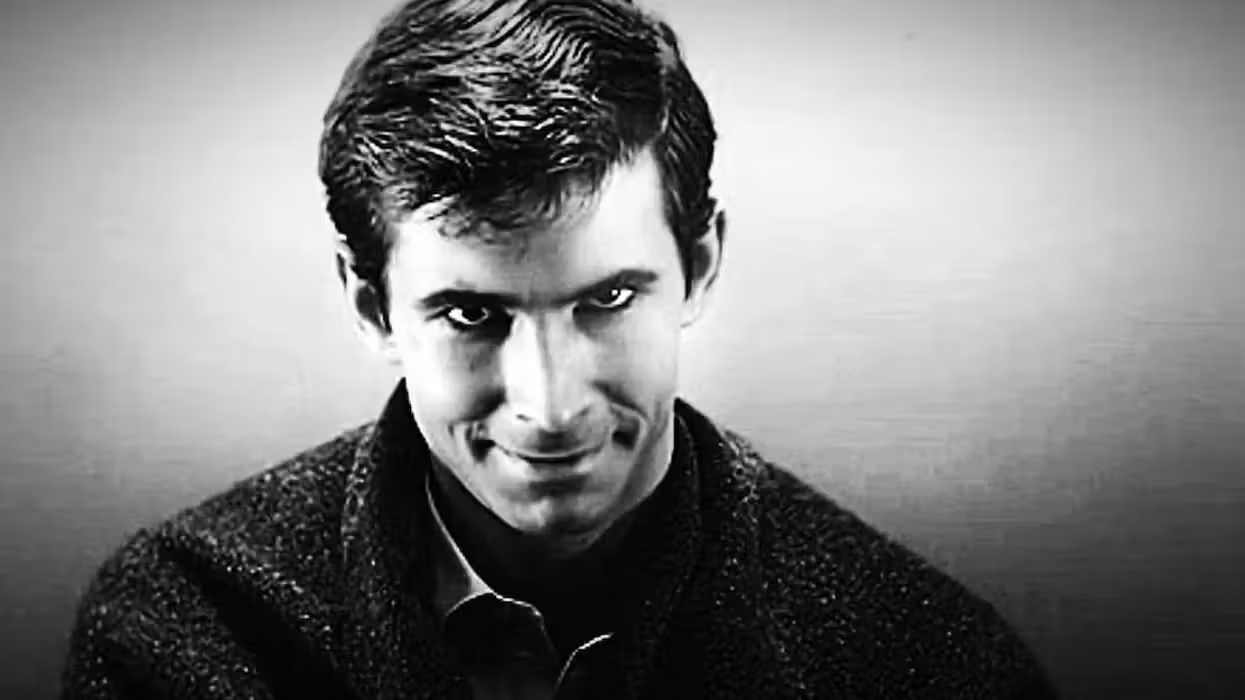
Psycho (1960)
Before Alfred Hitchcock’s Psycho, one thing missing from cinema was the dark, the morbid side of Hitchcock (which we only glimpsed in Shadow of a Doubt and Strangers on a Train).
Psycho made us look within for evil. As my mother and the Scooby Doo show like to put it, “Humans are the real monsters.”
But Psycho didn’t stop there. It ripped open the cover, showing us how evil seeps into the human psyche in the ugliest ways, especially when your mind is locked away into darkness.
Regarding this, I feel a particular scene in Psycho needs to be discussed. To me, it’s the very moment that marked the beginning of a new kind of horror—the one that deals with the human psyche, AKA our inner demons.
In this article, let’s examine that very moment from Psycho: the conversation between Norman Bates and Marion, where he tells her about his mother and how “She just goes a little mad sometimes.” Just like “we all go a little mad sometimes.”
The final blow comes from his rhetorical question when he asks Marion, “Haven’t you?”
Let’s dive in.
To Give You a Little Context…
Marion, an office worker, is tired of her life. She has a lover, but they cannot afford to get married because his ex-wife is draining most of his money in alimony. She has a job that she would love to quit immediately.
So, when her employer entrusts her with $40,000 to be deposited in the bank, she decides to run away with the money to start a new life, far, far away.
She leaves town and drives for miles until she is exhausted, then is caught in a storm that forces her to stop for the night. Marion gets off the highway and stumbles upon The Bates Motel—a quiet property, managed by an even quieter young man, Norman Bates.
She books a room for the night. When she asks about food, Norman tells her that they do not have a kitchen for guests, but he will gladly share his supper with her to prevent her from going out in the rain again. Marion agrees and goes to freshen up. While unpacking, she hears Norman and his mother quarreling.
The Scene
Later that night, during supper, Norman tells her about his mother. His narrative implies that she is suffering from some kind of mental ailment, and it's definitely affecting Norman. Marion, moved by his suffering, suggests that he should try to get some professional help for her in “some place,” implying a sanatorium.
The words “some place” and the implication immediately trigger Norman. His disgust is clear in his eyes, which he tries to hide with a straight, ominous face. He gets defensive about his mother and the symptoms of her mental illness. He tries to convince himself that there’s nothing wrong with her, but everything is wrong and evil with the illness that he very much despises.
Marion is taken aback, as she cannot read Norman well anymore. Suddenly, he is no longer the personable hotel manager. Norman emphasizes how his mother needs him.
“It—it’s not as if she were a… a maniac...a raving thing. She just goes a little mad sometimes,” he says. “We all go a little mad sometimes.”
He finally relaxes and leans back into his chair as an eerie smile breaks out on his face. He looks at Marion and asks her, “Haven’t you?”
The Underlying Implications of the Scene and the Dialogue
1. Everyone Is Right
Fictional or real, self-righteousness is an inherent part of every human being. Even those who do evil are convinced that they’re doing the right thing.
Also, while it doesn't take a mental ailment to become acutely self-righteous, it definitely works as a catalyst.
When Norman says, “She just goes a little mad sometimes,” moments after comparing her to the harmless taxidermy in his room, it serves as his defense against the world questioning his actions.
Assuming that he isn’t aware at this point that his personality is slowly splitting into two, but knows what “Mother” is capable of, his passive-aggressive defense that justifies violent behavior with madness is both alarming and eye-opening. It shows how, under the influence of a mental ailment, a person fails to judge the impact of an action.
At the same time, Bates affirms that he loves his mother but dislikes what she has become, which underscores his moral dilemma: his slow subjugation by his darkness. By the end of the movie, Mother takes over completely.
2. The Fear of the Unknown
The fear of the unknown can be more unnerving than horror unfolding before your eyes. Norman invites ambiguity when he defends his mother with "she goes a little mad sometimes." He never clarifies what he means by "a little mad," what her madness looks like, or how often it occurs.
He won't explain what to expect from his mother, yet his eerie smile foreshadows something ominous. When he adds, "We all go a little mad sometimes," he attempts to normalize his situation, suggesting that if we recognize our own small madnesses, we might excuse his mother's behavior.
More disturbingly, his logic equates everyday recklessness with violent acts, making the latter seem as commonplace as the former.
3. A Character and a Performance Unseen Before
Although medical research has proven that Norman Bates is not the most clinical portrayal of a psychopath, Psycho is one of the first movies to explore horror through the lens of a mental health disorder, with a protagonist showing symptoms of more than one personality disorder.
For instance, Bates’ lack of empathy is psychopathic; however, it is triggered by his split personality disorder. Hitchcock doesn’t bother to zero in on the specific ailment, but rather pursues the hell raised by a mind caged in darkness.
Anthony Perkins breathed life into Bates with stillness. His character’s ailing mind is ever spiraling, but Perkins maintains an eerie stillness in his performance, so much so that the contrast feels like an assault on the viewer. Perkins’ eyes are so still that they always seem to declare the storm before the calm. If you talk about perfect casting, this is it.
Overall, that one line of dialogue and the scene become the buildup to the violence that follows, turning Marion’s scream into an echo of his words, “We all go a little mad, sometimes,” as Bates stabs her to death.
Norman Bates opened the door to discussions and to characters exploring the darkness that the human mind conceals. Hitchcock’s choice to reinvent himself as a filmmaker by making an independent film with a meager budget of $800,000 ended up revolutionizing horror.
What is your favorite takeaway from Psycho? Let us know in the comments below.
- What Do Birds Symbolize in Alfred Hitchcock's 'Psycho'? ›
- How Hitchcock’s ‘Psycho’ Changed Movie Marketing Forever ›
- Unpacking The 'Psycho' Shower Scene with Hitchcock ›
- What Are Pyscho-Biddy Films? (Definition and Examples) ›
- How Hitchcock's 'Psycho' Changed How We Watch Movies in Theaters Forever ›
- Psycho Quote Mother ›
- Screenwriting Lessons From ‘Psycho’ That Every Writer Needs to Hear ›
- 4 Movies That Were Inspired By Alfred Hitchcock's 'Psycho' | No Film School ›