Most Screenwriters Rewrite the Wrong Way. Try This 3-Judge Test Instead
Don't let revisions kill your screenplay.
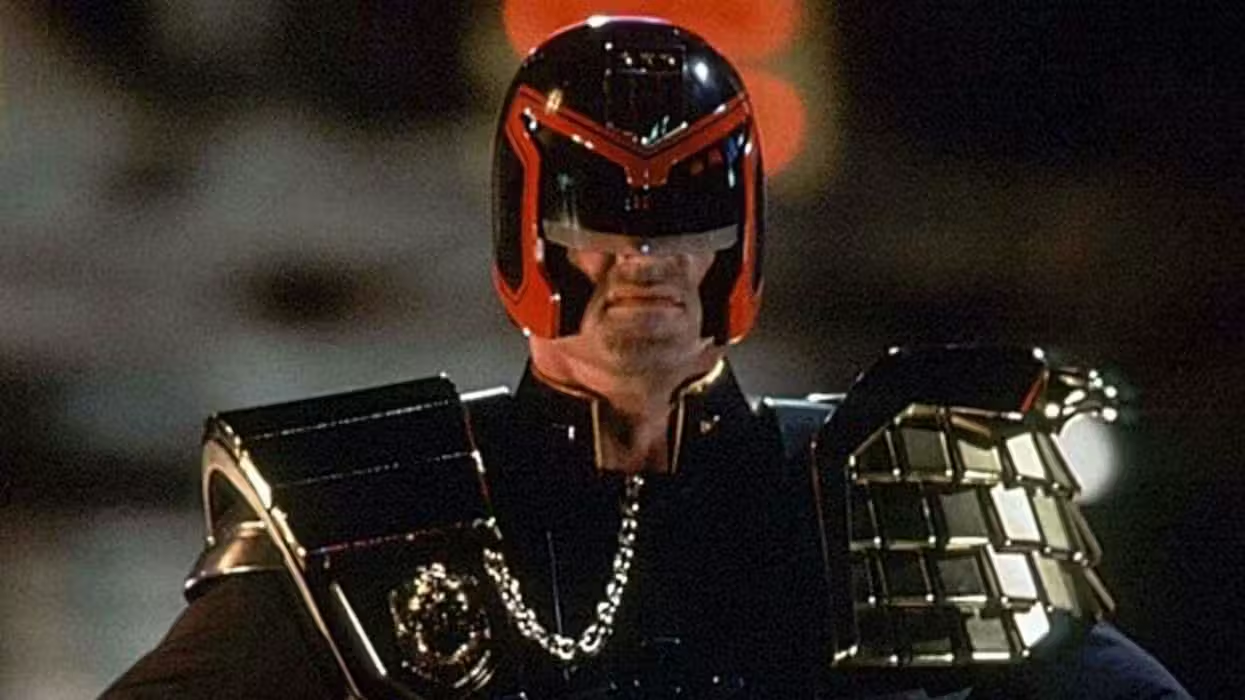
'Judge Dredd'
I was talking to a friend earlier this week about revisions and how we approached them. He asked me what kind of notes I like to get as a writer, and I don't think I had a preference on that—we're always searching for the note behind the note, right? So whatever we're told, it's usually a bit of a hunt to figure it out.
For me, taking notes and rewriting is a little bit intuitive. Sometimes you just feel the "bump," and you know something is not working. When it is working, it should feel easy. Screenwriter Benjamin Barfoot told me he calls it "the slide." You can breeze through a scene and not feel the bump. There's no friction.
But as you're revising, a potential problem is that your instinct gets clouded when you're emotionally invested in the work. You read something you wrote, and you remember how hard you worked on it, or how clever it is, and you worry you can't do it again. You try and try to rework things around these beloved bits, and it doesn't quite gel.
Jacob Michael runs Big Red Stripe, a YouTube channel on screenwriting. In a recent video, he talks about how most screenwriters sabotage their own scripts during revision. Not because they lack skill, but because they love their work too much. Michael's framework helped me articulate why that intuition is important.
You should love what you write, for sure. You should be proud of it. But that same love is probably preventing you from seeing what doesn't work. And as long as you can't see it, you can't fix it.
"What professional writers understand that you may not is that scripts are not extensions of who you are," Michael says. "They're artifacts designed to generate emotion in someone else."
If that's the case, you should figure out how to generate that emotion in the rewrite.
Most writers approach revision by going through the script and tightening up dialogue, cutting a few lines, maybe shortening some descriptions. But these are prescriptive fixes when the issue might actually be with structure or character. That's how you end up with 17 drafts that are somehow worse than your first. Because you never asked yourself the basic question. What does "better" actually mean for this script?
- YouTubeyoutu.be
The Courtroom Approach
Michael offers a new way to think about the whole thing that is fun and interesting. Imagine three judges sitting in a courtroom.
Each part of your script has to defend its existence before them. If it can justify its place, it stays. If it can't, it gets cut.
The first judge is obsessed with process. They want to know what draft you are on.
Your first draft is about story. You're getting it down. Period. Other good stuff might happen, but the story is the focus. Your second draft is about storytelling, or the emotional experience for the reader. You've fixed the plot problems from draft one, and now you're fixing how the story lands. The third draft is the polish. You're refining what's already working.
- Judge One wants to make sure you understand which job you're doing right now, because if you don't, you'll waste time fixing the wrong things.
- Judge Two puts every character on trial. Your protagonist should have wants, needs, and a life dream. Supporting characters get two of the three. String characters get one. Background characters get nothing. Every character has to either help or hinder your protagonist. No exceptions. That quirky side character who's fun but doesn't really do anything in the story? Get them outta here. You might have a brilliant subplot with dialogue you love, but it serves nothing. Cut it.
- Judge Three is merciless. Every word in your script has to prove it belongs there. Does it move the story or reveal character? No? Deleted. Description that paints pretty pictures but slows things down? Cut it. Dialogue that sounds clever but doesn't create conflict or show who someone is? Backspace. Try to be succinct and economical. Can you say a thing in two words, not five? Pare it down.
These judges don't work on the same timeline. Judge One comments on every draft. Judge Two focuses on drafts one and two because characters shape both story and storytelling. Judge Three mainly cares about draft three, once the story's solid.
Revisions can fail when writers argue from emotion rather than evidence. Stop asking whether you like something. Start asking whether it has a job. Does this scene move your protagonist toward their goal or away from it? Does it show us something about who someone is? Does it give the reader something they need? If the answer is no to all three, it goes.
Be Ruthless in the Edit
Michael is talking about removing yourself from your work so you can look at it with some distance. Sometimes you have to take a break from a project and come back to it to get there mentally.
Mind you, this will suck! You're working hard on a project at every level. Sometimes you have to kill characters or cut lines of dialogue that you really love.
When you do, your script moves faster. The story gets clearer. Characters feel more focused. Readers actually finish it instead of setting it down on page 20.
Take your current draft and run it through this imaginary tribunal. Be honest about what's serving your story versus what you just love. If you can't separate emotion from evaluation, that's when you need an outside perspective, like a writers' group, paid coverage, or another writer friend you can trust to be hard on you.
What's great is that we're talking about this as writers, but you can apply the same logic as a director or editor. If you feel the bump on set or when you're in the edit bay, run everything past these judges. Do you really have to shoot that line or include that particular shot? You can try it, but if it feels off or isn't adding to your story in a way that matters, get rid of it.
- Use These Handy Programs to Have Your Scripts Read Back to You ›
- Struggling on Your Screenplay Rewrite? Try the 'Coffee Filter' Method ›
- What a Working Screenwriter Wishes He'd Known at the Start ›
- What's a Shooting Script and How Do You Create One? ›
- Fix a Bad Scene by Looking at These Things ›
- It's Time to Start Romanticizing Your Rewrite Process | No Film School ›
- 3 Questions for Rewriting Any Scene | No Film School ›