The Line in 'Road to Perdition' That Hurts More Every Time You Hear It
The line that ends a life also completes a story—one about fathers, sins, and the price of devotion.
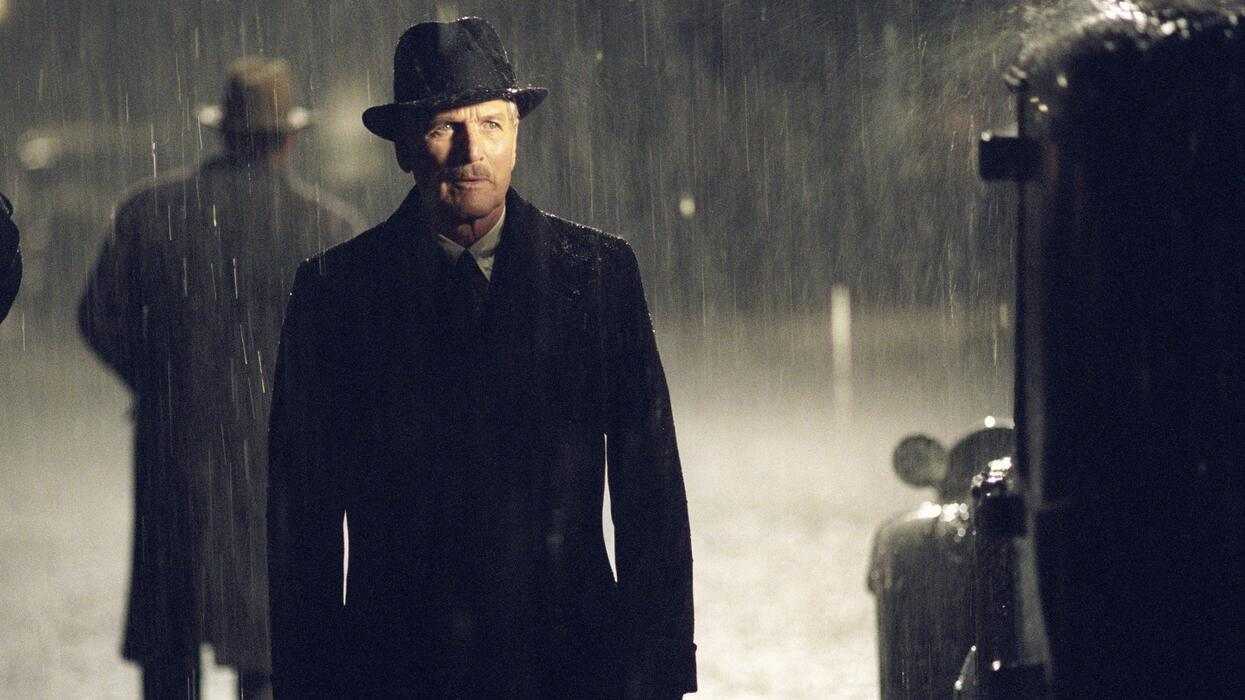
Paul Newman in a still from Road to Perdition (2002)
What stands out in Road to Perdition (2002) is that, despite being a movie about crime, the mafia, and violence, its most devastating moments are quite silent. That may be because, even though the characters are in a violent profession, the movie portrays them essentially as humans, as fathers and sons. And when it’s about “your own,” a whisper is enough to deliver a fatal blow.
In this movie, that whisper is delivered by John Rooney (Paul Newman), a mob boss and a fatherly figure to Michael Sullivan Sr. (Tom Hanks), just before Michael shoots him dead.
Adapted from Max Allan Collins’ graphic novel, Road to Perdition is a reflection on fathers and sons. The fathers we have and the fathers we fail, the sons we give birth to and the sons we raise and protect. The fathers we become and the sons we dread to see growing up in our image.
Here, we are going to look into where the shattering power in “I’m glad it’s you” comes from. We are going to see how a crime story transforms into a tale of acceptance. And we are going to see how vengeance can make way for something tender.
A Little Bit of Context
Michael Sullivan Sr., when orphaned, was adopted and raised by an Irish mob boss, John Rooney. Rooney has his own son, Connor (Daniel Craig), but he seems to favor Sullivan more. It reflects in the influence and love Sullivan receives from Rooney. Connor, not happy about it, manages to have Sullivan’s family killed, except Sullivan himself and his elder son, Michael Jr.
When Sullivan sets out to exact revenge, Rooney reluctantly chooses his own son’s life over Sullivan’s and hires a contract killer to eliminate him. The escalating situation finally results in Sullivan gunning down Rooney’s bodyguards and then Rooney himself.
Right before the distraught Sullivan empties his machine gun into Rooney, Rooney delivers this line.
“I’m glad it’s you.”
The Weight Behind the Words
The Father-Son Bond Built on Crime
Rooney’s treatment of Sullivan is reflective of his suppressed wish that Sullivan were his real son, not Connor. While Connor is impetuous, insecure, and desperate for his father’s approval, Rooney and Sullivan’s relationship is based on honor, discipline, and unspoken but deep affection. Rooney sees Sullivan as someone who is rightly raised in his image, with his values, and in his moral sphere. This triangular dynamic is unstable because of the imbalance between the physicality and soulfulness of the relationships.
The Betrayal: The Turning Point
The plot twist comes when Connor kills Sullivan’s wife and younger son out of jealousy. Rooney understands the ridiculousness and nefariousness of this act. That’s why he proves himself to be made of pure human clay when his primal instincts prompt him to safeguard the son made in his own flesh, rather than the son forged in his soul.
It changes everything, and Sullivan sets out for revenge. What’s sad is not the killing and not the violence, perhaps not even the unfortunate turn of the relationship between Rooney and Sullivan. What’s sad is that both men, the father and the son, know how it is and how it will end. The cold apprehension of this fact—that’s what is truly sad.
The Truth in the Final Moments
When Sullivan is killing all his henchmen, Rooney stands still in that chaos. He doesn’t turn, he doesn’t squirm. He knows how things are, what’s going to happen, and he has accepted everything. That’s the cold apprehension I was talking about. He has done what the tradition expected of him: choosing his biological son, even at the cost of injustice to his true son. Now he is doing what a true father would do: letting his son have what he deserves.
When he says, “I’m glad it’s you,” it shows his spiritual bond with Sullivan. There is no remorse, and there is no pain. There is only satisfaction. Rooney sees this death as the just death he can receive—at the hands of someone who understands him.
The Scene’s Lasting Impact
It’s been over two decades, and these words still resonate. That’s because they show something real and human. These words mark the deep understanding between a father and a son. They indicate that there is love and acceptance, even if it’s going to be gunned down.
Sam Mendes’ direction, his use of silence, and his focus on the rain, the play of lights and shadows, and Newman’s and Hanks’ poignant expressions elevate the scene from a violent one to a meditative study of a meaningful relationship. The moment is memorable because it shows that compassion and understanding can be found in the midst of a massacre.