Film Quote Of the Day: How 'The Odyssey' Beggar Line Went Viral
“Somebody get these beggars out of here!” — Antinous, in The Odyssey.
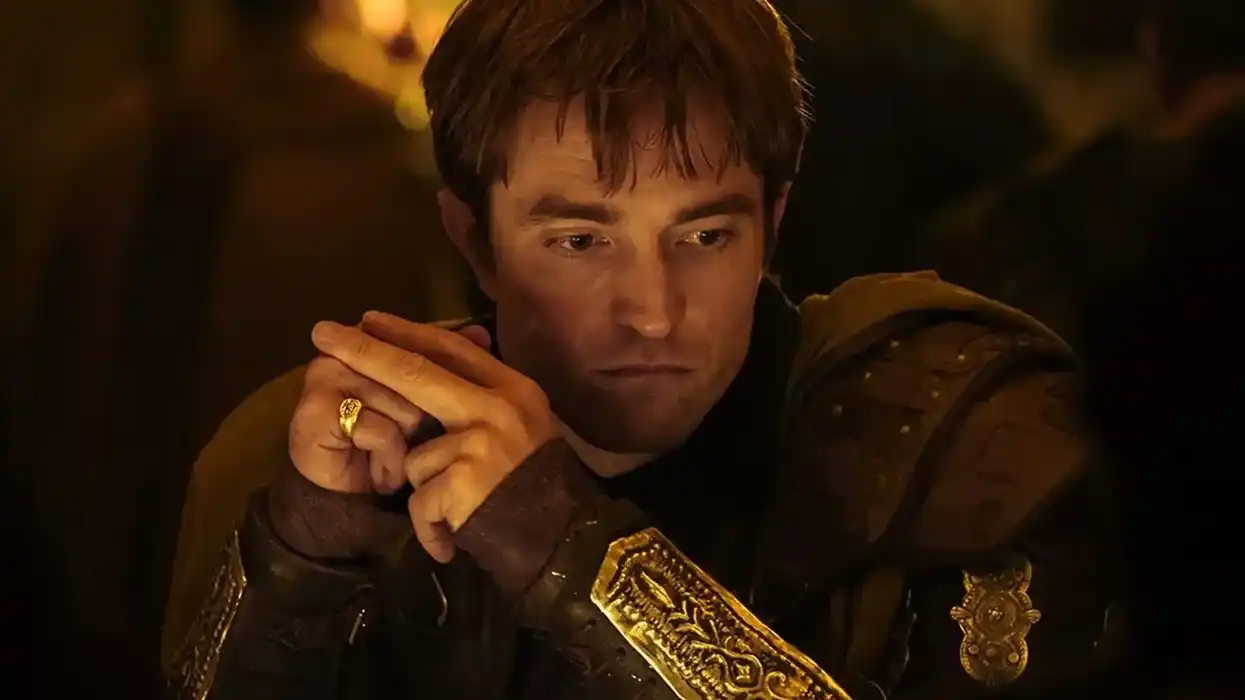
'The Odyssey'
It is impossible to go anywhere or talk to anyone without bringing up The Odyssey. It's the biggest movie in the world, and it's going to dominate the cultural conversation through the Awards Season.
And yeah, there are going to be massive awards for it to win, but right now, it's probably winning the most important marketing award: the internet.
Everyone is making a meme or clipping a scene or just talking about the size of the screen.
Yet, I think the biggest and best thing to come out of the movie that's getting people into the story is Robert Pattinson’s performance as Antinous. He's the lead, arrogance-fueled suitor laying siege to Odysseus' palace and hating on the poor people who keep disrupting his dinner and courtship.
There's one line in particular that is already dominating TikTok audio clips and film-bro memes across X and Reddit. But underneath the meme-able shouting lies a textbook example of how great screenwriting uses antagonist dialogue to lock in a story's thematic engine.
Let's dive in.
- YouTubewww.youtube.com
The Scene in Question
It's been twenty years, and the people have grown restless for their king.
When Odysseus was last seen, he was leaving the beach of Troy, and everyone else who survived that war has already come home and faced the consequences of it.
He's a missing man, and his kingdom has been run by his wife, and the leaders of the council are now demanding that they have a king in order to raise an army to defend the world from the Sea People who have been raising nearby islands.
The suitors for Penelope are led by Antinous, played with sheer sniveling joy and anger by Robert Pattinson. He's been violating Zeus's law for 20 years, hanging out, drinking all the wine, eating all the food, and hitting on Penelope.
But Odysseus has finally returned home to see what's been going on, and he’s covertly disguised as an old beggar to size up if his house is still loyal and if his wife has moved on.
When he gets to the great hall, he has to see Antinous and these guys basically spitting in the one thing he believes in: hospitality.
So Odysseus pushes him one step further and tries to get a scrap of food for him, any sign of generosity to redeem the people eating all his food and drinking his best wine.
The other suitors give him a hard time, but Antinous loses his cool and melts down, surely under pressure to get Penelope to pick him and also because he wansed Telemcheus dead, and now he's still alive.
And I want to say, this is where I found Robert Pattinson to be cooking. He was embodying this character so perfectly and so malevolently that he looked at this nameless stranger with absolute disgust and snarled the line across a silent room.
“Would somebody get these BEGGARS out of here?!”
Zeus's Rule Is the Movie's Moral Code
In ancient Greek drama, the most sacred rule of the cosmos isn't honor in battle or loyalty to the gods; it’s xenia, which is the law of hospitality to strangers and travelers.
You're supposed to treat these people well because you never know if they could be a god in disguise. Those of us who read The Odyssey know that in the book version, that's how these gods come to Odysseus and Telemachus and Penelope, and when they treat these people well, the gods take care of them.
When they don't, well, you might get stuck on a 20-year journey home.
Well, the movie takes these gods in disguise as more of a metaphor, but it hammers the law home over and over. Be kind to strangers, welcome them into your home with generosity, or bad things will happen.
Patton's is literally tossing out a beggar, and we get the explicit violation of their theme. It also puts him at his most villainous, which gets our blood pumping for him to get retribution at the end.
If you’re working on how to write a compelling villain, remember that an antagonist’s worst trait should directly clash with your script’s central ethical framework.
The Power of Dramatic Irony
We're digging into the joy I have in writing, because when you get to adapt something, you kind of have a break from all the imagination, and you can really dial in what drew you to the story and why it matters.
You can tell Nolan has been thinking about this movie for a very long time, because he ties in so many literary devices around it to get the audience to have fun.
What makes the line crackle is that the audience knows something Antinous doesn't: the "beggar" he’s ordering out of the hall is actually Odysseus.
We know this is an f around and find out moment, and we're waiting for it.
This is classic dramatic irony in screenwriting. When a character speaks out of sheer hubris while standing inches away from their own doom, we lean in and rejoice because we know there will be a payoff.
Summing It All Up
It’s easy to see why the clip went viral the moment the film hit theaters. You get the energy of Pattinson’s pitch-perfect performance, the hitting of the nerve of class dynamics, and the immediate payoff of this jerk getting humbled.
For filmmakers, remember that sometimes the best movie lines just distill down to the script's thematic statement and make sure they collide with the main character so the audience understands how they're going to arc and what they've faced along the way.
Let me know what you think in the comments.
- Unlocking Christopher Nolan's Passion For 'The Odyssey' ›
- The New 'Odyssey' Trailer is Astonishing ›
- Christopher Nolan's 'The Odyssey' Proves Practical Filmmaking Still Wins ›
- Why History Nerds Are Mad at Nolan’s The Odyssey—And Why It’s Fine ›
- ‘The Odyssey’ is Christopher Nolan’s Most Gargantuan Film Yet ›
- The Odyssey China ›