What 'undertone' Editor Sonny Atkins Learned Cutting Horror for the First Time
The unique challenge of sound-driven horror.
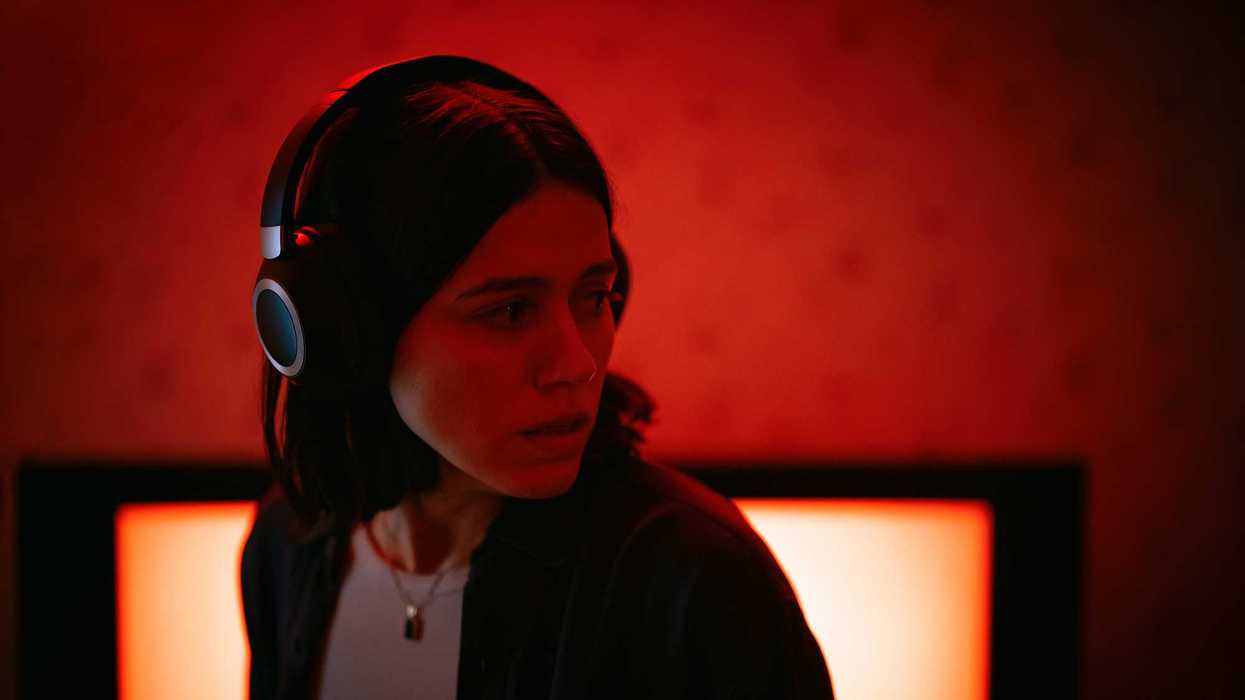
Nina Kiri appears in undertone by Ian Tuason, an official selection of the 2026 Sundance Film Festival.
There's nothing like a Midnighter at Sundance Film Festival, so this year I was, of course, lined up to see the low-budget Midnight selection, undertone.
The film is a single-location horror story that follows Evy (Nina Kiri), a woman providing end-of-life care to her mother. During the long nights, she co-hosts a paranormal podcast with her friend Justin. They have the tried-and-true believer-versus-skeptic dynamic. Evy has her doubts about the supernatural—until a strange series of audio files seems to creep into the real world of her childhood home.
The film's editor is Sonny Atkins. When a producer sent him writer/director Ian Tuason's script about a year ago, Atkins had already worked with the production team for 10 years. It was an easy yes, he said, even though horror was new territory for an editor who built his skills cutting 30-second commercials at Rooster, a Toronto post house.
We spoke with Atkins about editing his first feature, navigating a sound-driven horror film, and what he learned from bringing Tuason's precise vision to the screen.
- YouTube www.youtube.com
Editor's note: The following conversation has been edited for length and clarity.
No Film School: What got you excited to come onto the project?
Sonny Atkins: I knew the team for a long time. I'd never met Ian, the director, but Dan Slater, Rod Hafezi, and a couple of the people who were on the production team, producers—I'd known them for over a decade, started making films with them when we were all young and hungry and inexperienced and terrible at what we do.
They gave me Ian's script, which was one of the scariest things I'd ever read, and it was so detailed, and there's a lot of really cool stuff in there, way more sound direction than camera direction, which was really intriguing to me.
Then I met him over Zoom, and I fell in love with him immediately. I mean, he's just tapped into something that the rest of us don't see. The rest is history. It was an easy yes for me.
NFS: This is such a unique one in that it's one person most of the time, largely one location, and sound-based, like you said. What about your editing process changes with all of those parameters, if anything?
SA: Yeah, it was a challenge, obviously, to hold an audience's attention in some of those scenes where she's sitting and listening, and I had to kind of rewire my brain.
I come from commercials, and generally they're on the cuttier side. There are entire 7-, 8-, 9-minute scenes where it's just a bunch of different angles of our lead character's face as she's listening.
I think what we learned in the process was holding on things worked really well, because it made you want to lean forward and listen. So I had to adapt to that because my first cut was really fast, and cutting in it didn't quite work. It was a good skeleton for what we'd go on to build, but I hadn't quite nailed the feeling of it yet. And extending things was the solution to a lot of that because, like I said, it sort of made you lean forward a little bit and listen to what she was listening to.
NFS: I'm a person who always searches in the corners, so I'm like, "What should we be seeing?" The long takes helped with the tension and horror sensibility, too. Was there anything else that you noticed yourself doing that was different, working in horror?
Atkins: You bring up a good point about the searching in the corners and in the darkness. We sort of stumbled on that, and we realized when we started doing early test screenings that our film doesn't have really many jump scares.
It's not that kind of movie, but we found that it was a lot scarier. People were expecting something to jump out from the darkness, and then we wouldn't give you that release, and we really liked that tension there.
Something that was new for me is I was mixing the audio as we were going, which was a new thing. I always do a rough balance as we're cutting, but because it was so important that so much of the story is in the sound, it was important for test screenings, for showing it it to the producers, all that stuff, that it was close to where we were trying to get it so people could understand, "Oh, this sound needs to live up here, while this sound..." That kind of thing. So that was a bit different this time around for sure.
NFS: You've talked about how Ian came to this with a very clear plan. I'd love to hear a little bit more about that collaboration.
SA: He came with a really detailed document, which had almost everything really, really mapped out, and this was before we even started production. So I had gotten a really good sense of what he was going for then, and I can't praise Ian enough for this.
He said, "Well, do whatever you've gotta do on your first cut, and then we can find our way there." So I had this idea of where he was going, and then he gave me the freedom to strip a lot of that away so I could figure the movie out. And he was very hands-off during that period. They gave me about a month, and I put the movie together, put my first cut together, and then we sat and talked about which of the stuff we wanted to add back onto this skeleton that I had built.
And I'll say, totally with the utmost humility, there were some things that I didn't get in that first cut that he was trying for. And it wasn't until I sat with him and he said, "No, it needs to work like this. You need to draw this scene out," and everything. And then it started to click, and I understood what kind of movie it was.
It's strange and weird, and there are pieces of it that, yeah, in my first cut, I didn't get. And then once I sat with him, and we went through that document again, and he sat over my shoulder, and we worked together, it started to take shape.
NFS: Do you have any advice for editing those types of—not jumpscares, but jumpscare-adjacent things?
SA: You have to earn them. That's a big thing that I learned is, I think, when you have too many of them, they lose their power. And we really don't get into some of that stuff until maybe a third of the way through the film, or two-thirds of the way through the film, where we start going, "Hey."
It was more ambient horror at the beginning, where it was the sound, and we show you a little something over here, and we show you a little something over here, and then your heart rate's up, you're waiting, you're waiting, and then we punch you in the face with it.
I think that would be my piece of advice is not to be overzealous and fill your film with that stuff. You've got to earn those moments.
- YouTube www.youtube.com
NFS: This was also made at an extremely low budget. I'm wondering if there was anything you did in the edit that you couldn't achieve on set?
SA: I'm trying to think. We did a couple of camera moves in post. There's a sequence where she's dreaming, and there's a whole lot of tilting and moving. We couldn't do that on the day, and that was something that we discovered in post, where I was like, "Oh, I can just move these things around."
There are so many tools in post. You can mimic natural camera shake and all that stuff. So if you know how to fake those things really well, and you can do them really cheaply, I mean, they're all built into Premiere, Avid, or whatever you're using in post.
You can get away with a lot in that regard, where you don't have to spend the money on set, and you can do it in post.
NFS: What did you use on this?
SA: I cut it in Premiere.
NFS: Is there one skill you would say an editor needs on a low-budget production?
SA: Yeah, probably patience. Patience, humility.
I said this a lot in my talk at the Adobe House. I think editing is 10% of the job. And when you're working, particularly on a low-budget thing where you're trying to get as much as you can out of relatively little, and everyone has high expectations, putting your ego aside and being willing to try things and be surprised and never saying no to an idea, that kind of stuff is really important.
I think the thing with editing is that you can teach almost anyone how to use these programs. You can go on YouTube, and it's been so democratized, and how easy it is to learn how to use the programs, but the real skill comes in deciding what not to put in the movie, which is a big part of the job.
And then navigating a team of people's ambitions and what they want and what they don't want and how to inject a bit of yourself into that. Those are the skills that I think filmmakers and editors, in particular, if you're young and you're coming up, that's what you need to develop more ... the technical comes as you go. You learn.
NFS: Is there one big lesson that you're taking away from this?
SA: I was lucky. I had a great mentor in the commercial world who taught me a lot of these things, and I got to watch him navigate a lot of these things that I navigated on this movie live in the room, and he gave me an amazing education in that way.
I think the biggest thing that I'm taking from this is that so much of what we do is about the team that you make your film with. I think the best piece of advice I can give to young filmmakers is to cultivate relationships with other very creative people.
I think what made our film so special and what attracted A24 and a lot of these companies to our little project is that we've all been working together so long, we're so willing to experiment, and we have great shorthand with each other. That stuff is so important.
I think it comes back to the no film school/film school—I know you're from No Film School—but finding that community of other people that you want to make your stuff with is the most important part. I think that it sounds like we're all going to be working on more projects together, which is really exciting. That's the thing. Work with your friends as much as you can.
NFS: Is there anything else you want to add about your work on this project?
SA: I've been making films for 13 years now, and most of them were really, really bad. I think a lot of young filmmakers come up against that wall where you don't have momentum, or you work so hard on a piece, and it doesn't work out, and you don't make any money, and you don't know how to pay your rent, and all of these things.
There's a filmmaker, his name's Will Smith, not "slappy" Will Smith, the other Will Smith, he's a TV director. He works on The Vince Staples Show, and I met him by happenstance. He gave me a great piece of advice, which is that the people who make it in this industry are just the people who don't give up.
I know that that's really hard sometimes when you don't have any money, and you don't know what's coming next. But I think when you look at the people who "make it," it's just people who refuse to stop. And he gave me that advice 18 months ago, two years ago, just before we started the movie. And look how fast it can change.
- How Years as a Makeup Artist Prepared This First-Time Sundance Director ›
- How This Filmmaker Built a Sundance Short with DIY Animation ›
- One Last Run in Park City: How to Ski the Treacherous Slopes of Independent Film at Sundance ‘26 ›
- How Casper Kelly Turned Kids’ TV Nostalgia Into Sundance Horror with 'Buddy' ›
- The Horror in What You Don’t See: How Sound and Rhythm Build Suspense in 'undertone' ›